
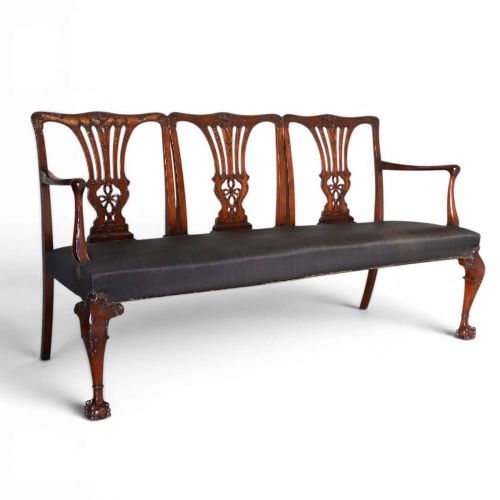


Mahogany Double Chair Back Bench
A mahogany double chair back bench unites the openwork carving of dining chairs with the proportions of a settee, offering structured seating built for formal reception rooms.
Mahogany Double Chair Back Bench
A mahogany double chair back bench presents a joined framework where two or three chair backs are integrated into a single long seating unit. Buyers searching for a mahogany double chair back bench will encounter settees and sofas spanning the eighteenth century through the Edwardian period, alongside revival pieces from the nineteenth and early twentieth centuries.
The prevailing forms on this page include chair-back settees, triple-back sofas, and ladderback settees framed in solid timber. These items range from genuine eighteenth-century examples to George II, George III, and Chippendale revival interpretations produced in the Victorian and Edwardian eras.
Materials and construction methods
Construction relies heavily on solid mahogany, chosen for its structural strength and deep reddish-brown grain. Selected pieces incorporate satinwood inlay for decorative contrast along the crest rails and splats.
Upholstered drop-in seats and fixed squabs employ traditional textiles such as fabric, velvet, hessian, and standard upholstery fabrics. Carved details define the backs, drawing on Chippendale and Hepplewhite design idioms.
Listings span dates from the eighteenth century through the 1930s, featuring Chippendale, Hepplewhite, and George II revival styles.
Evaluating craftsmanship and execution
Quality rests upon the crispness of the pierced splats and the depth of the hand-carving along the top rail and arms. Superior examples show seamless joinery where the individual chair backs meet the central seat rail.
Material selection divides standard production from finer work, particularly where finely figured mahogany meets precise satinwood inlay. The integrity of the frame dictates longevity, separating solid original construction from later adaptations.
The Mahogany Double Chair Back Bench Glossary
- Splat
- The vertical central strip of wood within a chair back. It often takes a pierced or carved ribbon shape in Chippendale designs.
- Settee
- A long wooden seat with a back and arms, designed for multiple occupants. It bridges the gap between a single chair and a full sofa.
- Crest rail
- The top horizontal member of a chair or settee back. This part frequently receives the most elaborate carving.
- Inlay
- A technique where contrasting woods like satinwood are inserted into recesses in the mahogany base. This creates decorative patterns on the surface.
Mahogany Double Chair Back Bench: Frequently Asked Questions
What is a chair-back settee?
A chair-back settee is a seating form that combines multiple individual chair backs into one continuous frame. It mimics the appearance of dining chairs joined side by side.
These pieces were typically placed against walls in hallways or reception rooms rather than used as lounging furniture. Their rigid backs encouraged upright posture.
How do I date a revival piece?
Revival pieces from the nineteenth and twentieth centuries adopt eighteenth-century design vocabulary such as Chippendale or Hepplewhite styling. Examining the secondary woods and construction marks helps reveal the actual age.
Makers working in the Edwardian or Victorian eras often utilised machine-assisted joinery alongside hand-carving, distinguishing them from original eighteenth-century furniture.
Where were these benches placed?
Historically, these settees stood in grand entry halls, formal parlours, and waiting rooms. Their shallow seats and upright backs suited formal social interaction.
They function well in modern interiors as hallway seating or statement pieces in living spaces where deep lounging is not required.
How do I care for mahogany?
Mahogany benefits from stable indoor humidity and protection from direct sunlight to prevent the timber from drying out. Regular dusting with a soft, dry cloth preserves the polished finish.
Harsh chemical cleaners should be avoided in favour of traditional beeswax applied sparingly to nourish the wood grain over time.