
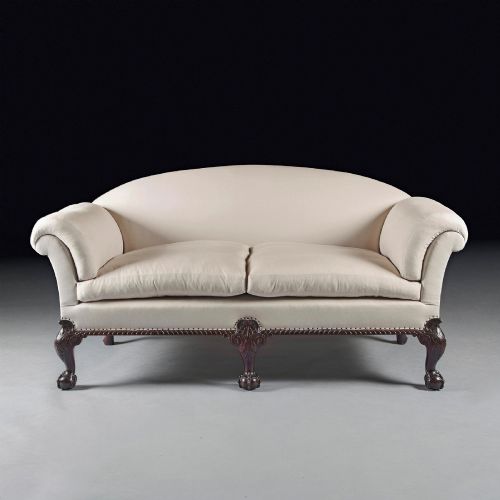


Claw and Ball Foot Settee
A claw and ball foot settee grounds a room with carved mahogany and substantial seating rooted in eighteenth-century design.
Claw and Ball Foot Settee
A claw and ball foot settee brings together sturdy timber frames and distinct carved terminals where a bird or beast's talon clutches a sphere. Buyers searching for a claw and ball foot settee encounter examples spanning the eighteenth, nineteenth, and early twentieth centuries.
The selections on this page range from authentic eighteenth-century Chippendale pieces to Victorian revivals and later Edwardian interpretations, including matching suites and multi-seat sofas. Mahogany serves as the primary timber, complemented by diverse fabric upholstery, leather, and cotton calico.
Formations vary from double-seat settees and triple-back settees to expansive lounge suites and chair-back designs. Makers such as Howard and Sons also appear among the offerings, linking traditional carving with deep-seated comfort.
Materials and Construction
Makers utilised solid mahogany for the structural frames, allowing craftsmen to carve deep relief details into the knees and terminals of the legs. Timber selection ensured the structural integrity needed to support substantial multi-seat frames and heavy upholstery.
Traditional upholstery methods incorporated horsehair, stuffing, and springs beneath outer coverings of leather, patterned fabric, or cotton calico. Brass castors occasionally supported the feet, while hand-carved details defined the hawk and ball motifs.
Some nineteenth-century makers applied hawk talons instead of standard rounded claws, giving these wooden birds a distinctly fierce grip on their spheres.
Judging Quality and Execution
The crispness of the hand-carved talon and the proportion of the spherical grip separate exceptional joinery from simpler production. Carvings executed with depth and sharp anatomical detail indicate superior workshop standards.
The integration of the frame with the upholstery dictates the overall success of the piece. Well-balanced proportions across triple-back formats and heavy mahogany frames distinguish finer examples from standard commercial output.
Howard and Sons
The Claw and Ball Foot Settee Glossary
- Chippendale
- A style originating from the mid-eighteenth-century design books of Thomas Chippendale. It heavily influences the carved mahogany frames and cabriole legs seen on these settees.
- Cabriole leg
- A furniture leg that bends outward in a convex curve and tapers inward in a concave curve, ending in a carved foot. This form provides structural strength without heavy rectilinear bracing.
- Mahogany
- A durable, reddish-brown tropical hardwood favoured by cabinetmakers for its stability and suitability for intricate carving. It forms the primary structural material for these frames.
- Aesthetic Movement
- A late nineteenth-century design current emphasising artistic expression and eclectic visual influences. Pieces from this movement often incorporate distinct fabric choices like chinoiserie alongside traditional frames.
Claw and Ball Foot Settee: Frequently Asked Questions
What is a claw and ball foot settee?
A claw and ball foot settee is a upholstered or timber seat featuring four legs that terminate in a carved foot shaped like a talon grasping a sphere. These pieces draw heavily on eighteenth-century stylistic traditions.
They appear across various periods, including Victorian revivals and Edwardian interpretations, constructed primarily from mahogany with diverse fabric or leather coverings.
How do I distinguish eighteenth-century pieces from Victorian revivals?
Distinguishing periods relies on examining timber patination, construction joinery, and the exact profile of the carved claw and ball foot. Eighteenth-century examples display period-specific tool marks and timber ageing.
Victorian and Edwardian revivals often utilise heavier framing techniques or incorporate later upholstery methods while imitating earlier Chippendale styles.
Are these settees suitable for daily use?
These settees accommodate regular seating depending on the condition of the internal webbing, springs, and upholstery support. Many historical pieces feature robust mahogany frames built for daily domestic life.
Selecting pieces with sound structural timber ensures longevity in a contemporary living space.
What upholstery materials are common on these settees?
Upholstery materials range from traditional leather and cotton calico to patterned fabric and specialised aesthetic movement textiles. The choice often reflects the period of manufacture, from early leather suites to later fabric variations.
Original coverings are uncommon, meaning many pieces feature subsequent reupholstery suited to their respective eras.