
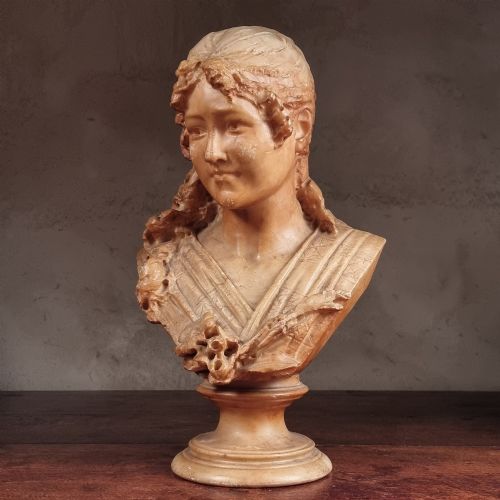


Classical Maiden Bust Sculpture
A classical maiden bust sculpture brings quiet academic dignity and carved stone presence into a room.
Classical Maiden Bust Sculpture
A classical maiden bust sculpture represents female figures drawn from antique antiquity, rendered in sculptural forms that range from modest portrait studies to grand allegorical subjects. When searching for a classical maiden bust sculpture, buyers encounter works spanning the nineteenth century, including Victorian interpretations and later French academic pieces. The versions most commonly met on this page are carved alabaster or marble portrait studies of young women, often mounted on contrasting stone bases.
Makers such as Hans Müller, Emmanuel Villanis, Henri Plé, Auguste Moreau, A. Cipriani, and Goldscheider shaped this sculptural tradition across marble, bronze, terracotta, and cast iron. These objects function primarily as interior decor, capturing idealized feminine beauty through varied regional stylistic lenses.
How they were made
Carved stone pieces utilise natural materials like alabaster and Carrara marble, shaped by hand using chisels and abrasive stones to achieve smooth flesh tones and intricate drapery. Artisans select blocks of marble or alabaster, sometimes combining white stone figures with dark bases such as Vert de Mer marble to heighten visual contrast.
Cast metal and ceramic works employ foundry techniques including bronze casting and terracotta moulding, occasionally finished with patination or paint to simulate aged metal or classical patinas. Cast iron provides a heavier industrial alternative for sculptural reproduction.
One maiden wears a carved stone veil so convincing it makes viewers instinctively reach out to lift the marble fabric.
What varies in quality
The degree of manual articulation in carved stone separates standard decorative items from superior sculptural works, particularly in the rendering of hair, facial expression, and delicate drapery like veils. Master carvers achieve subtle translucency in alabaster and lifelike softness in marble that mechanical copying cannot replicate.
Signatures of recognised artists and foundry marks indicate higher execution standards, alongside the quality of the base materials and the crispness of the cast in bronze or terracotta pieces.
Hans Müller·Emmanuel Villanis·Henri Plé·Auguste Moreau·A. Cipriani·Goldscheider
The Classical Maiden Bust Sculpture Glossary
- Alabaster
- A soft mineral stone, often white or translucent, widely used for nineteenth-century portrait busts and carved figures.
- Carrara marble
- A type of white or blue-grey marble from the city of Carrara in Italy, prized for classical sculpture.
- Terracotta
- Baked red clay used for sculptural modelling, frequently painted or patinated to resemble metal or stone.
- Vert de Mer
- A dark green decorative marble with white veining, commonly used as a contrasting base for portrait busts.
- Allegory
- The representation of abstract ideas, such as seasons or concepts, through human figures in art.
Classical Maiden Bust Sculpture: Frequently Asked Questions
What materials are used?
These sculptures utilise materials such as carved alabaster, Carrara marble, bronze, terracotta, and cast iron.
Some pieces combine white stone figures with contrasting coloured marble bases.
Are these pieces signed?
Certain sculptures bear signatures from notable nineteenth-century artists like Hans Müller or Auguste Moreau.
Foundry marks or signatures indicate the specific workshop origin of bronze and terracotta works.
How old are these sculptures?
The pieces date predominantly from the nineteenth century, extending into the early twentieth century around nineteen twenty.
Styles span Victorian classical, Art Nouveau, and French academic art movements.
How should I display them?
These busts suit prominent placement on sturdy tables, pedestals, or mantelpieces where their three-dimensional form is visible.
Placing them away from direct heat protects delicate alabaster and painted terracotta surfaces.