



Chippendale Revival Armchairs
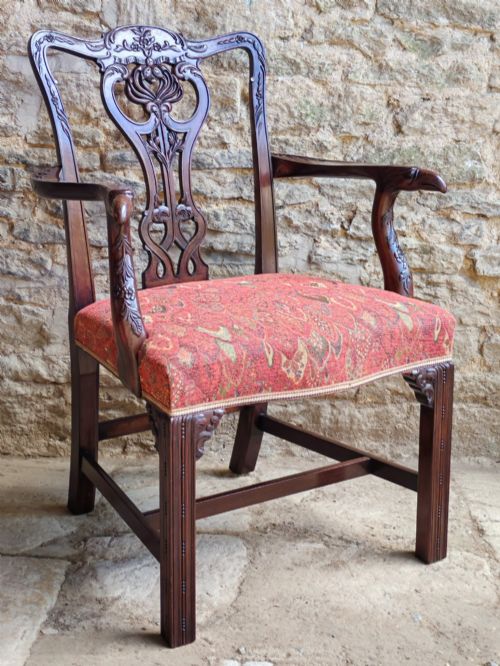
These Chippendale revival armchairs bring eighteenth-century carved forms back to life through solid nineteenth- and twentieth-century cabinetmaking.
Chippendale Revival Armchairs
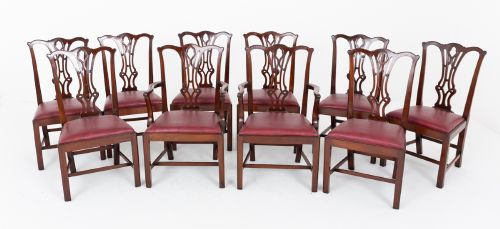
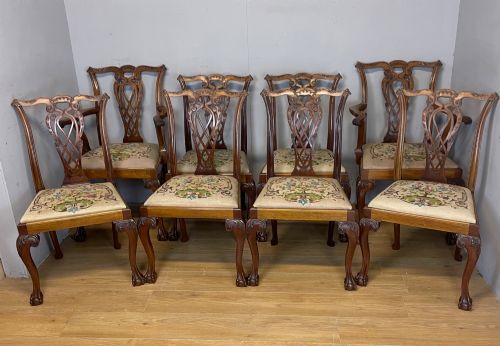
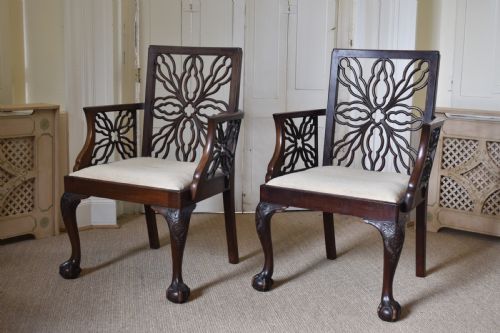
Chippendale revival armchairs replicate the substantial carved frames, distinct splats and overarching proportions associated with eighteenth-century English seating. The pieces on this page span the Victorian, Edwardian and early twentieth-century periods, capturing a sustained Victorian and Edwardian appetite for historical revival styles.
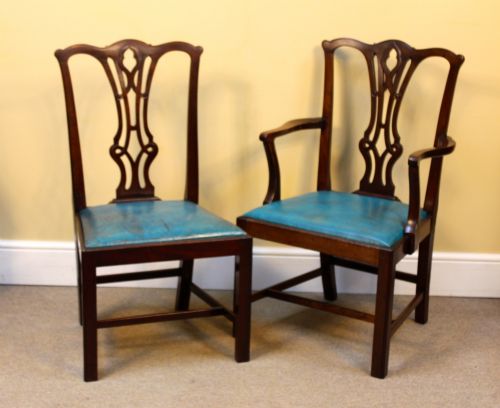
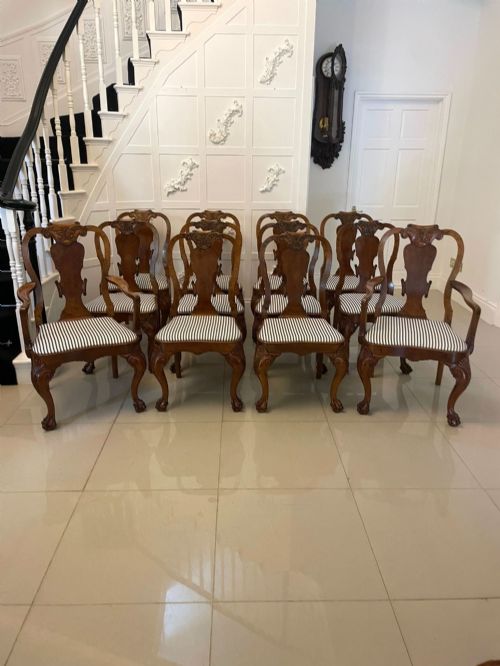
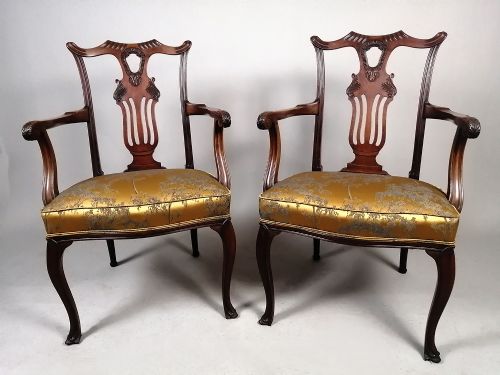
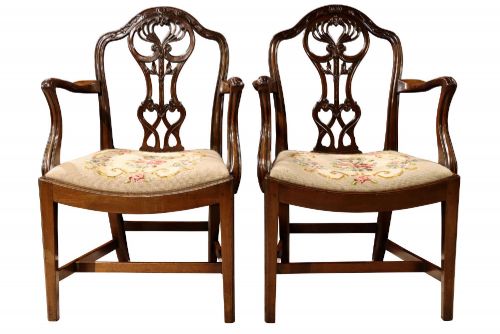
Most examples take the form of open armchairs, carvers or library seats, constructed predominantly in rich mahogany. Makers drew directly upon eighteenth-century pattern books, translating classical motifs into sturdy seating suited to late-Victorian and Edwardian drawing rooms and libraries.
Materials and construction
Construction relies heavily on dense mahogany timber, selected for its strength and capacity to hold crisp, deep hand-carving along the arms, rails and ball-and-claw feet. Cabinetmakers utilised traditional mortise and tenon joinery to ensure the structural integrity of heavy frames subjected to daily sitting.
Upholstery materials vary from period leather and velvet to damask and patterned textile fabrics, secured over sprung or padded seats. Brass tacks often finish the borders of leather-bound library chairs and Gainsborough armchairs.
Chippendale Revival Armchairs Retail Price Guide 2026
Typical asking prices for chippendale revival armchairs among the pieces listed under this phrase on Sellingantiques today, from the lower quarter to the upper quarter. They describe what is for sale here now, not the wider market.
Listings feature pieces spanning the Victorian, Edwardian and Regency periods, constructed primarily from mahogany with diverse fabric and leather upholstery.
Assessing quality and craftsmanship
Quality rests primarily in the depth, crispness and manual execution of the carved ornamentation rather than applied moulding. Superior pieces display deeply undercut acanthus leaves, finely fretted splats and substantial timber weights without structural compromise.
The choice of secondary timbers and the precision of the joinery distinguish workshop standards. Finer iterations exhibit meticulous attention to proportion, matching the architectural stance of original eighteenth-century prototypes.
Howard and Sons·Warings·Robert Strahan Dublin·Jas Shoolbred
The Chippendale Revival Armchairs Glossary
- Carver
- An armchair designed with arms, traditionally placed at the head of a dining table or used as a desk seat. These pieces match larger suites of single dining chairs.
- Splat
- The vertical wooden strip down the centre of a chair back. Revival pieces often employ intricately pierced splats based on mid-eighteenth-century designs.
- Gainsborough armchair
- A wide, upholstered armchair featuring open wooden arms and padded elbow rests. They typically stand on square or cabriole legs.
- Cabriole leg
- A furniture leg that curves outward at the knee and tapers inward toward the ankle, finishing in a claw-and-foot or pad foot. This form derives from classical Chinese architecture via Dutch furniture design.
Chippendale Revival Armchairs: Frequently Asked Questions
How do I spot a revival chair?
Revival chairs display nineteenth- or early twentieth-century construction methods, machine-sawn timber elements hidden beneath hand-carved surfaces, and secondary woods typical of the Victorian era. Closer inspection of the screw heads, glue blocks and interior frame construction usually reveals a later date than the eighteenth-century style suggests.
Makers working in the revival periods focused on heavy mahogany and precise emulation of pattern books. They replicated the aesthetic of earlier centuries while utilising contemporary workshop practices of their own time.
Are these chairs comfortable for daily use?
Many examples provide solid support through generous proportions and padded or upholstered seats. Library chairs and Gainsborough armchairs were specifically built for extended periods of reading or desk work.
Dining carvers feature open arms designed to slide neatly beneath tables. Comfort often depends on the condition of the internal webbing and upholstery stuffing, which can be restored.
What is a carver chair?
A carver chair is an armchair built to match a set of single dining chairs, historically positioned at either end of a dining table. They offer supportive wooden armrests for comfort during meals.
In revival dining sets, finding matching pairs or single carvers alongside sets of chairs is common. They also function independently as desk or occasional seating.
How do I care for mahogany frames?
Mahogany requires minimal maintenance, needing only occasional dusting with a dry, soft cloth to prevent surface grime buildup. Avoid placing chairs in direct sunlight or near heat sources to protect the polished timber finish.
Leather and fabric upholstery components benefit from regular, gentle vacuuming using appropriate attachments. Professional cleaning preserves delicate damask and velvet textiles.