



Chippendale Mahogany Games Table
A chippendale mahogany games table brings eighteenth-century proportion and folding ingenuity into a modern room.
Chippendale Mahogany Games Table
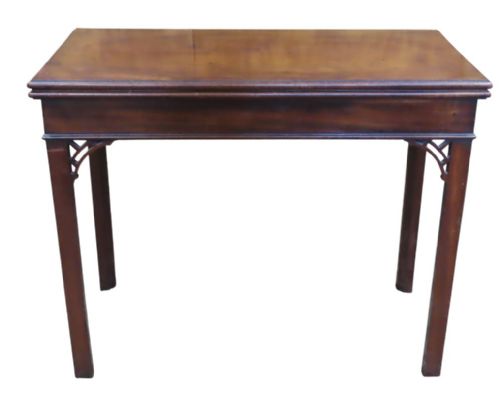
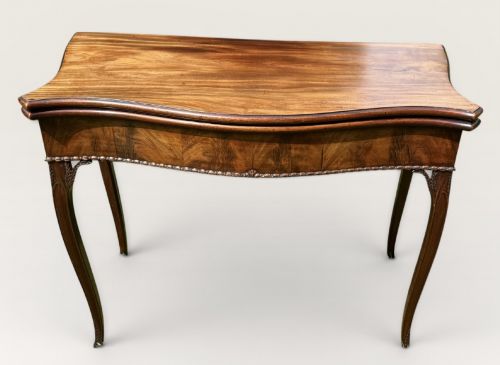
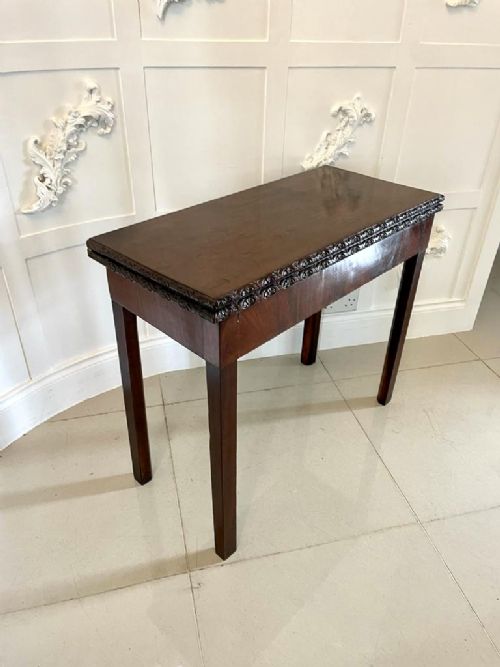
A chippendale mahogany games table is a hinged dual-purpose surface designed for card playing or tea, appearing primarily in eighteenth-century Georgian forms alongside later Edwardian and Victorian revivals.
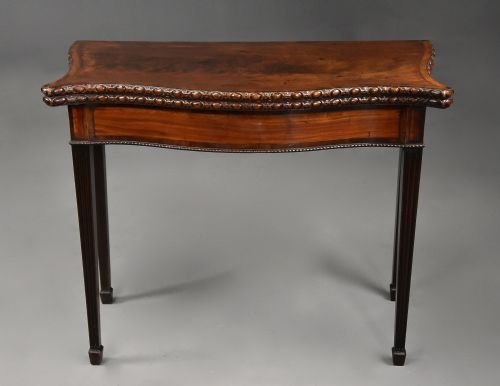
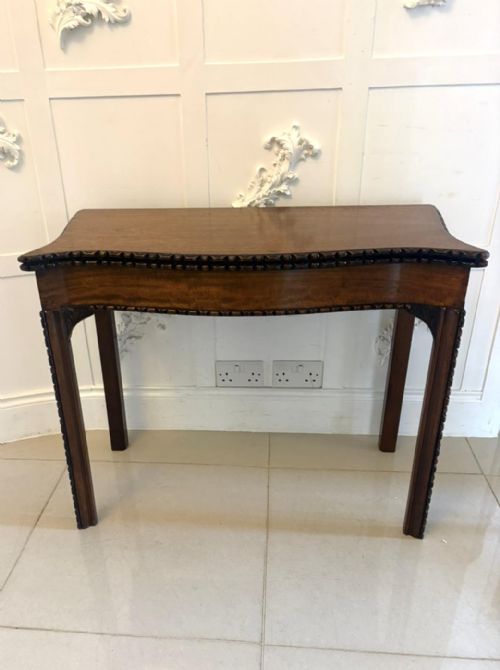
You will encounter pieces featuring fold-over tops, concertina actions, and serpentine fronts, originating from workshops spanning the George II, George III, and later revival periods.
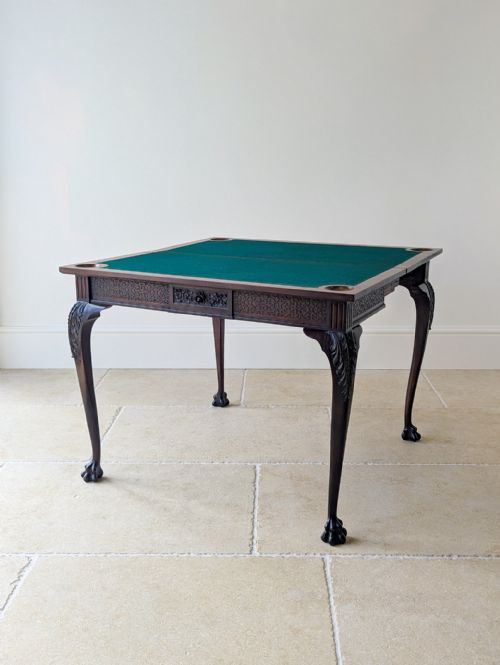
The form functions as a console or side table when closed, opening to reveal a baize-lined playing surface complete with candle corners and counter wells.
How they were made
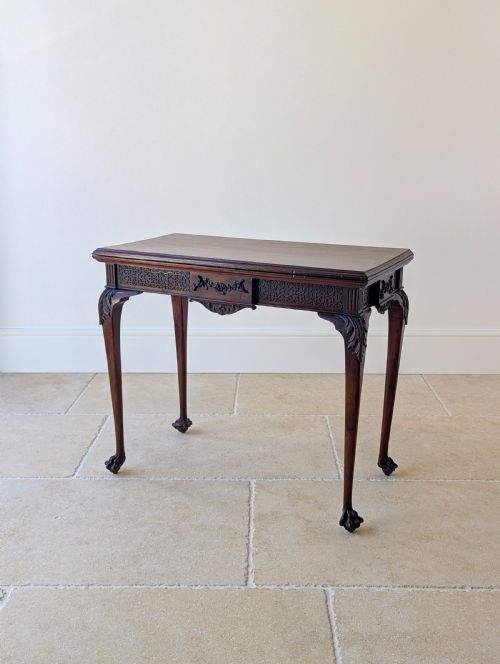
Cabinet makers utilised dense solid timber and wood veneer over sturdy frames, carving details such as acanthus leaves and ball-and-claw feet directly into the grain.
The complex concertina action and folding top mechanisms required precise joinery to ensure the rear legs extended securely to support the opened leaf without sagging.
Surfaces were finished with wool baize inserts for card playing and polished to achieve deep patination on the mahogany.
Card tables often conceal subtle wooden corner wells designed specifically to hold stray gaming counters and prevent chips from rolling away.
What varies in quality
The crispness of the hand-carving defines the upper tier, where details on the knees and frame remain sharp and deep rather than soft or cast.
Timber selection and original patination separate exceptional examples from standard ones, with rich grain depth and intact surfaces holding greater distinction.
Mechanical complexity, such as a true concertina frame that expands all four rails evenly, indicates superior construction compared to simpler rule-joint hinges.
James Shoolbred & Co.·Wylie & Lochheed of Glasgow·Hepplewhite
The Chippendale Mahogany Games Table Glossary
- Concertina action
- An expandable frame mechanism that allows all four legs to move outward when the top unfolds, supporting the open leaf evenly.
- Serpentine
- A shaped furniture front curving outward in the centre and inward at the sides, common in higher-end eighteenth-century designs.
- Baize
- A coarse woollen fabric traditionally used to line the playing surface of card tables.
- Fold-over top
- A hinged wooden surface that doubles the table area when opened and flipped outward.
- Patination
- The deep surface sheen and colour acquired by mahogany through age, handling, and polishing.
Chippendale Mahogany Games Table: Frequently Asked Questions
How do I use a games table daily?
These tables function well as console or side pieces against a wall when the top remains folded shut.
Opening the leaf transforms the piece into a functional surface for writing, dining, or card games.
How do I spot an 18th-century piece?
Look for heavy timber construction, hand-cut joinery marks, and concertina folding mechanisms rather than simple modern hinges.
Original eighteenth-century examples display deep patination on the mahogany and traditional wool baize linings.
What is a concertina action?
A concertina action is an ingenious frame design that expands outward with the folding top.
This mechanism allows the rear legs to move into position to support the opened leaf securely.
Are revival pieces well made?
Edwardian and Victorian revival pieces adopt eighteenth-century styling while utilising the manufacturing techniques of their own era.
These later iterations remain sturdy and decorative alternatives to original Georgian items.