
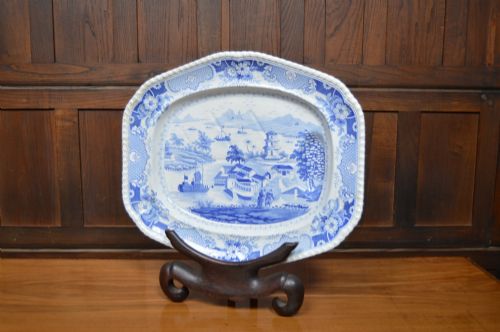


Chinoiserie Meat Plate
These heavy earthenware platters bring bold oriental scenes to the dining table, offering robust utility wrapped in imaginative Georgian and Victorian artistry.
Chinoiserie Meat Plate
A chinoiserie meat plate is a large serving platter decorated with imaginative oriental motifs, bridges, ruins, and temples rendered in rich blue and white transfer print. These sizeable earthenware vessels were made to serve substantial joints of meat at the Victorian and Georgian dining table.
The pieces encountered on this page span the nineteenth century, including examples from the Georgian, Regency, and Victorian periods. Most take a generous rectangular form, occasionally accompanied by a matching drainer to catch the juices of large poultry or game.
Makers such as Minton, Mason's, Copeland & Garrett, and Davenport dominate the offerings, translating fantastical Chinese garden scenes onto sturdy ironstone and ceramic bodies. Collectors find these serving platters in patterns like India Temple, Chinese Tree, and Indian Grasshopper.
How they were made
Potters built these substantial servers using dense earthenware, durable ironstone, and ceramic bodies capable of supporting heavy joints of meat. Cobalt pigment supplied the deep blue transfer prints that define the aesthetic of these platters.
Engraved copper plates transferred intricate blue designs onto the raw ceramic surface before a transparent lead glaze was applied to seal the decoration. Skilled hands occasionally added enamel and gilt highlights to enrich the finished glaze.
London Goldsmiths placed their coat of arms on a massive Minton platter, proving that even fine jewelers occasionally needed a proper place for Sunday roast.
What varies in quality
Quality rests in the crispness of the transfer print and the ambition of the scene, where finely detailed temples and gardens outclass simpler, repetitive borders. The weight and whiteness of the ironstone body also distinguish standard utility wares from finer cabinet pieces.
The presence of crisp maker marks and specialised components, such as an original ceramic drainer, elevates a platter. Clarity of the cobalt pigment under the glaze further separates superior productions from blurred or muddy prints.
Minton·Davenport·Copeland and Garrett·Elkin Knight and Bridgwood·J.W.R.
The Chinoiserie Meat Plate Glossary
- Transferware
- A pottery decoration technique where a design is engraved on a copper plate, inked with pigment, and transferred to paper before being pressed onto ceramic. This method allowed intricate blue and white patterns to be produced rapidly.
- Ironstone
- A dense, heavy ceramic invented in the nineteenth century that mimics porcelain in strength and durability. It became the favored material for large meat platters due to its resistance to chipping.
- Drainer
- A perforated ceramic insert that sits inside a meat platter to lift the joint above accumulated juices. These scarce components are prized by collectors when they survive alongside the main dish.
- Cobalt Pigment
- A metallic oxide used by potters to achieve deep, stable blue tones under a lead glaze. It withstands high kiln temperatures without losing intensity.
- Lead Glaze
- A glossy coating containing lead oxide applied to earthenware to create a smooth, waterproof surface. It protects the porous ceramic body beneath.
Chinoiserie Meat Plate: Frequently Asked Questions
What were meat platters used for?
These large ceramic vessels served as the centrepiece for presenting roasted joints of meat, poultry, and game at the formal dining table. Their generous proportions accommodated substantial meals during large Victorian and Georgian gatherings.
Many featured recessed wells or removable ceramic drainers to catch juices and prevent the meat from sitting in liquid during carving.
How do I identify a Victorian piece?
Victorian examples often display heavy ironstone bodies, deep blue transfer prints of exotic gardens or ruins, and specific nineteenth-century registry marks or maker stamps on the reverse. Stylistic clues include floral borders and romanticized architectural motifs.
Comparing the blue pigment and the weight of the ceramic against documented nineteenth-century standards helps confirm the era of production.
Can I use these platters for serving food?
Most buyers choose to display these historic earthenware platters on walls, dressers, or plate racks due to their age and decorative value. Using them for dry foods is possible, though old glaze can be sensitive to modern detergents.
Hand washing in warm water without harsh abrasives preserves the historic lead glaze and cobalt transfer print.
What is Chinese Tree pattern?
Chinese Tree is a popular nineteenth-century transferware design featuring stylized oriental flora, flowering branches, and architectural elements. Factories like Minton utilised this motif to satisfy the Victorian appetite for exotic chinoiserie decoration.
The pattern combines whimsical botanical elements with traditional blue and white printing techniques.