
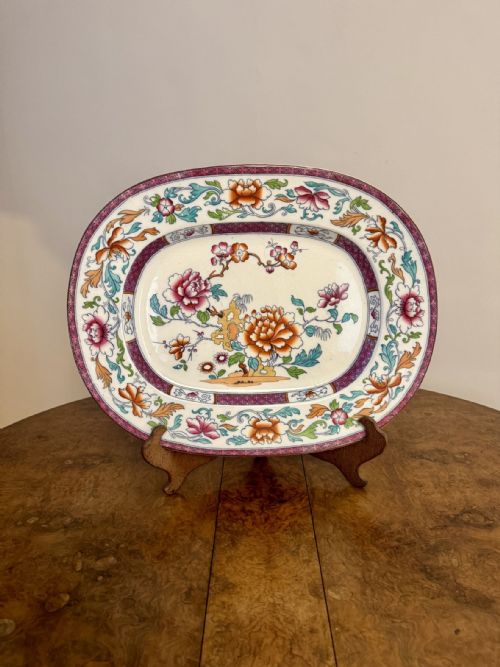


Large Oval Meat Platter
A large oval meat platter is a substantial ceramic or ironstone serving dish designed for carving at the table, offering both practical capacity and striking period decoration.
Large Oval Meat Platter
When you search for a large oval meat platter, you encounter heavy serving dishes built to accommodate joints of meat for large Victorian households. These pieces appear frequently in nineteenth-century earthenware and ironstone, often decorated in deep blue and white transfer printing.
The most common examples on this page date from the Victorian era, particularly the latter half of the century, alongside earlier nineteenth-century variants. They measure significantly larger than standard dinner plates to hold heavy roasts and collect carving juices.
Serving platters of this scale take various forms, including those fitted with internal drainer inserts or paired with matching metal domes. Styles range from traditional British blue and white transfer prints to Victorian Chinoiserie and Imari patterns.
How they were made
Potters shaped these robust vessels from dense earthenware and heavy ironstone bodies designed to withstand the daily demands of nineteenth-century dining rooms. Earthenware surfaces received smooth lead glazes, while ironstone provided a tougher, vitreous finish capable of holding large joints without cracking under heat.
Decoration relied heavily on blue and white transfer printing, a technique that allowed intricate patterns like Chinese Garden motifs to be applied evenly across broad curved surfaces. Certain high-end pieces incorporated delicate hand-painted enamel details or touches of gold leaf over the glaze.
Specialised items such as heavy ironstone dishes utilised fitted ceramic strainers to separate meat juices from the roast, demonstrating careful attention to practical kitchen utility. Metal elements like silver-plated meat domes were manufactured separately to cover the platter and retain heat.
Listings feature heavy nineteenth-century ironstone and earthenware, decorated predominantly in blue and white transfer print alongside Victorian Imari and Chinoiserie styles.
What varies in quality
Quality rests primarily in the crispness of the transfer print and the clarity of the glaze across the broad well of the dish. Finer examples display deep, uniform cobalt blues without smudging, whereas lesser pieces suffer from blurred transfer lines and pooling glaze.
The weight and substance of the ceramic body also separate standard utility wares from superior productions, particularly when comparing heavy ironstone to porous earthenware. Platters retaining intact gold leaf or crisp hand-painted enamel highlights sit firmly at the upper end of the scale.
Completeness dictates much of the appeal, with platters accompanied by original ceramic strainers or matching silver-plated domes representing superior manufacturing output. The presence of a recognised factory mark adds further distinction to the ceramic body.
Meissen
The Large Oval Meat Platter Glossary
- Ironstone
- A heavy, durable type of ceramic patented in the nineteenth century that mimics porcelain. It resists chipping and staining much better than standard earthenware.
- Transfer print
- A decoration method where a design is engraved on a copper plate, inked, transferred to tissue paper, and then rubbed onto the unfired ceramic body.
- Meat dome
- A large, domed cover, often made of silver plate, placed over a platter to keep carved joints warm at the dining table.
- Strainer
- A ceramic insert pierced with holes that sits inside the well of a platter to drain juices away from the meat.
- Lead glaze
- A shiny coating containing lead compounds applied to pottery before firing to create a waterproof and glossy surface.
Large Oval Meat Platter: Frequently Asked Questions
How were large meat platters used?
These platters sat at the centre of the nineteenth-century dining table to hold large roasted joints of meat during family meals and formal dinners.
Servants brought the heavy dish to the table where the host carved the meat directly upon the ceramic surface for guests.
Can I still use these antique platters for serving food?
Most nineteenth-century platters remain robust enough for serving dry foods like roasts, bread, or fruit at a modern dining table.
Because older glazes and ironstone can contain microscopic crazing or historic materials, hand washing is essential to preserve the ceramic body.
How do I date a Victorian meat platter?
Dating relies on examining the style of the transfer print, the weight of the ceramic body, and any registration marks stamped underneath.
Early nineteenth-century examples often feature deep ironstone bodies and romantic blue and white landscapes, while later Victorian pieces show greater variety in stylistic revivals.
What is the difference between earthenware and ironstone?
Earthenware is a porous, traditional pottery body that requires a reliable glaze to remain waterproof and tends to feel lighter in the hand.
Ironstone is a much denser, semi-vitreous ceramic developed to withstand heavy kitchen use, resulting in a heavier dish with higher resistance to chipping.