


Chinese Export Porcelain Lighting
Chinese export porcelain lighting brings centuries of ceramic artistry into domestic rooms as table lamps and oil lanterns.
Chinese Export Porcelain Lighting
Chinese export porcelain lighting transforms antique vases, ginger jars, and lidded vessels into functional table lamps. These pieces originate primarily from the eighteenth and nineteenth centuries, spanning distinct stylistic periods from Qing Dynasty production to later nineteenth-century interpretations.
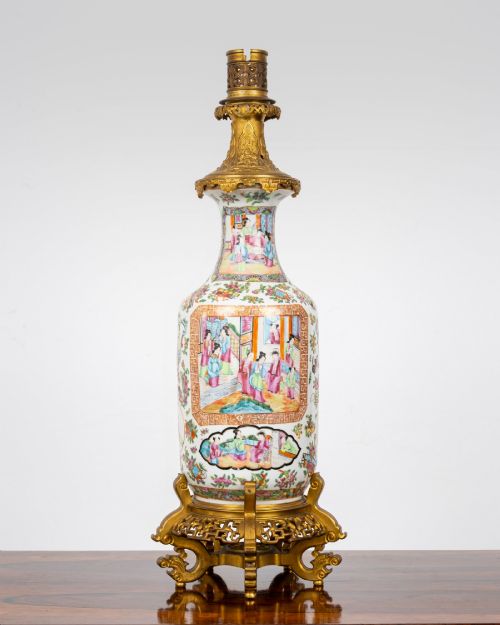
The most common forms encountered on this page are table lamps adapted from Rose Medallion, Canton, Famille Rose, and blue and white porcelain vases. Many of these lamps appear in pairs, retaining their original decorative symmetry despite later electrical conversion.
Makers such as Samson also produced pieces in these historical styles during the nineteenth century, creating porcelain bodies intended to emulate earlier Chinese export traditions. These vessels are frequently paired with metal mounts to serve as domestic illumination.
Materials and technique
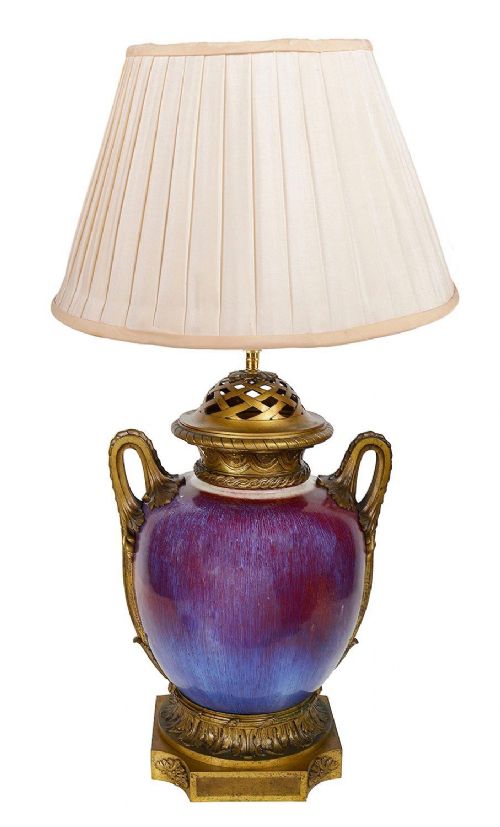
The foundational bodies consist of hard-paste porcelain, often hand-painted with enamels in palettes such as Famille Rose, Famille Verte, or monochrome glazes like celadon and sang de bœuf. Artisans applied these pigments over or under the glaze before firing the ceramics in kilns.
Metal mounts in brass, ormolu, and gilt bronze provide structural support and elevate the ceramic vessels. These mounts are fitted to the top and bottom of the porcelain bodies during conversion into lamps or during the initial manufacture of the decorative hardware.
Complementary materials include fabric and silk for the lampshoes or shades, alongside wooden components that anchor the electrical fittings to the antique vases.
Object types recorded in the inventory comprise table lamps, oil lanterns, candlesticks, and lidded vases.
Quality and execution
The standard of hand-painted detail on the porcelain surface separates exemplary pieces from simpler commercial output. Finely executed enamel work displays precise brushwork, controlled colour blending, and intricate gilding across the motifs.
The integration of metal mounts also defines the calibre of the piece. High-grade ormolu and gilt bronze mountings demonstrate crisp chasing and secure adaptation to the ceramic body without compromising the underlying porcelain.
The Chinese Export Porcelain Lighting Glossary
- Famille Rose
- A palette of opaque enamels dominated by pink or rose colours, introduced during the Qing Dynasty. This scheme appears frequently on nineteenth-century export porcelain.
- Rose Medallion
- A distinct decorative pattern featuring partitioned panels of figures, birds, and flowers arranged around a central medallion. It is commonly found on nineteenth-century Cantonese export wares.
- Ormolu
- Finely ground high-carat gold applied in a mercury amalgam to a bronze base. This technique creates a rich golden finish on mounts attached to porcelain vessels.
- Celadon
- A pale green jade-like glaze achieved through iron oxide in the glaze mixture fired in a reduction atmosphere. It appears on various monochrome vases adapted into lamps.
- Samson
- A nineteenth-century French ceramic factory known for producing high-quality copies and interpretations of earlier Chinese export porcelain styles. Their pieces often bear imitation marks.
Chinese Export Porcelain Lighting: Frequently Asked Questions
What is Chinese export porcelain lighting?
These pieces are functional table lamps and lanterns created by converting antique Chinese porcelain vases, ginger jars, and candlesticks. They combine historical ceramic bodies with modern electrical wiring and metal mounts.
Most examples date from the eighteenth and nineteenth centuries, utilising decorative schemes such as Famille Rose, Canton, and blue and white designs.
Are these lamps sold as pairs?
Many listings comprise matched pairs of lamps converted from symmetrical vases or ginger jars. These paired items share identical decorative motifs and colour palettes.
Single lamps also appear where the companion piece did not survive or where a solitary vase was chosen for conversion.
How do I live with these lamps?
These lamps function as primary or accent illumination in traditional and contemporary interiors. Their colourful ceramic bodies introduce texture and historical depth to a room.
They require standard table surfaces near electrical outlets and benefit from compatible fabric or silk shades that complement the proportions of the porcelain base.