


Chinese Display Shelf
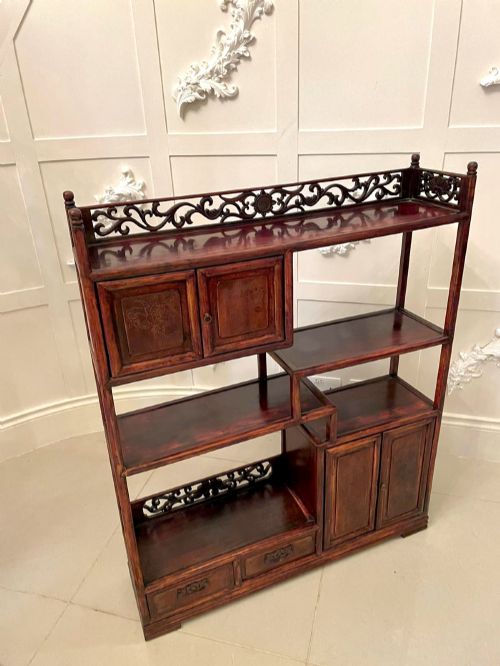
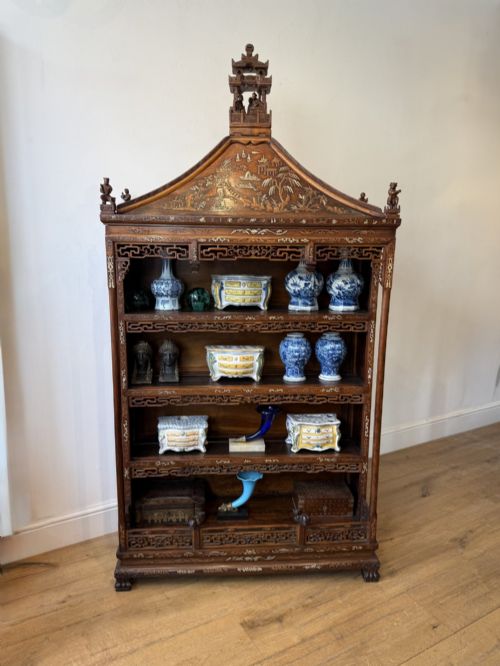
A chinese display shelf brings intricate woodwork and centuries of craftsmanship into a room to hold small treasures.
Chinese Display Shelf
A Chinese display shelf organises curios and small objects upon asymmetrical tiers designed for visual balance. These pieces emerge from periods spanning the late nineteenth century into the early twentieth century.
The format ranges from hanging display shelves to floor cabinets, open cabinets, and dwarf side-cabinets known as shodanas. Examples reflect influences from the Qing Dynasty, Chinese Export traditions, and Japonisme.
Buyers encountering this category will find forms intended to exhibit precious porcelain, jade, and small carvings. The structure prioritises varied compartment sizes to accommodate objects of different heights.
How they were made
Construction relies upon dense timbers including rosewood, hongmu, elm, and general hardwoods selected for their strength and grain. Workshops utilised these materials to build sturdy frames capable of supporting heavy stone and ceramic pieces.
Surface enrichment involves intricate carving alongside brass mounts, bone inlay, and mother-of-pearl inlay. Red lacquer also appears on select cabinets, providing a smooth coloured finish over the wooden substrate.
Listings feature hardwood, rosewood, elm, and hongmu, often enhanced with bone and mother-of-pearl inlay across nineteenth and early twentieth century forms.
What varies in quality
The standard of a Chinese display shelf rests upon the depth and crispness of the carving across the woodwork. Profuse and finely detailed execution distinguishes superior examples from plainer commercial production.
Material selection dictates value, with dense hongmu and rosewood timbers achieving a more substantial presence than softer woods. The precision of joinery and the intact preservation of mother-of-pearl or bone inlay further separate tiers of quality.
The Chinese Display Shelf Glossary
- Hongmu
- A dense tropical hardwood prized in traditional Chinese furniture making for its deep colour and durability. It provides a heavy and stable structure for intricate display cabinets.
- Shodana
- A style of multi-tiered display cabinet featuring asymmetrical shelving, popularised during the nineteenth century under Japanese and Chinese aesthetic cross-currents. These pieces serve to exhibit small decorative objects.
- Mother of Pearl Inlay
- The technique of embedding iridescent shell fragments into recessed channels within the wooden surface. This ornamentation creates contrasting luminous patterns against dark timber.
- Qing Dynasty
- The final imperial dynasty of China, spanning from sixteen forty-four to nineteen twelve. Furniture from this era often exhibits elaborate carving and formal symmetry mixed with asymmetric compartments.
Chinese Display Shelf: Frequently Asked Questions
What fits on a Chinese display shelf?
These shelves suit small porcelain vessels, jade carvings, and miniature bronzes. The varied compartment sizes accommodate diverse heights.
Larger cabinets also house small clocks or tiered scholar's objects without crowding the visual space.
How do I date a Chinese display shelf?
Dating relies upon timber choice, carving style, and construction methods. Pieces from the nineteenth century often display deep hand-carving and dense rosewood or hongmu.
Later pieces from the early twentieth century shift slightly in proportion while retaining traditional joinery techniques.
Where should I place a display shelf?
Position these cabinets against solid walls away from direct sunlight to protect the timber and lacquer finishes. Placing them at eye level allows the intricate shelf tiers to be viewed clearly.
Floor-standing cabinets require stable ground to support heavy hardwood structures safely.
How do I clean a hardwood display shelf?
Dust the intricate carvings gently with a soft brush to prevent dirt accumulation in recessed areas. Avoid chemical polishes that can damage aged lacquer or dry out the natural timber.
Maintaining a stable room humidity prevents the hardwood and inlaid elements from shifting or cracking over time.