

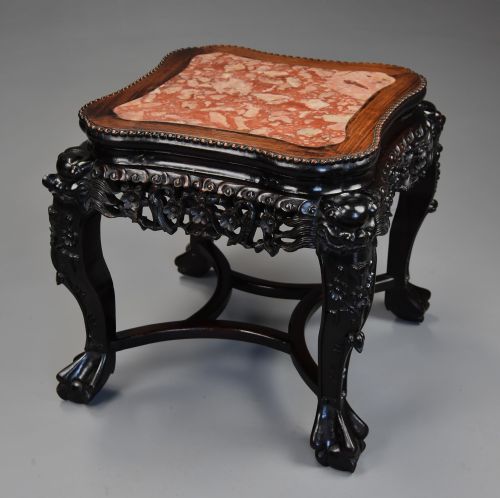


Chinese Bonsai Display Table
A Chinese bonsai display table elevates miniature trees and scholarly objects with carved timber and inset stone.
Chinese Bonsai Display Table
A Chinese bonsai display table functions primarily as a specialised stand for potted plants, jardinieres, and scholar's objects rather than a conventional dining or writing surface. These pieces appear in forms such as low tables, pedestals, plant stands, and kang tables created during the nineteenth century and the Victorian era. The most common examples on this page are compact stands featuring an inset top designed to hold a ceramic vessel or a potted specimen securely.
Most items on this page trace their origins to the Qing Dynasty and Chinese Export production of the late nineteenth century. Makers constructed these low tables and plant stands to showcase nature indoors, integrating carved woodwork with stone panels. Buyers encounter pieces spanning from the eighteen-eighties to nineteen-hundred, each reflecting traditional forms adapted for both domestic use and export markets.
Materials and construction methods
Carpenters utilised dense tropical timbers including rosewood, hongmu, padouk, and mahogany to build these stands. These heavy hardwoods allowed artisans to carve intricate floral and geometric motifs into skirts and legs without compromising structural integrity. The inherent strength of the timber supports the weight of stone insets and heavy ceramic jardinieres.
Makers set smooth marble or rouge marble panels directly into the wooden framework of the top surface. This technique created a cool, durable platform resistant to moisture from potted plants and vases. Joinery relied on precise interlocking joints that avoided modern metal fasteners, maintaining the clean lines characteristic of Qing Dynasty style work.
Some nineteenth century makers scaled down their low opium tables so scholars could use them to display tiny potted trees instead.
Assessing quality in carved stands
The depth and clarity of the hand carving dictate the distinction between standard production and superior craftsmanship. Finer examples display undercut relief work with crisp botanical details on the aprons and legs, whereas simpler pieces feature shallow, mechanical incisions. The crispness of the edges around the carved panels reveals the hand of a more skilled carver.
The selection and fitting of the marble insert also separate grades of manufacture. Superior tables incorporate stone with active veining that sits completely flush with the surrounding hardwood frame, showing no large gaps or shims. The grain selection in the primary timber further distinguishes a workshop piece made for a scholar from a basic export item.
The Chinese Bonsai Display Table Glossary
- Hongmu
- A dense, dark red-brown timber translated literally as red wood. Artisans frequently selected this heavy material for scholar's furniture and display stands during the Qing Dynasty.
- Jardiniere
- A large ornamental pot or container for plants. These stands were built specifically to support such heavy ceramic vessels.
- Kang table
- A low table traditionally placed upon a heated brick bed in northern China for dining or writing. Smaller scale versions function effectively as display platforms for bonsai.
- Padouk
- A durable, heavy exotic hardwood native to Asia and Africa. It exhibits a vibrant reddish tone that darkens gracefully over time with exposure to light.
- Rouge marble
- A decorative limestone featuring deep reddish and pinkish hues. Craftsmen valued this stone for its striking contrast against dark tropical hardwoods.
Chinese Bonsai Display Table: Frequently Asked Questions
What was a Chinese bonsai display table used for?
These tables served as raised platforms for potted miniature trees, flowering plants, and bronze or ceramic vessels. Placing the plant on an elevated stand allowed scholars and collectors to examine delicate botanical details at eye level.
In traditional interiors, they also held incense burners and scholar's rocks within reception rooms and studies. Their modest footprint enabled placement beside seating areas or against walls.
How do I date a nineteenth century stand?
Dating relies on examining the timber density, tool marks left by hand carving, and the overall style of the piece. Nineteenth century examples typically show patination consistent with age and traditional joinery methods without modern hardware.
Reference points include period markers such as Qing Dynasty aesthetics or Victorian export markers found in the inventory records. Subtle variations in the sharpness of floral relief work help narrow down the decade of production.
Can these tables hold heavy plant pots?
The dense tropical hardwoods and sturdy joinery ensure these stands easily support standard ceramic plant pots and jardinieres. Their original purpose demanded structural resilience against heavy stone and earthenware vessels.
Owners should still verify the stability of the joints and the integrity of the marble insert before placing exceptionally heavy specimens on top. Regular care with appropriate wood maintenance preserves the load bearing capacity of the timber.
Where should I place a plant stand at home?
A plant stand fits well in corners, beside windows, or next to seating where it can support a trailing plant or a decorative lamp. Their compact dimensions make them adaptable for accent placement in both traditional and contemporary rooms.
Keeping them away from direct heat sources prevents the dense hardwood from drying out or splitting. The stone insert naturally accommodates damp pots, making them practical for indoor greenery.