




Cherub Garniture Clock Set
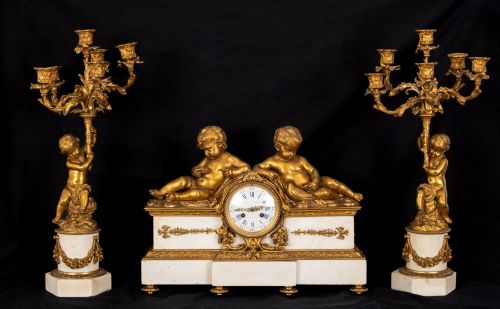
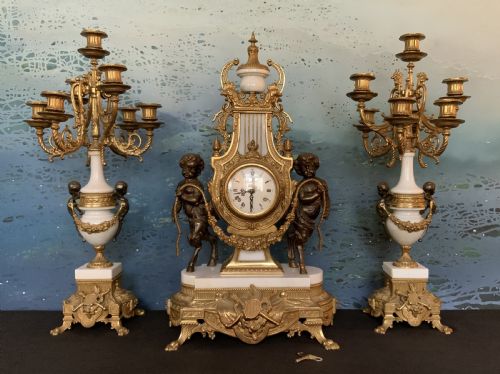
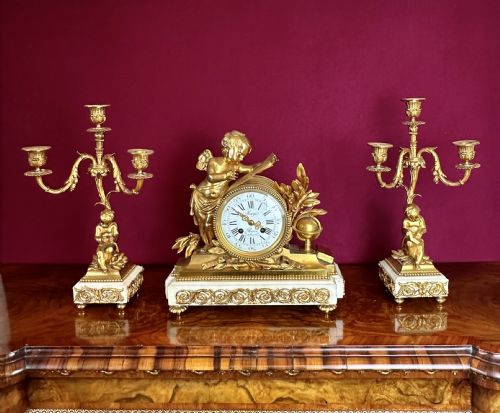
These cherub garniture clock set pieces combine sculptural bronze figures with matching sidepieces to bring monumental nineteenth-century French design into a room.
Cherub Garniture Clock Set
A cherub garniture clock set comprises a central mantel clock accompanied by matching sidepieces such as candelabras or urns, frequently featuring cast putti figures. You encounter these primarily in nineteenth-century French interpretations spanning Victorian and Belle Epoque periods.
The configurations range from three-piece white or red marble ensembles mounted in gilt bronze to porcelain and onyx arrangements. Louis XVI revival and Rococo styles dominate the forms, reflecting nineteenth-century French taste for ornate domestic display.
Materials and construction
Foundry workers cast components in bronze before applying mercury gilt to create the characteristic ormolu finish. Stonemasons shaped white marble, red marble, and onyx bases to support heavy metal mounts and clock housings.
Enamel dials received delicate hand-painted numerals, while clockmakers fitted mechanical eight-day striking movements behind glazed bezels. Artisans then assembled the cast putti, scrolls, and foliage with threaded pins and screws.
Gilt cherubs occasionally clutch visible pendulums, allowing watchers to trace the steady swing while brass gears tick away inside.
Distinctions in quality
The integration of the garniture set relies on uniform mercury gilding and matched stone blocks rather than mismatched replacement candelabras. Original movements bearing maker signatures and matching serial numbers separate standard decorative assemblies from high workshop output.
H Luppens Paris·Meissen
The Cherub Garniture Clock Set Glossary
- Garniture
- A matched set of ornamental objects designed to display together on a mantelpiece or sideboard, typically comprising a clock flanked by two matching candelabras, urns, or vases.
- Ormolu
- Gilt bronze produced by applying a mercury and gold amalgam to a cast bronze object and heating it until the mercury vaporised, leaving a durable golden coating.
- Putto
- A plump, naked male child figure frequently depicted as a winged cherub in Renaissance, Baroque, and nineteenth-century decorative arts.
- Candelabra
- A branched candlestick holder designed to hold multiple tapers, often made to match the style and materials of a central mantel clock in a garniture set.
- Louis XVI Revival
- A nineteenth-century design movement that reinterpreted eighteenth-century French neoclassical motifs including symmetrical scrolls, classical urns, and restrained floral garlands.
Cherub Garniture Clock Set: Frequently Asked Questions
How do I wind an antique clock set?
Most nineteenth-century mechanical movements utilise a key inserted into winding holes on the enamel dial to tension the mainsprings.
Care must be taken not to overwind the mechanism, and striking trains should be allowed to complete their sequence without manual interference.
Are these clock sets heavy?
These ensembles are exceptionally heavy due to the dense combination of cast bronze, ormolu mounts, and solid marble or onyx bases.
Furniture supporting them requires a sturdy top surface capable of bearing significant dead weight safely over time.
How do I identify Louis XVI style?
Louis XVI style pieces rely on classical symmetry, straight architectural lines, architectural urn motifs, and restrained gilt-bronze mounts.
This aesthetic contrasts sharply with the earlier curved asymmetry found in Rococo revival designs.