
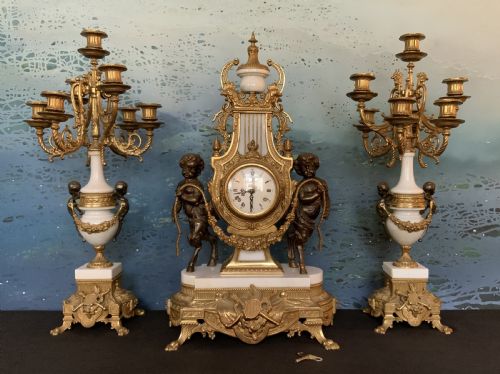


Bronze Lyre Mantel Clock
A bronze lyre mantel clock brings classical French proportion and precision engineering to a room, styled after the ancient musical instrument.
Bronze Lyre Mantel Clock
A bronze lyre mantel clock is a striking timekeeper modelled after the classical stringed instrument, combining sculptural metalwork with a visible dial. These pieces span the Regency period through to the late nineteenth and mid twentieth centuries, showing the enduring appeal of classical motifs in domestic interiors.
You will most frequently meet French and English examples on this page, often drawing upon Louis XVI and neoclassical design vocabulary. Formats range from modest desk pieces to elaborate garniture sets featuring matched candelabra, utilising contrasting materials such as marble and porcelain.
The architectural layout typically suspends the movement within a symmetrical frame flanked by scrolling arms or brass strings. Makers experimented with materials and sizes, producing everything from compact burr walnut desk timepieces to substantial marble and ormolu centrepieces.
How they were made
Foundry work relied on the casting of bronze and brass, subsequently gilded or finished as ormolu to provide a rich golden lustre. Artisans shaped these metals into the characteristic curving arms and decorative bezels that define the instrument silhouette.
Enamel dials with painted numerals were fitted behind protective glass bezels, housing mechanical movements driven by springs or weights. Structural components frequently incorporate white, pink, or Bleu de Roi marble bases that provide stability and contrast to the metallic mounts.
Cabinetmakers and bronze-workers collaborated to integrate wood veneers such as burr walnut and maple into specific frames, employing precise joinery alongside metal casting.
Listings feature marble, ormolu, bronze, and porcelain materials across French and English stylistic traditions spanning the nineteenth and twentieth centuries.
What varies in quality
The crispness of the cast metalwork separates standard production from superior pieces, where chased details on the ormolu and bronze remain sharp and well-defined. The weight and selection of the supporting marble or porcelain body also indicate the original ambition of the piece.
Complexity of the movement, such as the inclusion of a chain fusee mechanism or mystery clock configuration, marks out advanced horological execution. The integration of signed movements by notable firms demonstrates a higher tier of workshop standard.
Lenzkirch·FB Adams London·Maple and Co Paris
The Bronze Lyre Mantel Clock Glossary
- Ormolu
- Gilded bronze, where a finely ground gold-mercury amalgam is applied to a bronze base and heated to leave a gold layer. This technique provides the bright metallic finish seen on many classical mounts.
- Garniture set
- A decorative grouping consisting of a central clock flanked by matching ornaments such as candelabra or vases. These sets were designed to sit symmetrically on a mantelpiece.
- Mystery clock
- A timepiece where the visual connection between the movement and the hands is obscured, creating the illusion that the hands float without internal gears. This mechanical trickery was popular in nineteenth-century French horology.
- Bleu de Roi
- A deep, rich royal blue ceramic glaze developed at the Sèvres porcelain factory. It often forms the contrasting body of French decorative clocks.
- Chain fusee
- A conical pulley device connected to a chain that equalises the driving force of the mainspring as it unwinds. This mechanism improves the timekeeping accuracy of antique clocks.
Bronze Lyre Mantel Clock: Frequently Asked Questions
How do I wind a lyre clock?
Winding requires a matching key inserted into the winding holes on the enamel dial, turning gently until resistance is felt. Care must be taken not to overwind the mainspring.
Most mechanical movements run for eight days per wind, requiring a steady rhythm to maintain accurate timekeeping without straining the internal gears.
Where should I place a bronze lyre mantel clock?
These clocks suit sturdy surfaces such as a fireplace mantel, sideboard, or large desk where their vertical symmetry can be appreciated. Placement should avoid direct sunlight and damp areas to protect the delicate gilt surfaces and marble.
Because many examples include heavy marble or bronze components, ensure the supporting shelf can safely bear the weight of the piece and any matching garnitures.
How do I tell a Regency period clock apart from a Victorian one?
Regency examples often display restrained neoclassical lines reflecting early nineteenth-century taste, sometimes incorporating English fusee movements signed by domestic makers. Victorian pieces lean further into revival styles, frequently utilising ornate ormolu mounts and French mechanisms.
Examining the movement signatures, dial typography, and material combinations helps establish the likely decade of manufacture within the broader nineteenth-century span.
What is a garniture clock set?
A garniture set pairs a central mantel clock with two matching side ornaments, such as candelabra or decorative urns, designed as a unified decorative scheme. These sets were intended to fill large mantelpieces in formal reception rooms.
The materials and decorative motifs on the side pieces directly mirror those of the clock, creating a balanced display across a room.