


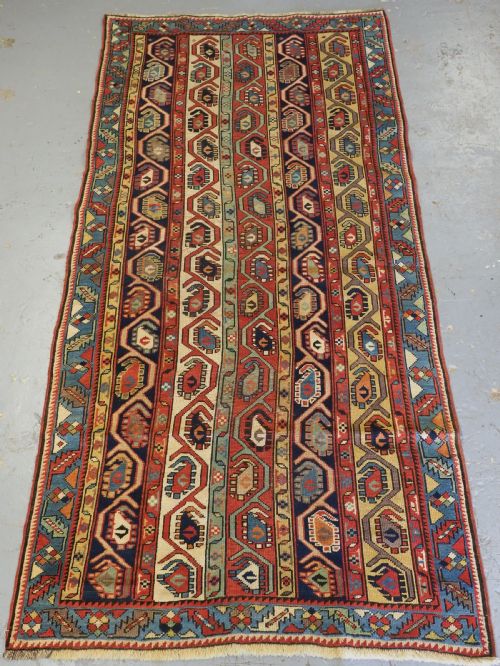


Caucasian Boteh Runner
These caucasian boteh runner pieces are hand-knotted long carpets featuring traditional seed motifs, prized for their striking tribal geometry.
Caucasian Boteh Runner
A caucasian boteh runner is a narrow, elongated antique rug woven with repeating almond-shaped boteh motifs across the field. You encounter examples originating from regional weaving centres such as Gendje, Karabagh, Shirvan, and Kazak.
The format serves long corridors, hallways, and narrow spaces where a linear arrangement of tribal designs makes a strong visual impact. Most date from the late nineteenth century around eighteen eighty to nineteen hundred.
Makers in the Caucasus and north-west Persia relied on traditional regional wools and dense knotting to produce durable floor coverings. These textiles combine long formats with the symbolic paisley or seed forms that define the style.
How they were made
Weavers utilised hand-spun wool for both the foundation warps and the dense pile, creating a sturdy structure that withstands foot traffic. Natural dyes provide the palette, yielding rich tones that age with considerable character.
Dyers extracted colours from plant and mineral sources, fixing them to the wool before women tied symmetrical or asymmetrical knots by hand. The resulting pile holds the geometric precision of the boteh and border patterns.
Caucasian Boteh Runner Retail Price Guide 2026
Typical asking prices for caucasian boteh runner among the pieces listed under this phrase on Sellingantiques today, from the lower quarter to the upper quarter. They describe what is for sale here now, not the wider market.
The listings show pieces dated between eighteen eighty and nineteen hundred, utilising hand-spun wool and natural dyes.
What varies in quality
Quality rests upon the crispness of the drawing and the clarity of the natural dye palette used throughout the field. Finer knots permit intricate detailing within each individual boteh motif and the surrounding geometric borders.
The handling of wool and the integrity of the original selvedges and ends dictate the structural preservation of the piece. Well-preserved examples retain their full proportions and structural firmness without heavy modern intervention.
The Caucasian Boteh Runner Glossary
- Boteh
- A stylised floral or almond-shaped motif representing a seed, palm leaf, or flame. It appears repeatedly across antique caucasian rugs.
- Kazak
- A style of robust tribal weaving characterised by bold geometric designs and saturated primary colours. These rugs hail from the southern Caucasus region.
- Gendje
- A specific weaving origin in the Caucasus known for diagonal rows of boteh and structured striped fields. Pieces from this area display distinctive regional colour combinations.
- Karabagh
- A highland region in the Caucasus famed for distinctive long rugs and runners featuring floral and boteh patterns. Karabagh weaving often incorporates striped or diagonal compositions.
- Selvedge
- The bound outer edge of a rug that prevents the horizontal weft threads from unravelling. Original side cordings indicate proper preservation.
Caucasian Boteh Runner: Frequently Asked Questions
Where did these runners come from?
The pieces originate from weaving communities across the Caucasus mountains and north-west Persia during the late nineteenth century. Local weavers produced them using regional geometric traditions.
Villages and nomadic groups in regions such as Karabagh, Gendje, and Shirvan created these elongated formats for domestic use and regional trade.
How do I care for my runner?
Protect the antique wool pile by placing a quality underlay beneath the rug to prevent slipping and reduce friction. Vacuum gently with the suction attachment rather than a rotating brush.
Keep the textile out of direct sunlight to protect the natural dyes from fading over time. Rotate the runner occasionally to ensure even wear across the length.
How are different regional types distinguished?
Distinctions rely on the specific arrangement of the boteh motifs, the structure of the borders, and the local colour palette. Karabagh pieces often feature diagonal or striped layouts.
Gendje and Kazak examples tend to exhibit crisper geometric framing and distinct primary shades derived from local plant and mineral dye baths.
What is a boteh motif?
The boteh is an ancient eastern design resembling a twisted teardrop, flame, or stylised floral seed. It symbolises life and eternity in traditional textile arts.
In these runners, rows of boteh create a rhythmic diagonal or vertical flow across the central field.