
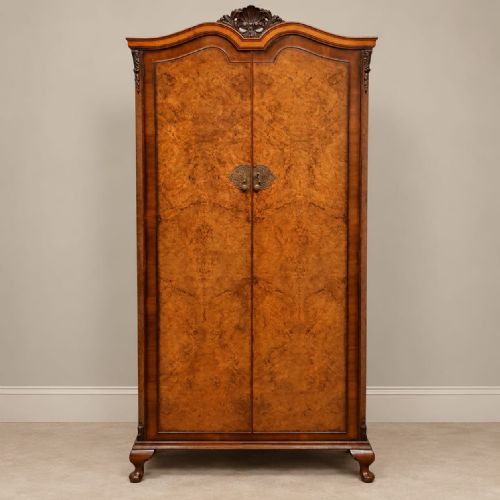
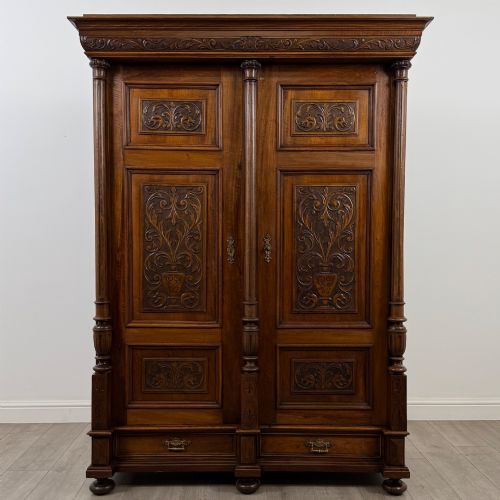
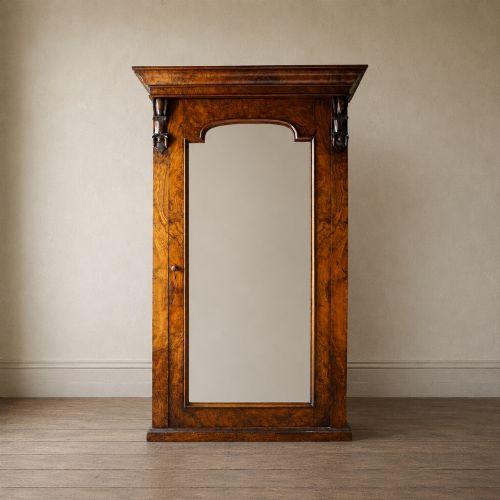
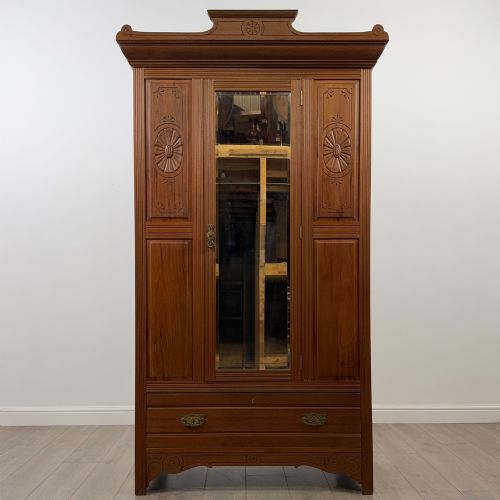
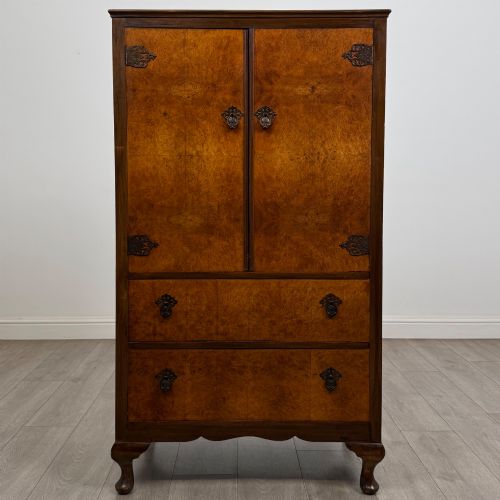
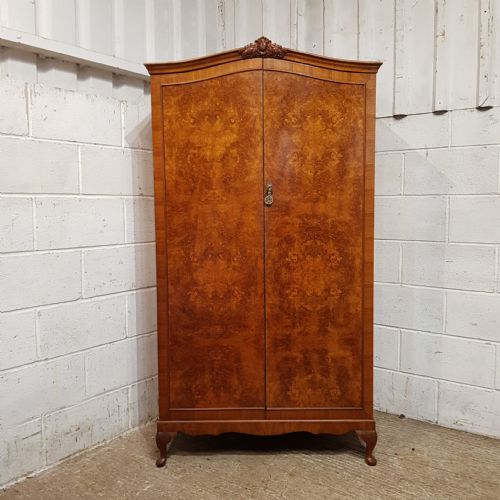
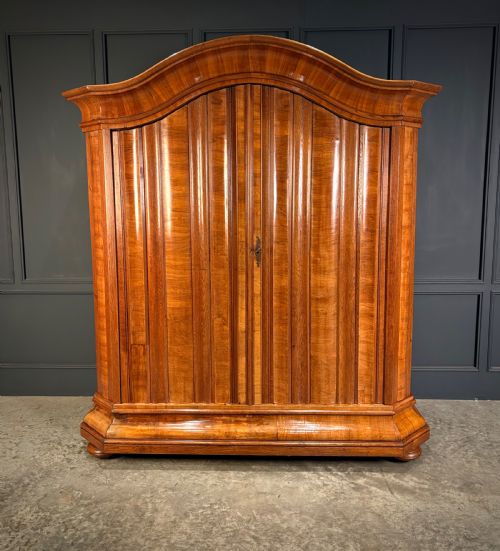


Carved Walnut Clothes Cupboard
These carved walnut clothes cupboard examples offer grand proportions and rich timber grain, bringing both historic charm and substantial storage to a bedroom.
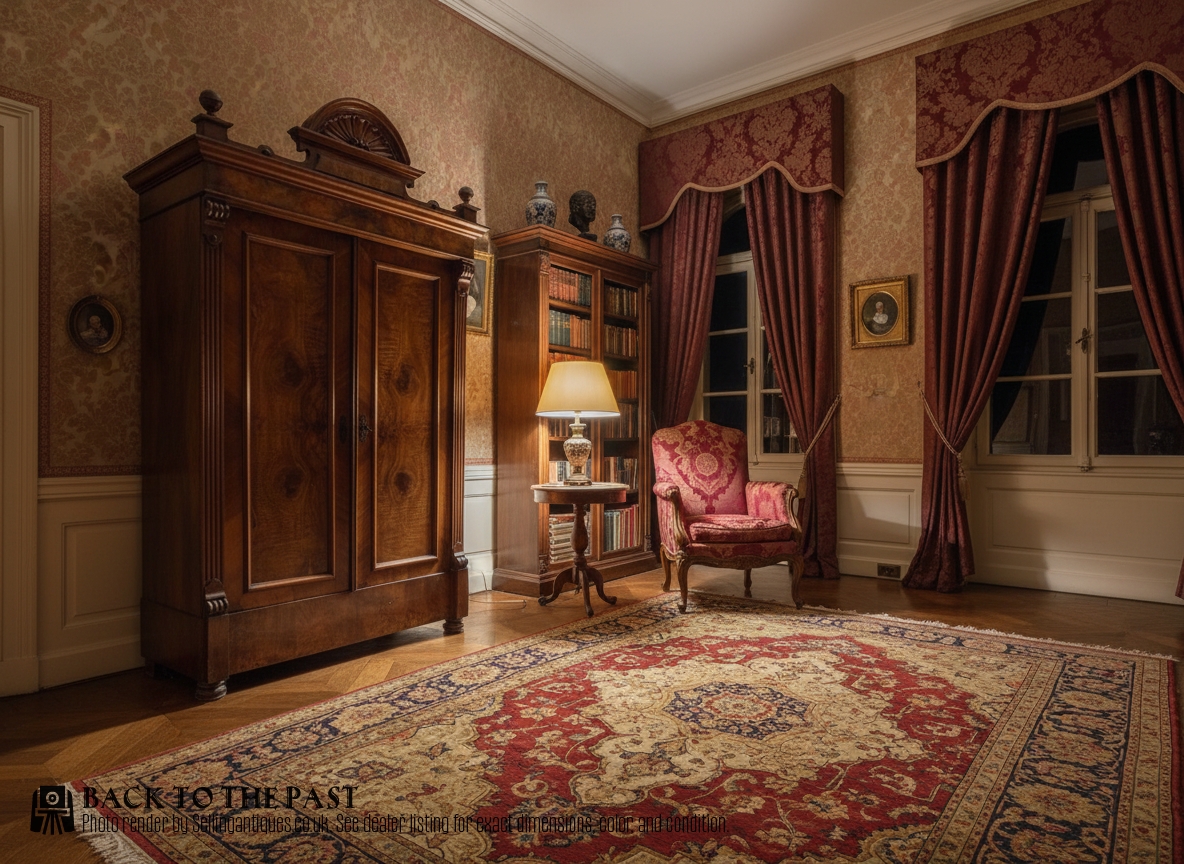
Carved Walnut Clothes Cupboard
A carved walnut clothes cupboard provides substantial storage through grand wardrobe and armoire forms shaped from rich timber. These pieces span periods from the eighteenth century through the Edwardian era and the nineteen-twenties.
Buyers encounter single, double, and triple door formats alongside compactum designs and armoires. French provincial, continental baroque, and Victorian revival styles frequently appear across these listings.
Selection ranges from mirrored single doors to large triple wardrobes featuring burr walnut veneers and ornate brass or ormolu mounts. Pieces draw from nineteenth-century English workshops as well as continental traditions.
Materials and construction methods
Cabinet makers utilised solid walnut and figured burr walnut veneers over secondary timbers such as oak. Timber selection defined the visual weight, showing deep grain patterns across large panel doors.
Carving was executed by hand directly into the dense walnut timber, forming relief motifs along cornices and door panels. Brass and ormolu mounts provided structural hardware and decorative accents.
Internal configurations incorporated hanging space, drawers, and fitted compartments within compactum frames. Glass panels occasionally featured in single mirrored doors.
Some nineteenth-century armoires retain faint traces of chalk workshop markings inside their heavy panel doors.
Distinguishing quality in walnut cabinetry
Quality rests upon the selection of timber figures, where matched burr walnut veneers show exceptional grain movement across large surfaces. Plain timber surfaces rely instead upon the depth and crispness of hand carving.
Construction integrity appears in the joinery of heavy panel doors and the trueness of large wardrobes over time. Superior examples integrate original brass hardware, ormolu mounts, and fitted internal compartments without later alterations.
The Carved Walnut Clothes Cupboard Glossary
- Armoire
- A large upright cupboard or wardrobe, typically of continental European origin, designed for hanging garments or storing textiles.
- Compactum
- A fitted wardrobe containing a combination of hanging space, shelves, and internal drawers within a single carcass.
- Burr Walnut
- Timber taken from a tree growth or burl, highly prized for its swirling, intricate grain patterns used in decorative veneer work.
- Ormolu
- Gilt bronze mountings applied to furniture for decorative effect, common on finer continental pieces.
- Grunderzeit
- A nineteenth-century central European architectural and decorative style drawing upon historic revival forms.
Carved Walnut Clothes Cupboard: Frequently Asked Questions
How do I fit a large wardrobe in a modern bedroom?
Measure ceiling height and floor clearance carefully before delivery, keeping in mind that many historic wardrobes dismantle into manageable sections for transport.
Position the cupboard away from direct heat sources to protect the solid walnut and delicate veneer surfaces from drying out.
What is the difference between an armoire and a wardrobe?
Armoires generally originate from continental traditions and often feature deep proportions with elaborate carved panel doors. Wardrobes tend to follow English cabinet forms, frequently incorporating internal hanging rails and fitted compartments.
Both serve the primary function of garment storage but display distinct regional woodworking styles.
How do I care for walnut veneer?
Dust the timber regularly with a soft, dry cloth and avoid applying modern silicone polishes that can degrade historical finishes. Maintain a stable room humidity to prevent the burr walnut veneer from lifting or cracking.
Feed the timber occasionally with a traditional beeswax polish to preserve the rich lustre of the grain.
How can I tell the period of a carved cupboard?
Examine the internal construction methods, hardware, and timber preparation alongside the exterior decorative style. Victorian and Edwardian pieces often display machine-assisted elements, whereas eighteenth-century examples rely entirely on hand- cut joinery.
Stylistic cues such as baroque curves or art deco lines help narrow down the decade of manufacture.