
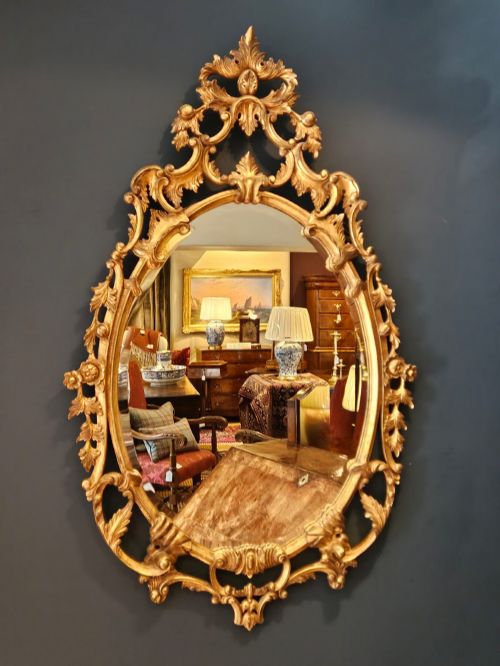
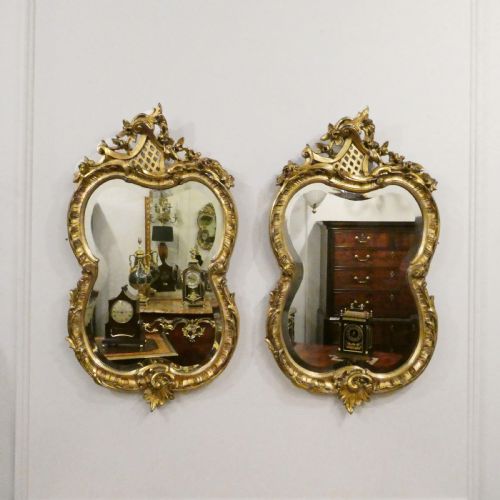


Carved Scrollwork Frame Mirror
A carved scrollwork frame mirror brings depth and ornamental presence to a room, drawn mainly from Victorian and 18th Century traditions.
Carved Scrollwork Frame Mirror
A carved scrollwork frame mirror combines practical reflection with elaborate woodwork, spanning wall mirrors and overmantel formats. Most examples appearing here date from the 19th Century and the Victorian era, alongside earlier Georgian pieces.
The styles range widely across European traditions, including Rococo Revival, Florentine, and Italian Baroque interpretations. Buyers most frequently encounter giltwood and mahogany constructions shaped with sweeping, organic contours.
Origin points vary from English country houses to French chateaux and Spanish workshops. These pieces function naturally above mantelpieces, in hallways, or as standalone wall focal points.
Materials and construction
Makers shaped these frames from solid timbers such as mahogany and walnut, or constructed them for intensive gilding using gesso over softer woods. Gold leaf was then applied to create the characteristic luminous finish seen on giltwood examples.
Carving techniques required skilled handwork to execute the intricate fret cuts, scrolls, and pierced foliage typical of Rococo and Baroque styles. Beveled mirror glass was integrated into these frames, often retained in original or period-appropriate settings.
Materials recorded across the current selection include giltwood, gesso, walnut, mahogany, and bleached wood.
Judging the craftsmanship
Quality rests in the crispness and depth of the hand-carved scrollwork, where confident, fluid lines distinguish superior workmanship from mechanical replication. The handling of the gesso and gold leaf also dictates the visual richness of the frame.
The integrity of the underlying timber or gesso foundation determines the longevity of heavier overmantel and wall pieces. Original mirror glass with age-appropriate oxidation adds character that machine-made replacements lack.
The Carved Scrollwork Frame Mirror Glossary
- Giltwood
- Wood that has been coated with gold leaf or gold paint. This technique creates a brilliant reflective surface popular in ornate European mirror styles.
- Gesso
- A plaster-like mixture applied to wood frames to provide a smooth base for carving and gilding. It allows for intricate relief ornamentation.
- Fret cut
- Wood pierced and shaped with a fretsaw into geometric or organic patterns. This technique defines lighter walnut and mahogany wall mirrors.
- Overmantel mirror
- A large mirror designed specifically to hang above a fireplace mantel. These pieces often anchor the decorative scheme of a period room.
- Rococo Revival
- A 19th-century design movement resurrecting the asymmetric scrolls and floral motifs of the 18th century. It heavily influences the carved frames found in this selection.
Carved Scrollwork Frame Mirror: Frequently Asked Questions
How do I hang a heavy carved mirror safely?
Heavy carved frames require robust wall fixings anchored directly into studs or masonry rather than standard plasterboard hooks. Professional mirror hangers use heavy-duty D-rings and steel wire rated well above the weight of the piece.
Position the mirror at a height that reflects eye level or balances the surrounding furniture, particularly when placing it above a mantelpiece.
What rooms suit an overmantel mirror?
Overmantel mirrors work naturally above living room fireplaces, where their scale helps to anchor the room and bounce natural light around the space. They also perform effectively in large dining rooms or grand hallways.
Ensure the width of the mirror aligns harmoniously with the mantelpiece below it to maintain visual balance.
How do I distinguish Georgian from Victorian mirrors?
Georgian mirrors often feature precise walnut veneers, fret-cut mahogany outlines, and restrained architectural symmetry typical of the 18th century. Victorian interpretations tend toward heavier proportions, exuberant Rococo Revival gilding, and dense gesso ornamentation.
Examining the backboards, fixings, and wood ageing helps clarify the manufacturing era.