
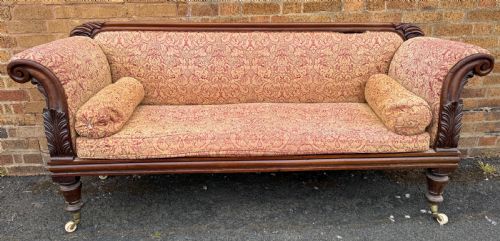

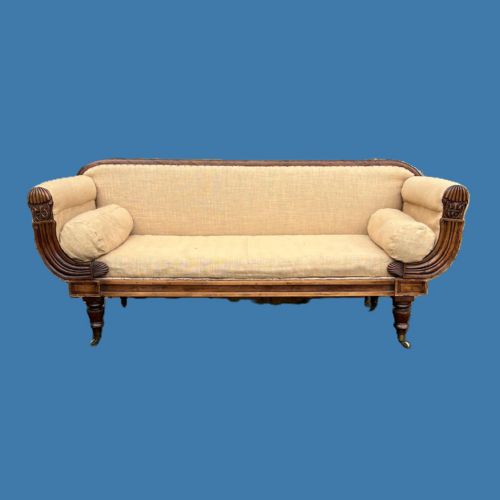

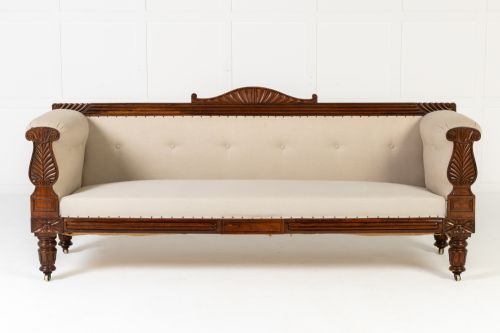


Carved Scroll Settee
A carved scroll settee brings stately neoclassical lines and generous roll-over ends to a drawing room, offering substantial seating with a strong architectural silhouette.
Carved Scroll Settee
A carved scroll settee is a substantial seating form designed for formal entertaining and leisurely reclining, most frequently encountered here in Regency and William IV guises. The listings on this page span the nineteenth century, ranging from crisp Regency pieces of 1800 to Victorian interpretations and revival styles such as Carolean and William and Mary.
These items primarily present as sofas and settees, though related day beds, chaise longues, and window seats also appear. They combine deep timber show frames with upholstered bodies, providing long, horizontal lines anchored by elaborate scrolling terminals.
Materials and Construction
The primary structural timber across these pieces is mahogany, accompanied by substantial use of rosewood, simulated rosewood, walnut, and occasional exotic woods like ebony and ebonised finishes. Frames are heavily carved, particularly around the scroll ends, back rails, and show frames, reflecting the craftsmanship of the nineteenth century.
Upholstery relies on traditional stuffing supported by Hessian and finished in varied fabrics, upholstery leather, or fabric ready for reupholstery. Brass accents and castors frequently complete the lower framework of these substantial items.
Several pieces are specifically noted as awaiting new upholstery, offering a blank canvas for modern textiles on ancient timber.
Distinguishing Quality
Quality in a carved scroll settee is defined by the crispness and depth of the timber carving, particularly on the scroll ends and show frames. The choice of timber grain, such as figured mahogany or rich rosewood veneers, dictates the visual weight and elegance of the piece.
Proportion and structural integrity separate standard examples from exceptional country house pieces. A well-balanced frame with harmonious scroll terminals and substantial timber substance commands greater presence than simpler, utilitarian alternatives.
The Carved Scroll Settee Glossary
- Scroll end
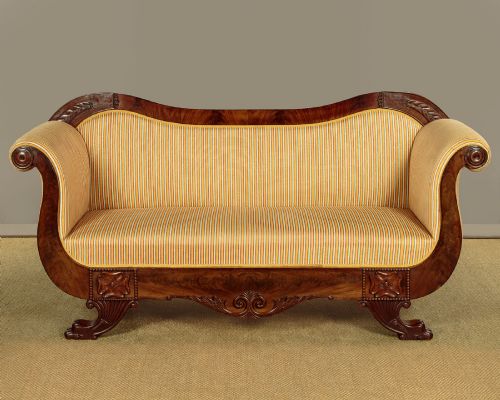
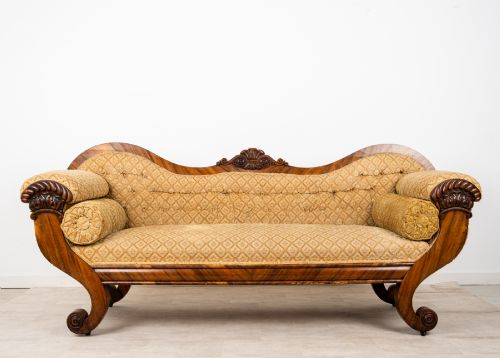
- A sweeping, volumetric terminal at one or both arms of a sofa, mimicking a classical scroll. This architectural feature defines the silhouette of the piece.
- Show frame
- The exposed wooden structural framework surrounding the upholstered elements of a settee. It displays the timber grain and carving.
- Double ended sofa
- A seating form with symmetrical scroll ends at both sides, allowing a person to recline comfortably facing either direction without a fixed head.
- Campaign sofa
- A portable form adapted for travel, often featuring clever construction details and durable materials. They reflect the mobility of the nineteenth-century elite.
- Bergere suite
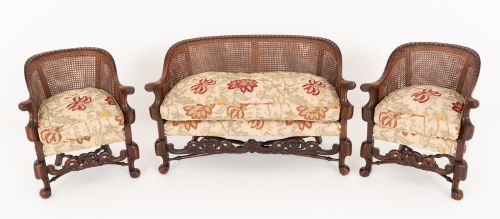
- A matching set of seating furniture incorporating cane or upholstered panels within an exposed wooden frame. These suites bring uniformity to large drawing rooms.
Carved Scroll Settee: Frequently Asked Questions
How do I style a carved scroll settee?
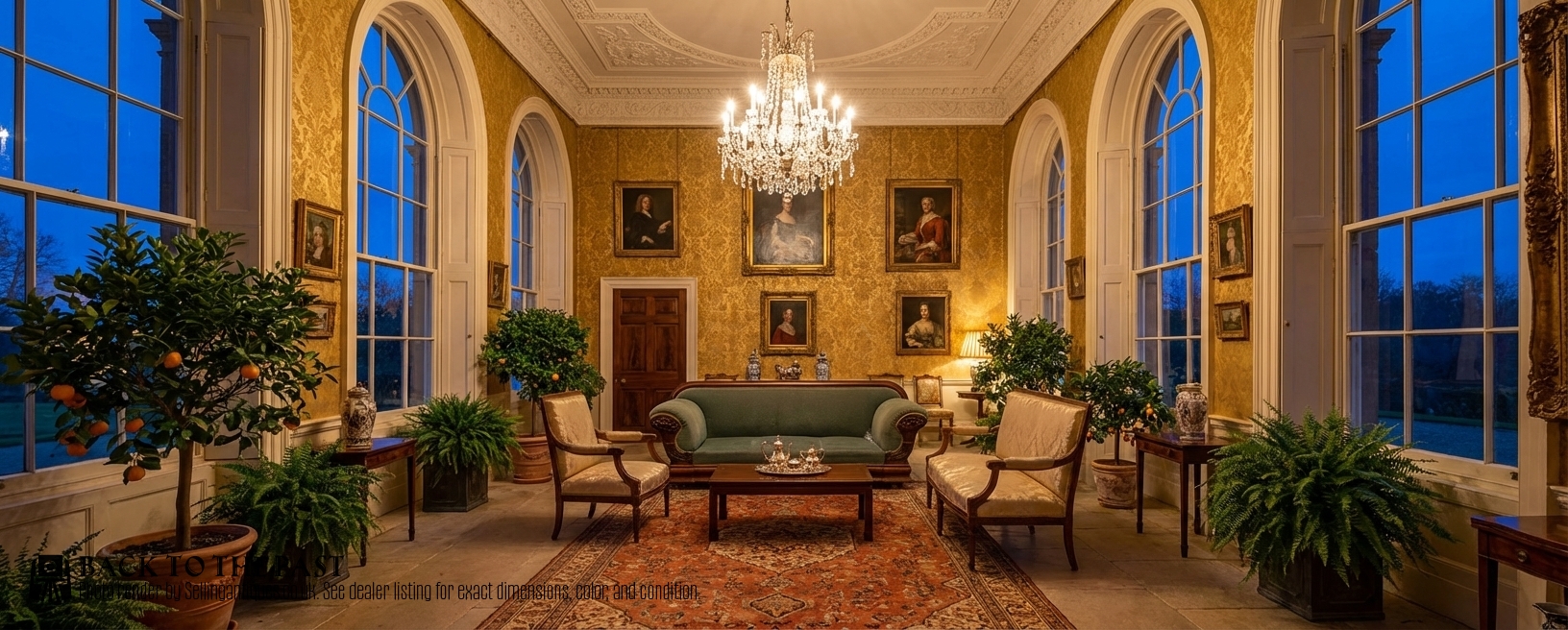
Position the settee away from the wall in a spacious drawing room or library where its sculptural silhouette and detailed show frame can be appreciated from all angles.
Pair it with restrained antique furniture so the grand proportions and prominent scroll ends remain the focal point of the interior scheme.
What is the difference between a Regency and a Victorian settee?
Regency settees, dating from the early nineteenth century, typically exhibit cleaner neoclassical lines, classical scrollwork, and rich rosewood or mahogany timbers.
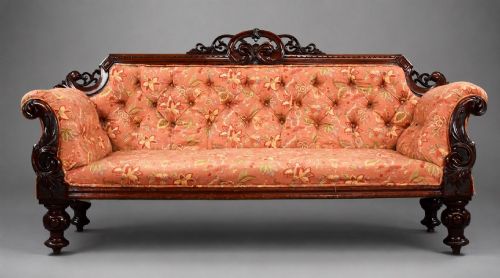
Victorian examples tend to be heavier in proportion, often featuring deeper button upholstery and more exuberant revival carving on the mahogany frames.
Were these settees used for sleeping?
Many examples, particularly double-ended sofas and day beds, were designed for daytime resting and lounging rather than overnight sleeping. Their generous length and supportive scroll arms accommodated reclining.
They served as elegant day furniture in grand country houses for reading and quiet contemplation.
How do I identify a William IV piece?
William IV items date from the 1830s and display robust, heavy proportions executed in dense mahogany or rosewood. They often feature bold scroll ends and substantial paw or scroll feet.
The carving is typically heavier and more architectural than earlier Regency work.