
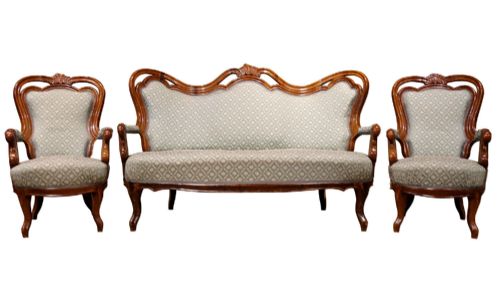


Green Fabric Settee
A green fabric settee brings timeless seating into a room, offering upholstered comfort shaped by centuries of craftsmanship.
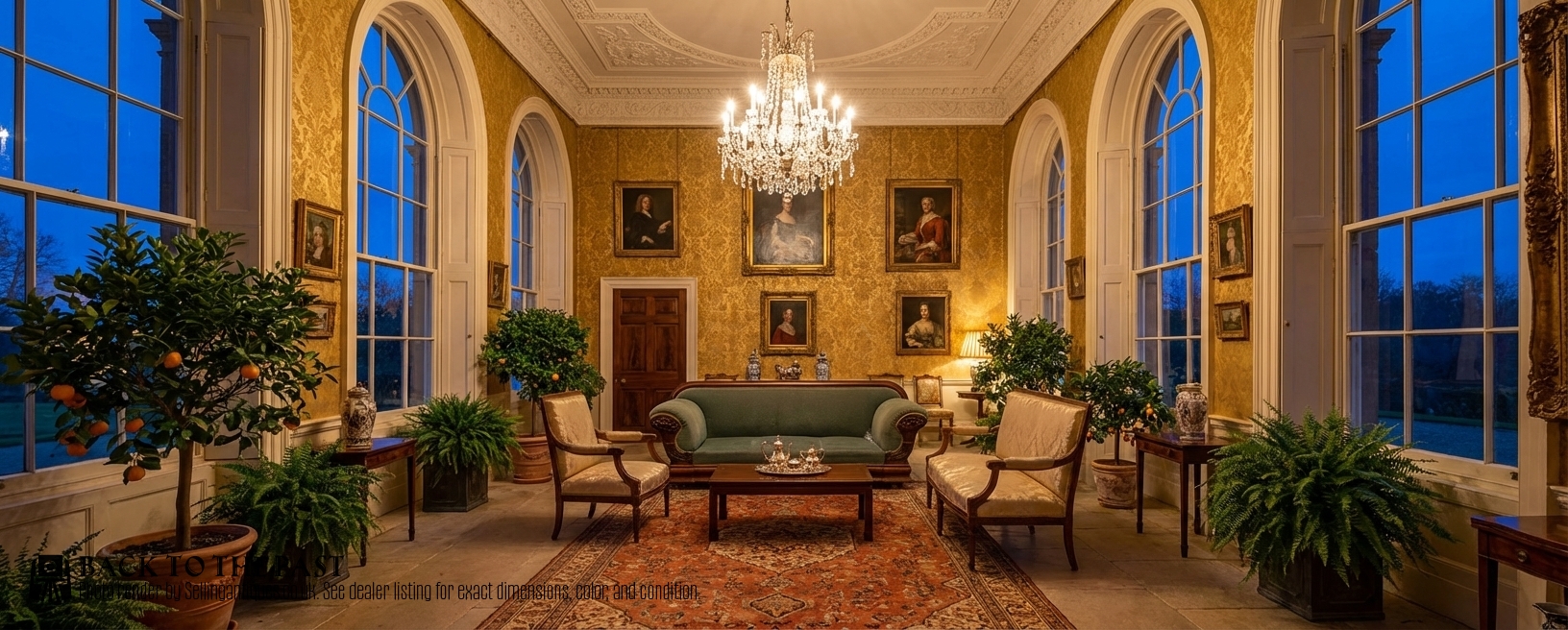
Green Fabric Settee
A green fabric settee is a cushioned seating piece appearing in styles from the nineteenth and twentieth centuries. These pieces encompass forms ranging from Edwardian and Victorian creations to Regency and Queen Anne interpretations, alongside continental salon suites and English country house designs.
The most common examples on this page are Edwardian and nineteenth-century two-seater and three-seater sofas upholstered in textile or tapestry fabric. They present diverse wooden frames including walnut and mahogany, often accompanied by matching armchairs or salon arrangements.
Materials and construction
Frames are built predominantly from timber, specifically walnut and mahogany, providing a sturdy structural skeleton for the upholstery. Wood and brass components frequently accent the primary frames of these seating pieces.
Upholstery relies on fabric, textile, and tapestry fabric materials applied over traditional sprung or stuffed foundations. Carved details ornament the wooden show-wood on specific nineteenth-century and continental iterations.
Some nineteenth-century makers hid handwritten signatures deep inside the horsehair stuffing, playing a secret game with future restorers.
Assessing quality
Quality rests in the precision of the timber frame construction and the integrity of the carved detailing. Pieces featuring refined walnut or mahogany frames with crisp carving stand apart from simpler timber builds.
The character of the upholstery fabrics and the retention of maker attribution also separate examples. Works bearing signatures from notable makers command higher regard than anonymous workshop pieces.
Howard and Sons·Colefax and Fowler
The Green Fabric Settee Glossary
- Settee
- A long upholstered seat with a back and arms, designed for multiple persons. This term is often used interchangeably with sofa in historical inventories.
- Salon suite
- A matched set of seating furniture comprising a settee and accompanying armchairs. These groupings were traditionally arranged in formal reception rooms.
- Show-wood
- Exposed wooden framing on an upholstered piece of furniture that displays the grain and carving. Walnut and mahogany are frequently utilised for this purpose.
- Tapestry fabric
- A heavy, decorative woven textile often featuring pictorial or repeating patterns. It provides a durable and ornate upholstery covering for traditional frames.
Green Fabric Settee: Frequently Asked Questions
What is a green fabric settee?
A green fabric settee is a period upholstered seating piece designed for two or more people. These pieces date from the nineteenth and early twentieth centuries.
They reflect historical design movements including the Edwardian, Victorian, and Regency eras. Each piece combines a timber frame with textile upholstery.
How do I date a settee?
Dating a settee involves examining the timber species, structural joinery, and stylistic vocabulary. Characteristic traits of Edwardian or nineteenth-century design point to specific decades.
Upholstery fabrics may be later replacements, so the underlying frame and secondary woods provide the most reliable chronological evidence.
Where should I place a settee?
A settee fits well in living rooms, studies, or large hallway spaces as a secondary seating option. Its compact proportions compared to a large modern sofa make it versatile for smaller rooms.
Positioning the piece away from direct sunlight helps protect the green fabric from fading over time.
How do I care for antique upholstery?
Care for antique upholstery requires gentle vacuuming using a low suction attachment to remove surface dust. Avoiding harsh chemical cleaners preserves the integrity of the original textile fibres.
Professional textile conservation is recommended for deep cleaning or repairing antique tapestry and fabric coverings.