
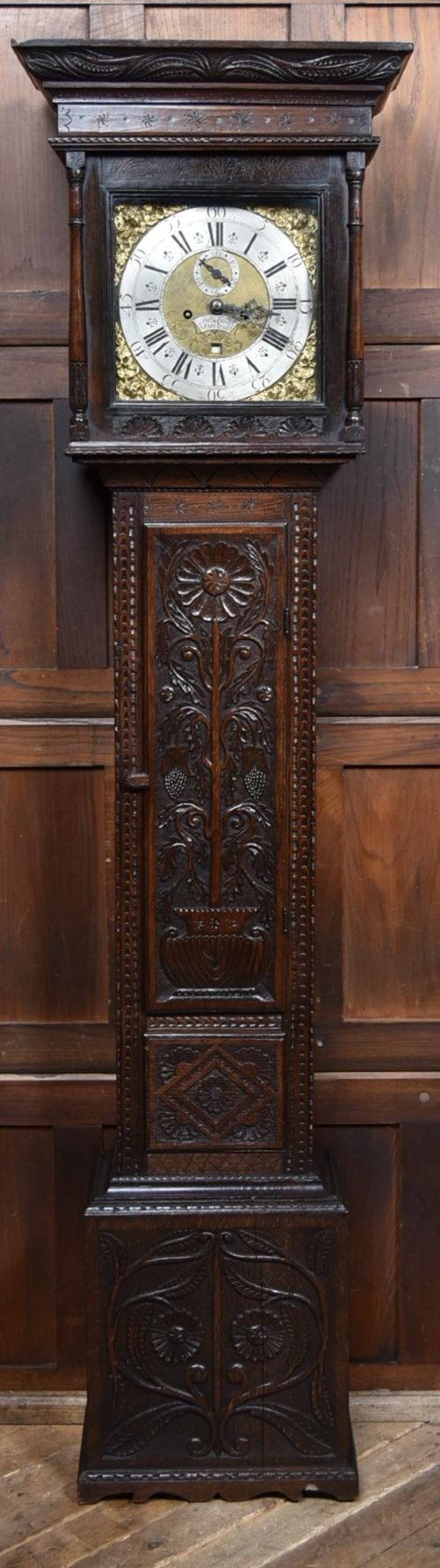
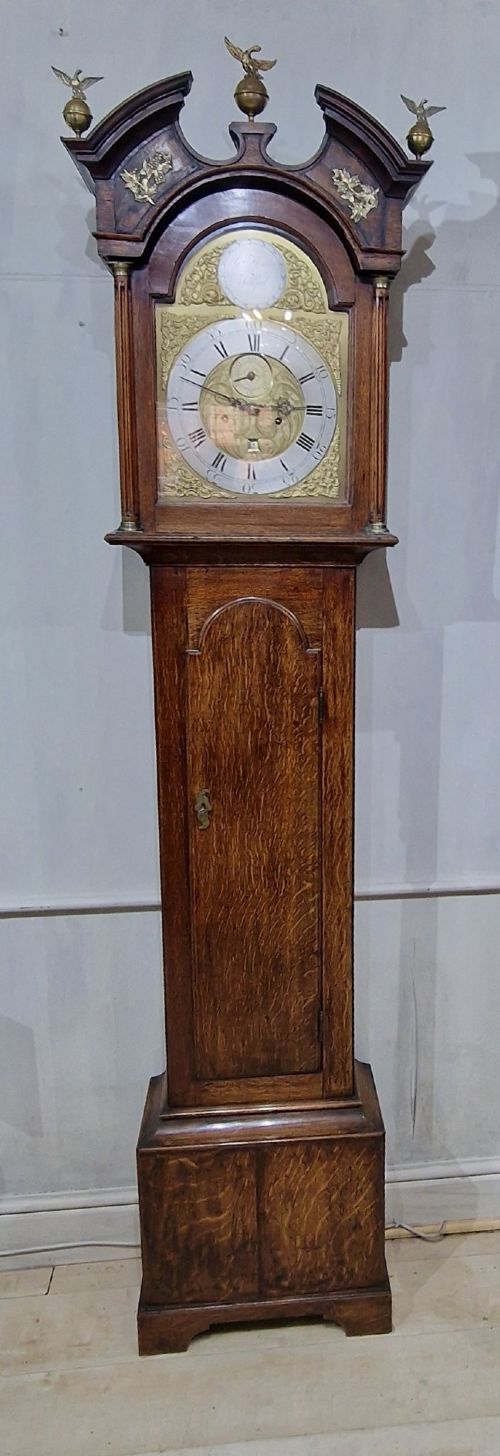
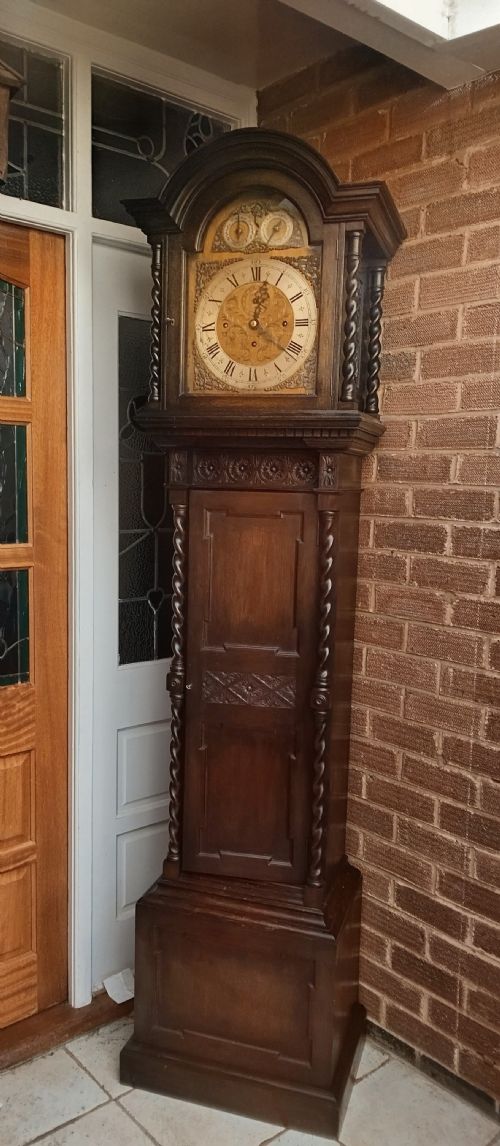
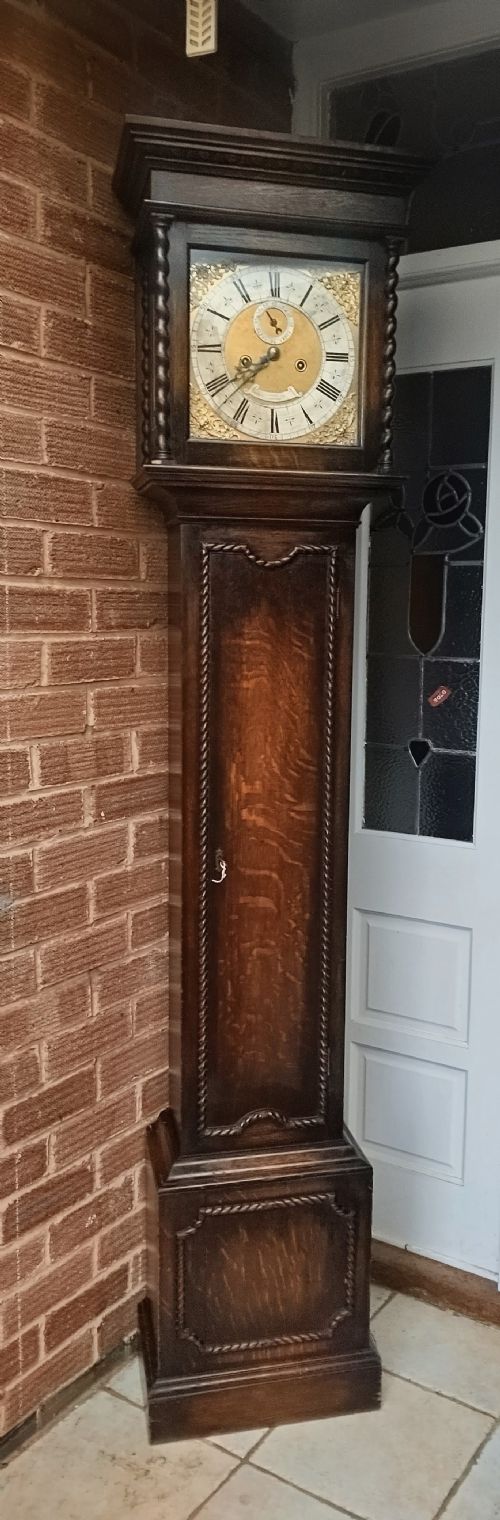


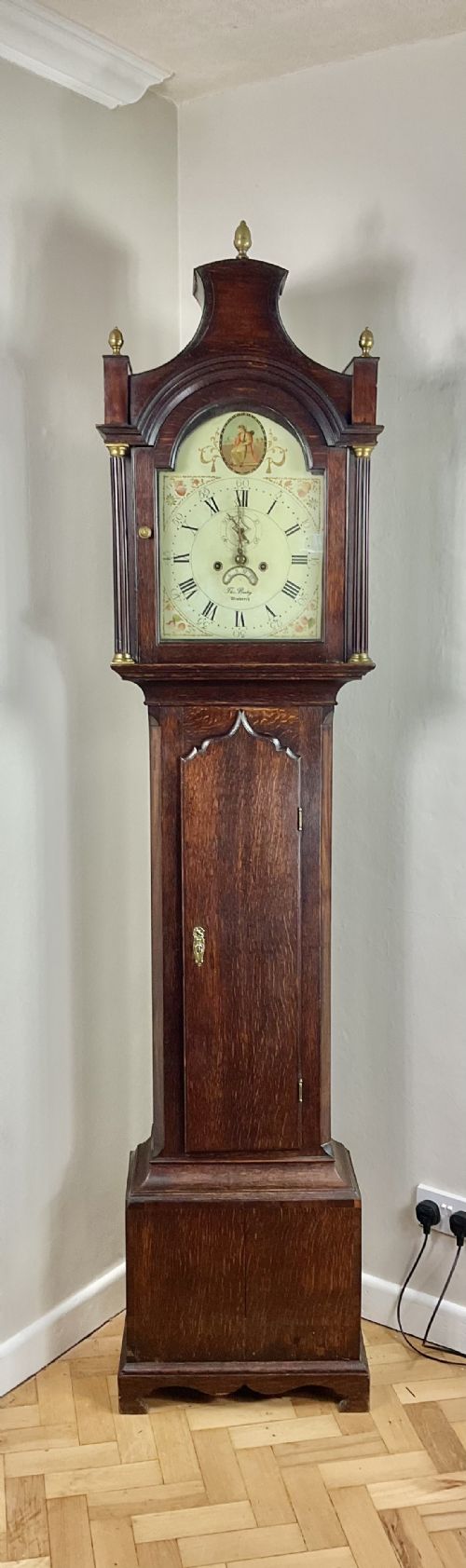


Carved Oak Tallcase Clock
A carved oak tallcase clock brings architectural presence and mechanical heritage into a room, anchoring the interior with the deep warmth of aged timber and steady movement.

Carved Oak Tallcase Clock
A carved oak tallcase clock combines a tall wooden housing with a weight-driven movement, serving as both a functional timekeeper and a dominant piece of furniture. These pieces appear across several distinct periods, stretching from the late seventeenth century through the Georgian era and into later Victorian and twentieth-century revivals.
The format encompasses various scales, ranging from grand floor-standing models down to smaller grandmother clocks designed for more modest spaces. Regional variations emerge clearly in the titles, with makers working in Scotland, Cheshire, Shropshire, and London.
Buyers seeking a carved oak tallcase clock encounter examples featuring traditional brass dials, moon phase mechanisms, and chequered inlaid decoration alongside heavily carved surfaces. The construction ranges from simple thirty-hour movements to complex eight-day chiming systems.
Markers of quality
Quality in these clocks rests upon the harmony of proportions, the crispness of the oak carving, and the sophistication of the internal movement. Superior examples display careful integration between the fitted case and the dialwork, whether featuring a moon phase display or musical chimes.
The reputation of the maker and the regional origin also influence distinction, as signed dials from known horologists demonstrate higher craftsmanship. Well-proportioned smaller formats often command attention for their restrained balance and skilful scaling.
Some tallcase clocks whisper the lunar cycle across the room through a painted moon phase dial, tracking the night sky in brass and wood.
Jn° Smith Macclesfd·James Hendrie Falkirk·Mappin and Webb London·William Noke Shropshire·Robert Darling Melrose
The Carved Oak Tallcase Clock Glossary
- Longcase clock
- A tall pendulum clock enclosed in a wooden case with a weighted movement. This term is frequently used interchangeably with grandfather clock.
- Moon phase
- A mechanical dial feature that tracks the lunar cycle through a rotating painted disc. It adds significant visual complexity to the clock face.
- Fusee
- A conical pulley used in clock movements to maintain even tension on the gear train as the drive spring unwinds. This mechanism improves timekeeping accuracy.
- Grandmother clock
- A smaller, scaled-down version of the traditional tallcase clock, typically standing lower to the ground. These pieces emerged in later periods while retaining traditional proportions.
Carved Oak Tallcase Clock: Frequently Asked Questions
How do I wind an eight day clock?
Winding requires using a key or pulling the cords to raise the heavy weights suspended inside the trunk. Care must be taken not to overwind the mechanism.
Consistent handling ensures the gear train operates smoothly and maintains accurate timekeeping over the weekly cycle.
Where should I place a tallcase clock?
These clocks require a stable, level floor against a solid interior wall to prevent vibration from disrupting the pendulum swing. Avoid placing them in areas subject to dampness or extreme temperature swings.
Adequate ceiling height is essential, as these floor-standing pieces often measure well over six feet tall.
What is the difference between thirty hour and eight day movements?
A thirty-hour movement requires winding daily or almost daily, utilising a simpler gear train and lighter weights. These are often found in earlier vernacular pieces.
An eight-day movement requires winding only once a week, employing a more complex arrangement of gears and heavier driving weights.
How can I identify the period of the clock?
Dating relies upon examining the dial style, the intricacy of the oak case carving, and the construction methods used inside the trunk. Georgian and seventeenth-century examples display different joinery and dial proportions compared to later Victorian revivals.
Signatures inscribed on the brass or painted dial often provide a direct link to the active working dates of the maker.