


Carved Oak Corner Chair
A carved oak corner chair brings architectural solidity and compact seating to a room, fitting neatly into angles that standard chairs miss.
Carved Oak Corner Chair
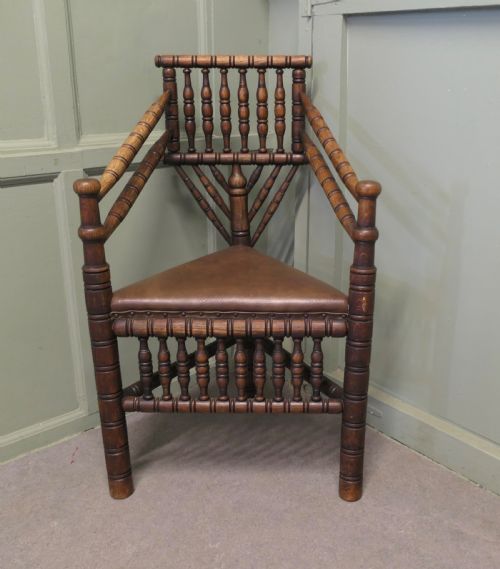
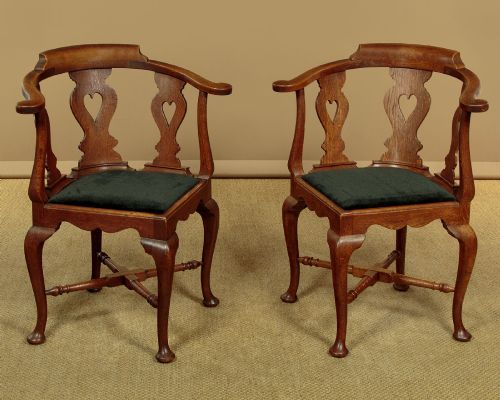
A carved oak corner chair is designed to sit snugly into the corner of a room, combining a horseshoe-shaped backrest with three or four supporting legs and a central seat. These pieces appear across several distinct eras, spanning eighteenth-century vernacular designs through to heavy Victorian Gothic revivals and later nineteenth-century interpretations.
The material palette focuses on English oak and dark oak, occasionally paired with leather, fabric upholstery, cane, or brass detailing. Forms vary from sturdy writing and desk chairs to decorative armchairs, accent seats, and turner's chairs influenced by older vernacular traditions.
Buyers will encounter eighteenth-century examples alongside numerous Victorian interpretations, including Gothic Revival pieces and Arts and Crafts models influenced by designers like Pugin. This mix provides a strong range of regional and historical variations within the same functional seating type.
Materials and construction
Solid timber forms the foundation of these pieces, utilising English oak and dark oak selected for density and strength. Joinery relies on traditional methods such as pegged mortise and tenon joints to withstand the stress placed upon angular frames.
Carving is executed directly into the timber, ranging from geometric strapwork and floral motifs to elaborate linenfold panels and deep relief carving associated with Victorian revival movements. Secondary materials like cane work, brass hardware, and upholstered pads in leather or floral fabric provide functional contrast to the rigid wooden structure.
Several examples carry the old Saxon or turner's chair moniker, proving that Victorians loved medieval cosplay just as much as we do.
Evaluating craftsmanship and integrity
Quality in a carved oak corner chair rests upon the crispness of the timber carving and the structural rigidity of the frame. Superior examples demonstrate deep, confident chisel work with clean lines, whereas lesser pieces exhibit shallow, mechanical stamping or excessive subsequent alterations.
The integrity of the original joints and the preservation of the timber surface determine the overall standard. Pieces retaining their original finish without heavy modern stripping or improper timber replacement stand at the upper end of the scale.
S&H Jewell
The Carved Oak Corner Chair Glossary
- Corner chair
- A seating form featuring a diagonal orientation designed to fit into room angles, typically possessing a horseshoe-shaped back rail supported by turned spindles.
- Turner's chair
- A heavy chair constructed primarily from turned wooden members and spindles, drawing on sixteenth- and seventeenth-century vernacular styles often revived in later periods.
- Gothic Revival
- An architectural and decorative style popular during the nineteenth century that reinterprets medieval motifs such as pointed arches, tracery, and heavy linenfold carving.
- Bergère
- An enclosed armchair with upholstered sides, occasionally adapted in lighter French provincial styles utilising caned panels alongside exposed oak framing.
- Arts and Crafts
- A design movement emphasising handcraftsmanship, simple construction methods, and vernacular traditions, frequently associated with oak furniture from the late nineteenth century.
Carved Oak Corner Chair: Frequently Asked Questions
What is a carved oak corner chair?
A carved oak corner chair is a specialised seating form featuring a diagonal orientation designed to fit neatly into room angles. It typically incorporates a curved backrest supported by turned spindles and robust wooden legs.
These pieces combine decorative carving with practical space-saving utility, making them suitable for studies, hallways, and parlours.
How were these chairs used historically?
Historically, these seats served various domestic functions, acting as writing chairs at small desks, casual accent seating in reception rooms, or specific forms like turner's and burgermeister's chairs.
Their angular design allowed occupants to sit comfortably in a corner while utilising minimal floor space in domestic interiors.
How do I distinguish eighteenth-century from Victorian examples?
Eighteenth-century examples generally display simpler, more restrained vernacular construction with lighter proportions and warmer timber patination developed through age. Victorian pieces often lean towards heavier proportions, deeper relief carving, and revivals of Gothic or old Saxon styles.
Examining the tool marks, joinery methods, and the density of the oak helps clarify the period of manufacture.
How do I live with a carved oak corner chair?
Living with a carved oak corner chair involves placing it in an underutilized room angle where its architectural form can be appreciated without blocking walkways. Maintaining stable indoor humidity prevents the solid oak timber from drying out or splitting.
Routine dusting and occasional application of appropriate furniture wax preserve the natural finish of the wood over time.