

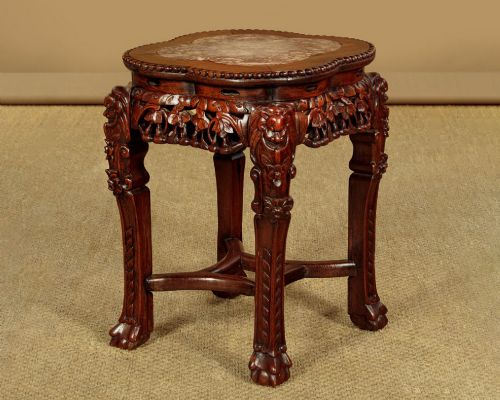




Carved Marble Top Stool
A carved marble top stool offers a solid stone inset paired with carved wood, bringing distinctive height and surface to a room.
Carved Marble Top Stool
When you search for a carved marble top stool, you are looking at nineteenth-century furniture designed to display plants, lamps, or decorative objects. The pieces appearing here span the Victorian era, the Meiji period, and the Qing Dynasty, originating from British workshops and Chinese export traditions.
Most examples function as plant stands, occasional tables, or low barrel-form stands rather than seats. You will frequently meet Chinese hardwood or ebonised hardwood frames inset with smooth marble or quartz surfaces.
The forms range from pedestals to pairs of plant stands and low occasional tables. These items combine structural woodwork with polished stone tops to create sturdy display surfaces.
Materials and construction
Makers utilised dense timbers such as hardwood, rosewood, hongmu, and rootwood to build sturdy frames capable of supporting heavy stone. Ebonised finishes and lacquer techniques occasionally appear alongside natural wood grains.
The stone elements consist of inset marble or deep quartz, shaped to fit precisely into the carved wooden tops. Mother-of-pearl details also supplement the decoration on specific pieces.
Carved Marble Top Stool Retail Price Guide 2026
Typical asking prices for carved marble top stool among the pieces listed under this phrase on Sellingantiques today, from the lower quarter to the upper quarter. They describe what is for sale here now, not the wider market.
The listings show nineteenth-century items combining hardwood frames with marble, quartz, and mother-of-pearl.
Judging the work
Quality rests upon the depth and precision of the carving across the hardwood frame. Deeply carved foliage and robust joinery distinguish finer stands from simpler production.
The integration of the stone top into the wooden structure marks another distinction. A well-fitted marble or quartz insert sits flush and secure within the surrounding timber.
The Carved Marble Top Stool Glossary
- Hongmu
- A dense tropical hardwood utilised in traditional Chinese furniture making. It provides a heavy, durable frame for stone insets.
- Rootwood
- Timber taken from the root mass of a tree, displaying gnarled and organic grain patterns. Makers selected these sections for their natural sculptural qualities.
- Ebonised
- Wood treated to resemble ebony through staining or painting. This finish creates a dark, uniform surface popular in nineteenth-century design.
- Meiji Period
- The era in Japanese history spanning from eighteen sixty-eight to nineteen twelve. Items from this time reflect distinct craftsmanship and international export influences.
Carved Marble Top Stool: Frequently Asked Questions
What were these stands used for?
These pieces served primarily as elevated surfaces for displaying large plants, urns, lamps, and decorative ornaments within nineteenth-century parlours and drawing rooms.
While some bear the name of stools or low tables, their sturdy construction and stone insets were chosen to support heavy decorative items safely off the floor.
How do I clean the marble top?
Clean the stone surface with a soft, damp cloth and mild soap, avoiding harsh chemical cleaners that can etch or dull the polished finish.
Dry the marble thoroughly afterwards to prevent water spots from settling into the natural stone.
Are these pieces stable enough for daily use?
The dense hardwoods and heavy stone tops make these stands remarkably solid and stable for holding lamps or decorative objects in everyday rooms.
Their robust nineteenth-century construction is designed to bear downward weight without wobbling.
How do I tell Victorian pieces from Chinese export ones?
Victorian pieces often employ ebonised woodwork and European furniture silhouettes, whereas Chinese export items utilise rosewood, hongmu, and traditional Asian carving motifs.
Both categories frequently overlap in nineteenth-century collections due to global trade during that period.