
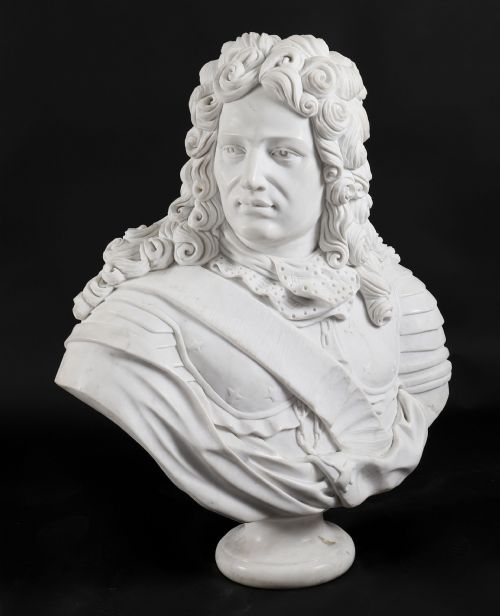
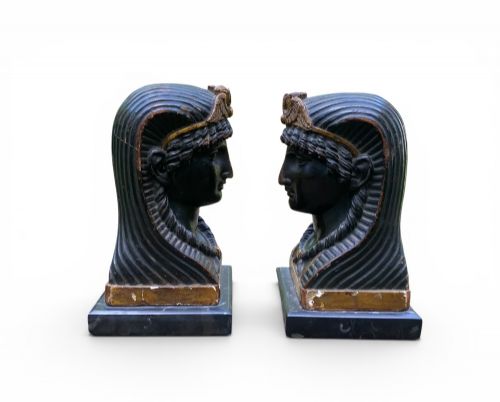


Carved Marble Style Bust
A carved marble style bust brings classical presence into a room, capturing historical likenesses through enduring stone and sculptural detail.
Carved Marble Style Bust
The selections available here draw on periods stretching from the eighteenth century through the nineteenth century, alongside later twentieth-century interpretations. You will frequently find pieces styled after earlier neoclassical, baroque revival, and Louis XVI traditions.
Beyond standalone portrait busts, the categories extend to carved profile plaques, wall plaques, and supportive pedestals or columns designed to display sculpture. Italian and English origins appear regularly among these works.
How they were made
The primary material across these objects is stone, specifically varieties such as Carrara marble, variegated green Victorian marble, and translucent alabaster. Artisans also utilised wood, gilt, iron, and mahogany for related architectural supports and complementary figures.
Carving techniques required skilled handwork to shape the contours of drapery, hair, and facial expressions from heavy blocks of mineral. Selected pieces incorporate cast bronze or ormolu mounts to accent stone columns and pedestals.
Listings span multiple centuries of stone carving, featuring materials from white Carrara marble and alabaster to variegated green Victorian stone.
What varies in quality
The choice of raw material also dictates distinction, ranging from uniform white Carrara marble to richly figured variegated green stone and finely grained alabaster. The integration of period-appropriate mounts, such as ormolu on pedestals, further elevates the work.
Thomas Hope·Mieczyslaw Leon Zawiejski
The Carved Marble Style Bust Glossary
- Alabaster
- A fine-grained, translucent stone often used for nineteenth-century sculpture and decorative objects. It takes a smooth polish and allows light to penetrate slightly beneath the surface.
- Carrara marble
- A type of white or blue-grey marble from the mountains of Tuscany, prized by sculptors for its purity and fine crystal structure. It served as the preferred medium for neoclassical portraiture.
- Neoclassical
- A style spanning the eighteenth and nineteenth centuries that revived the classical aesthetics of ancient Greece and Rome. Works in this manner emphasise restraint, proportion, and classical dress.
- Ormolu
- Gilt bronze applied as a decorative mount on furniture, pedestals, and clocks. The technique involves coating bronze with a finely ground gold-mercury amalgam and heating it.
- Relief sculpture
- A sculptural technique where figures project from a flat background surface rather than standing entirely free. Profile plaques often employ this method to portray historical or literary subjects.
Carved Marble Style Bust: Frequently Asked Questions
Where should I place a heavy stone bust?
Heavy marble and stone sculptures require stable, weight-bearing surfaces such as sturdy console tables, sideboards, or dedicated columns and pedestals.
Positioning them away from high-traffic walkways prevents accidental knocks while ensuring adequate natural light illuminates the carved details.
How do I clean an alabaster sculpture?
Alabaster is a softer and more water-sensitive material than marble, requiring gentle dusting with a dry, soft cloth rather than liquid cleaners.
Moisture can permanently stain or dissolve the surface, so professional conservation advice should be sought for deeper cleaning.
What is the difference between a bust and a relief plaque?
A bust is a three-dimensional sculpture portraying a person's head, shoulders, and upper chest, designed to be viewed from multiple angles.
A relief plaque depicts a similar subject carved flat against a solid backing, intended specifically for wall hanging.
How can I tell a nineteenth-century piece from a later copy?
Nineteenth-century carvings typically exhibit hand-tooled chisel marks, natural ageing patinas on the stone, and material composition consistent with historical quarries.
Later reproductions often display uniform machine finishing, modern adhesives, or artificial weathering that lacks the depth of genuine age.