
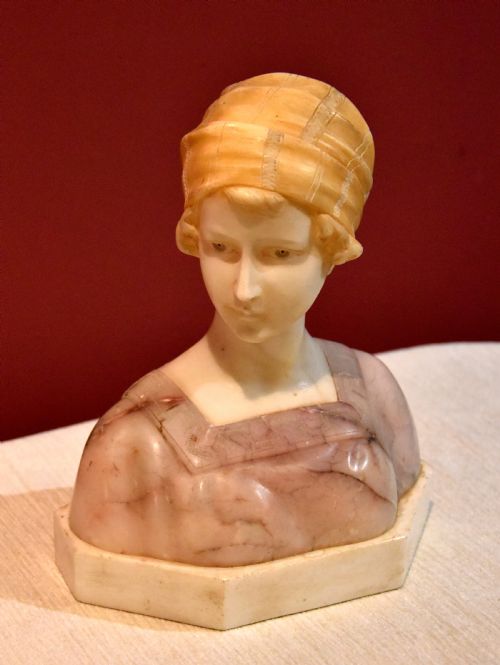
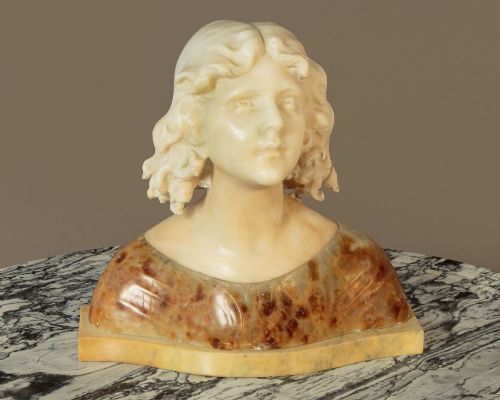


Art Nouveau Alabaster Statue
An art nouveau alabaster statue brings fluid lines and soft mineral warmth into a room, capturing the graceful curves of the turn of the century.
Art Nouveau Alabaster Statue
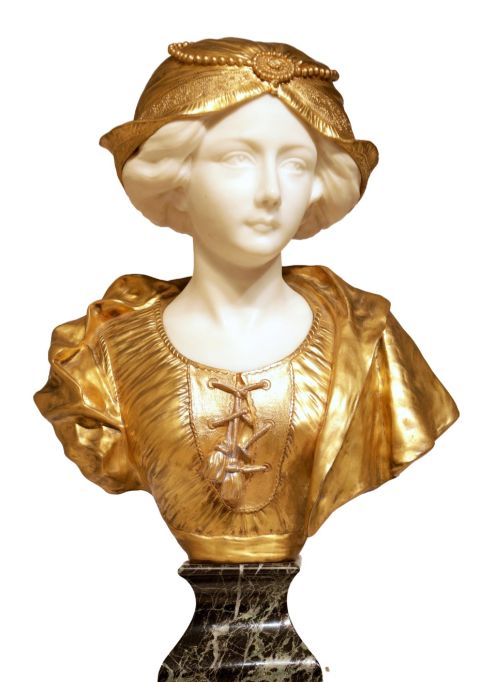
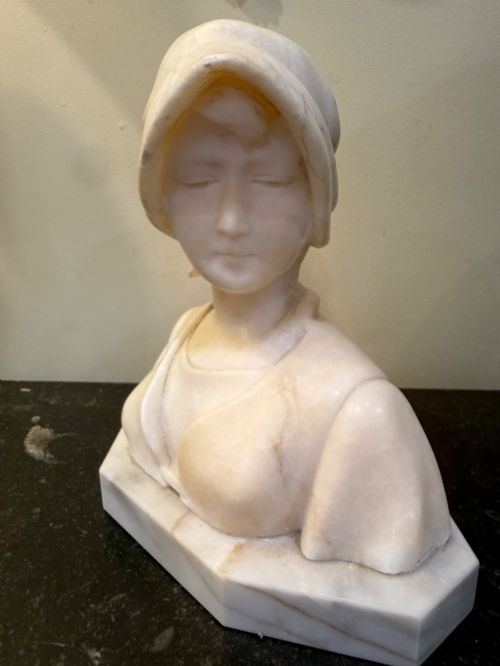
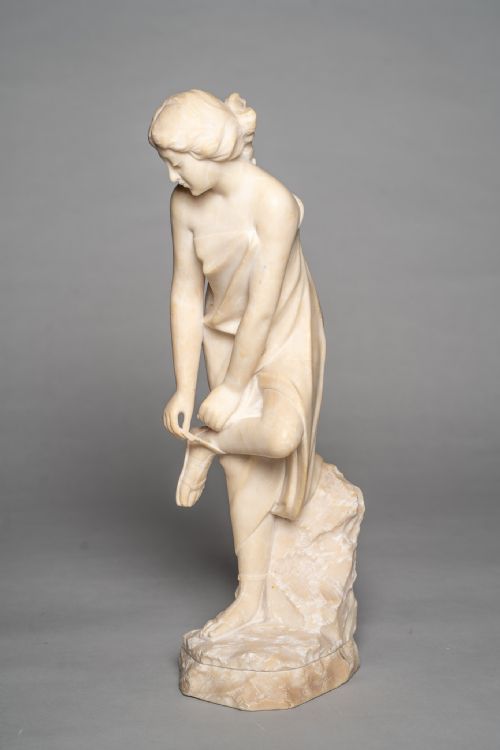
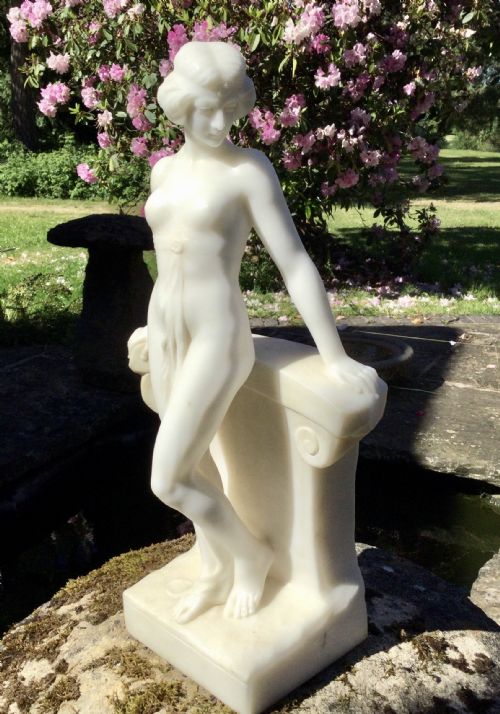
An art nouveau alabaster statue embodies the sinuous, organic forms and flowing drapery characteristic of the turn of the twentieth century. These sculptural pieces predominantly depict female figures, young women, and romantic pairs, often rendered as busts or full reclining and standing nudes.
The selection ranges from French and Italian workshops operating across the nineteenth century, the nineteen-hundreds, and the nineteen-tens. You will frequently encounter carved busts and figures that combine the soft stone with contrasting metals.
How they were made
Carvers shaped these sculptures from alabaster and white marble, exploiting the translucent quality of the stone to mimic human skin. Artisans frequently combined these mineral materials with cast bronze, gilt bronze, spelter, and ormolu to provide structural contrast and rich surface detail.
Makers utilised manual carving techniques alongside metal casting to produce multi-media compositions. Sculptors often integrated two-tone colouration and detailed patination to accentuate the drapery and hair of the female subjects.
Listed items span the nineteenth century, nineteen-hundreds, nineteen-tens, and nineteen-twenties across French and Italian aesthetics.
What varies in quality
The finesse of the carving dictates the distinction between standard and superior examples, particularly in the rendering of facial expressions, hands, and flowing hair. Master carvers achieved remarkable subtlety in the translucency of the stone and the delicate fall of fabric.
The incorporation of secondary materials such as gilt bronze, ormolu, and contrasting marble bases alters the visual weight and complexity of a piece. Signed works by recognised sculptors carry distinct artistry in their proportions and compositional balance.
Affortunato Gory·A.Gamay·Auguste Henri Carli·Fritz Kochendorfer·George Van Der Straeten·Pugi·G.V. Vaerenbergh·Gugielmo Pugi·R.LUSILI·A.Cipriani
The Art Nouveau Alabaster Statue Glossary
- Alabaster
- A fine-grained, translucent stone favoured by sculptors for its soft appearance and suitability for detailed carving. It absorbs light slightly beneath the surface.
- Spelter
- A zinc alloy commonly utilised as a substitute for bronze in decorative figures, often treated with a bronze finish. It allowed workshops to produce affordable metal components.
- Orpiment
- A historic mineral pigment sometimes associated with colouration, though the listings here rely principally on natural stone tones and applied patinas.
- Belle Epoque
- A period of French cultural and artistic confidence spanning the late nineteenth century up to the First World War. It heavily influenced the decorative arts and sculptural themes seen here.
- Ormolu
- Gilded bronze ornamentation applied to mount or complement stone sculptures. This technique adds metallic brilliance against the matte finish of carved alabaster.
Art Nouveau Alabaster Statue: Frequently Asked Questions
Where should I place an alabaster statue?
Position your sculpture away from direct sunlight and damp conditions to protect the delicate surface of the stone.
Place the piece on a sturdy pedestal or a heavy sideboard where the subtle translucency of the material can catch ambient indoor light.
What periods do these sculptures date from?
The available pieces span from the late nineteenth century through the early twentieth century, including the nineteen-hundreds and nineteen-tens.
This era encompasses the height of the art nouveau movement and the belle epoque in France and Italy.
How can I tell who made a piece?
Inspect the base, reverse, or lower edges of the stone and metal components for incised signatures or foundry stamps.
Many prominent sculptors signed their work directly into the alabaster or cast their names into the bronze elements.