
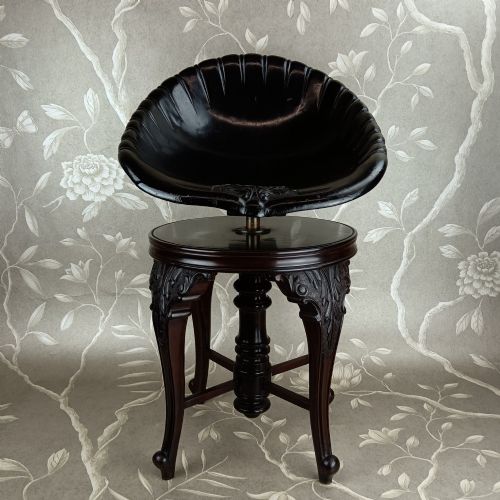
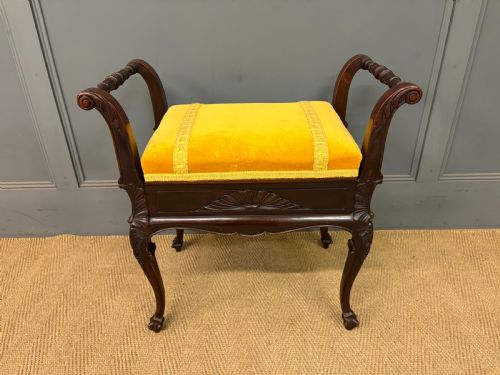
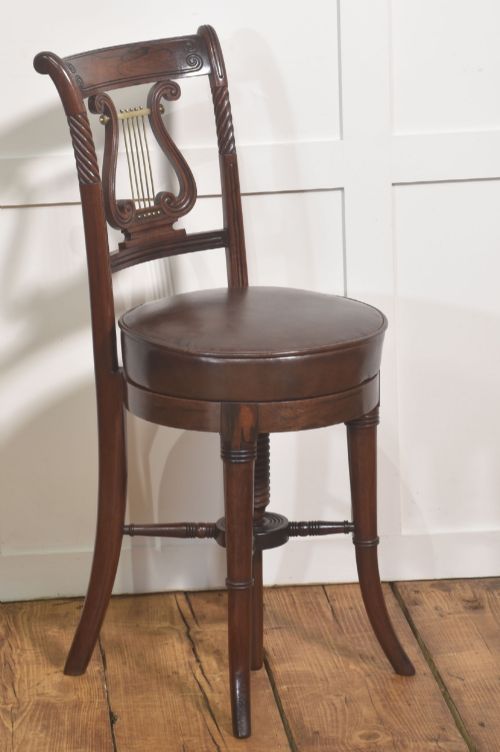


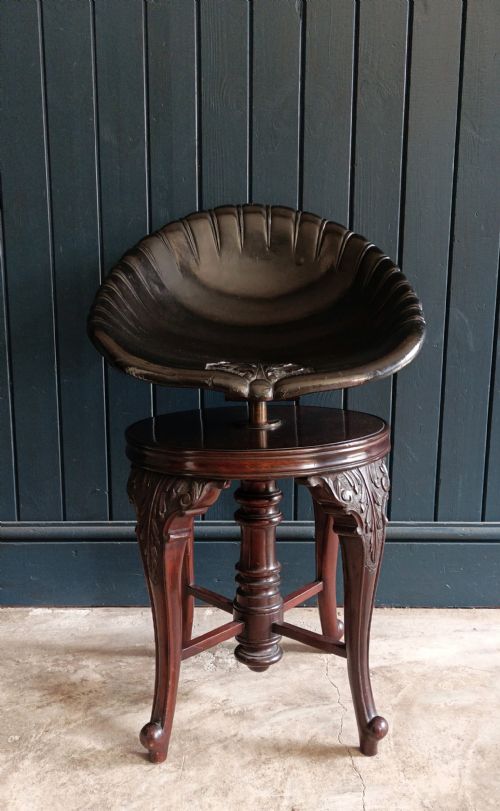


Carved Mahogany Music Stool
A carved mahogany music stool brings period character to a room, offering practical seating alongside adjustable height or clever storage.
Carved Mahogany Music Stool
A carved mahogany music stool combines timber construction with specific seating forms designed for keyboard players and musicians. The evidence reveals pieces spanning the Regency, William IV, Victorian, and Edwardian periods.
Most examples function as revolving piano stools or piano duet stools with hinged seats. Other forms include dressing table chairs and harpist music stools.
Makers such as Jennens & Bettridge and Jas Shoolbred appear alongside unbranded nineteenth-century workshop pieces. The timber frames often incorporate brass or papier-mâché alongside upholstery in fabric, velvet, and leather.
Materials and construction
Construction relies primarily on solid mahogany shaped by cabinetmakers through turning, joining, and carving. Brass mechanisms provide adjustable heights and revolving seats on many nineteenth-century examples.
Upholstery materials range from simple fabric and leather to rich velvet. Papier-mâché components also supplement the timber framework on specific Victorian designs.
Specific harpist music stools required musicians to perch at peculiar angles, proving that historical seating arrangements were rarely straightforward.
Distinguishing quality
Quality reveals itself in the crispness of the timber carving and the smoothness of the mechanical adjustment. Superior examples demonstrate careful jointing and refined proportions that elevate them above standard utility seating.
The integration of secondary materials such as brass inlay or papier-mâché indicates ambitious workshops. Surviving upholstery choices and secondary woods further distinguish regional workshop output from major firm production.
Jennens & Bettridge·Jas Shoolbred
The Carved Mahogany Music Stool Glossary
- Mahogany
- A dense tropical hardwood prized for its deep reddish-brown colour and stable grain. It forms the primary structure for the majority of these seating pieces.
- Revolving piano stool
- A seat featuring a threaded spindle mechanism allowing the sitter to alter their height by spinning the top. This design dominates nineteenth-century keyboard seating.
- Duet stool
- An extended bench designed to accommodate two players simultaneously at a piano. These often incorporate hinged seats concealing internal music storage compartments.
- Papier-mâché
- A composite material made from paper pulp or layers of paper bound with glue, then pressed and lacquered. It appears combined with timber on specific Victorian pieces.
Carved Mahogany Music Stool: Frequently Asked Questions
How do adjustable music stools work?
Adjustable music stools typically rely on a central wooden or metal screw mechanism hidden beneath the upholstery. Turning the seat clockwise or anticlockwise raises or lowers the height for the player.
Buyers should test the movement gently to ensure the screw threads engage smoothly without excessive wobble.
What is the difference between solo and duet stools?
Solo music stools provide a compact square or round seat intended for one musician at the keyboard. Duet stools are significantly wider rectangular benches built to seat two people.
Many duet versions feature hinged tops that lift to reveal compartments for sheet music.
Can I use a music stool as a dressing chair?
Yes, many nineteenth-century music stools function comfortably at modern dressing tables due to their compact footprints and adjustable heights. The pivoting or fixed upholstered seats suit daily vanity use.
Their decorative carved frames also allow them to sit easily as occasional chairs in bedrooms or hallways.
How do I date a mahogany music stool?
Dating relies on examining the turning styles, joinery techniques, and secondary materials present in the frame. Regency and William IV pieces show bolder classical carvings and brass inlay, while Edwardian examples display lighter proportions.
Makers' stamps or patent markings underneath the seat provide definitive evidence of origin and date.