


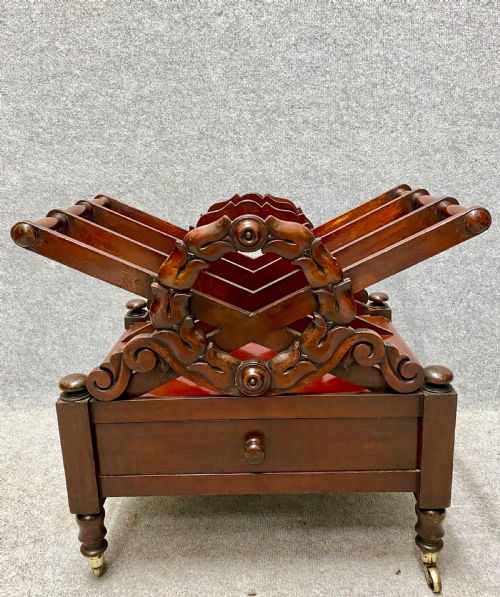


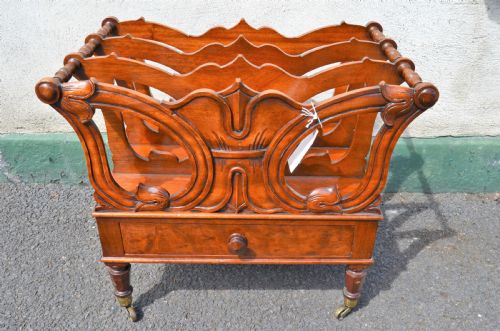


Carved Mahogany Canterbury
These carved mahogany canterbury pieces offer partitioned storage for sheet music and periodicals, bringing robust timber construction and crisp carved detail to any interior.
Carved Mahogany Canterbury
A carved mahogany canterbury functions as a dedicated stand for magazines, newspapers, and music scores, featuring multiple vertical divisions to keep papers upright and sorted. The pieces listed on this page span the 18th century, Regency period, George IV style, William IV era, and the Victorian epoch, offering various interpretations of this domestic furniture form.
The dominant material across these listings is mahogany, with specific variants such as Cuban mahogany appearing alongside standard stock. Craftsmanship aligns with distinct historical periods, moving from Regency elegance through William IV mass to Victorian execution.

Materials and Construction
Makers utilised solid mahogany and Cuban mahogany to build these frames, selecting dense tropical hardwoods known for their deep grain and durability. Timber was planed, joined, and shaped to form the upright slats and structural chassis of each magazine rack.
Carving defines the decoration, as seen in wreath-carved details and period-specific mouldings applied to the frame. Metal components such as brass castors are integrated into the base designs to allow smooth movement across floor surfaces.
Carved Mahogany Canterbury Retail Price Guide 2026
Typical asking prices for carved mahogany canterbury among the pieces listed under this phrase on Sellingantiques today, from the lower quarter to the upper quarter. They describe what is for sale here now, not the wider market.
Early musicians trusted these stands to keep their scores from blowing away while practising near an open Victorian draft.
Distinctions in Quality
Quality rests upon the crispness of the timber carving and the selection of the wood itself, particularly where figured Cuban mahogany is employed. Pieces featuring refined turnings, integrated drawers, and substantial structural framing sit at the higher end of the range.
Proportion and execution distinguish standard production from finer examples. The integration of solid brass hardware and well-balanced division frames separates superior cabinetwork from simpler utility stands.

The Carved Mahogany Canterbury Glossary
- Canterbury
- A low stand with partitions, originally designed for holding sheet music and later utilised for newspapers and magazines.
- Cuban Mahogany
- A dense, heavily figured hardwood species imported from the Caribbean, prized for deep colour and cabinetmaking suitability.
- X Frame
- A structural design utilising intersecting diagonal timber members to form the sides or partitions of a piece of furniture.
- Castor
- A small swiveling wheel attached to the base of furniture legs to facilitate easy movement across floors.
- Regency
- An English design period spanning the early 19th century, characterised by classical restraint and refined decorative motifs.
Carved Mahogany Canterbury: Frequently Asked Questions
What is a canterbury used for?
A canterbury serves as a partitioned stand designed to hold sheet music, periodicals, and newspapers in an upright position.
Historically placed beside pianos or seating areas, these stands keep reading materials organised and accessible within a room.
How do I identify a Regency canterbury?
Regency pieces typically display classical proportions, restrained carving, and elements inspired by ancient Greek and Roman design.
They often date from the early 19th century and utilise dark mahogany timbers with delicate turning.
What wood is used in these canterburys?
The pieces on this page are constructed from mahogany, including dense and heavily figured Cuban mahogany.
This hardwood provides structural strength and a deep reddish-brown grain that takes a polished finish.
Are all canterburys fitted with castors?
Many examples incorporate small brass wheels, known as castors, fitted to the base of the legs.
This hardware allows the stand to be repositioned easily across carpets or wooden floorboards.