


Carved Islamic Side Table
A carved islamic side table brings geometric intricacy and rich material contrast into a room.
Carved Islamic Side Table
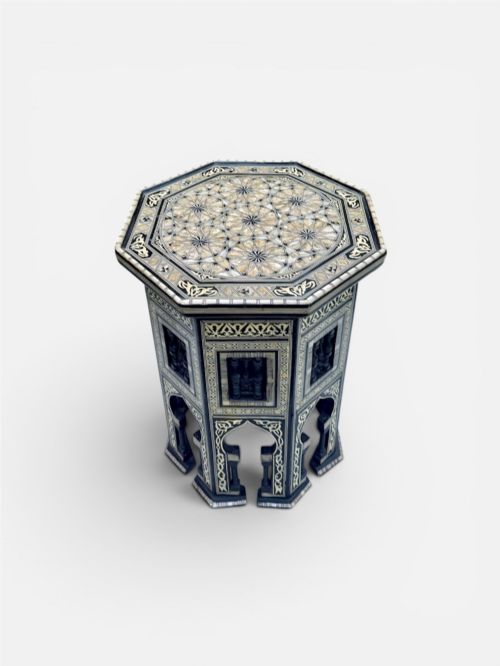
When you search for a carved islamic side table, you encounter low occasional furniture built with octagonal or hexagonal forms, heavily patterned surfaces, and distinct regional influences. These works date primarily from the nineteenth century, extending into the early decades of the twentieth century under various revival movements.
The specimens most frequently met on this page take the form of side tables, lamp tables, and occasional tables. They draw upon Moorish, Ottoman, Mamluk, and Syrian design traditions, serving as compact statement pieces for living spaces.
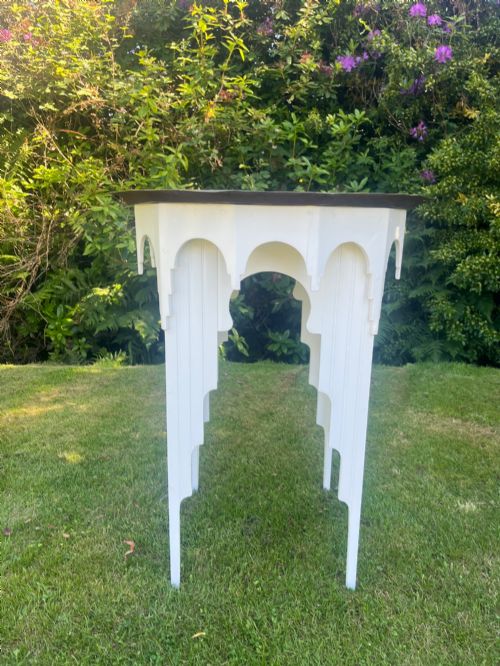
Makers working within these styles utilise specific geometries, often creating multi-sided tops that stand upon folding or rigid bases. The resulting objects function practically as coffee or lamp tables while displaying dense surface carving and inlay.
How they were made
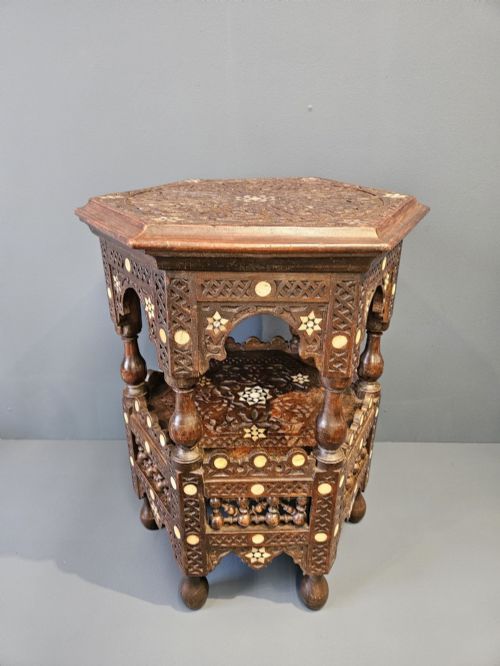
The construction of these items relies on dense hardwoods and walnut, frequently finished with hand carving across every visible surface. Artisans shape the wood into geometric lattice panels and multi-sided tabletops designed to catch the light.
Surface ornamentation is achieved through the meticulous insertion of mother-of-pearl and bone into carved recesses. Metal elements and painted finishes also appear, creating textural contrast against the dark timber.
Tables that fold flat transport easily, proving that nineteenth-century makers anticipated modern apartment moves.
What varies in quality
Quality rests upon the precision of the geometric woodwork and the complexity of the inlay work. Pieces that integrate extensive mother-of-pearl or bone panels with tight, accurate joinery demonstrate a higher level of workshop execution.
The depth and crispness of the hand carving dictate the visual impact of the item. Shallower, less defined patterns indicate simpler production, whereas deep, sharply articulated carving reflects greater artisan skill.
Liberty & Co
The Carved Islamic Side Table Glossary
- Octagonal
- Having eight sides. This geometric layout forms the primary shape for many tabletops in this category.
- Inlay
- A technique where contrasting materials are embedded into a recessed wooden base. Mother-of-pearl and bone are typical materials used to create geometric patterns.
- Moorish Revival
- An architectural and decorative style popular in the nineteenth century. It borrows design elements from medieval Islamic Spain and North Africa.
- Mamluk Revival
- A design movement referencing the art and architecture of the Mamluk Sultanate. Metalwork and complex geometric surface patterns frequently characterise these items.
Carved Islamic Side Table: Frequently Asked Questions
What periods do these tables span?
The pieces listed originate predominantly from the nineteenth century, with examples extending into the nineteen-twenties and nineteen-thirties.
Design influences span Victorian revivals and specific regional traditions such as Ottoman and Syrian styles.
How were these tables used?
These items function as occasional, lamp, and centre tables within domestic interiors. Their compact footprints allow them to sit easily beside seating.
The multi-sided tops and decorative surfaces were intended to display objects or provide a distinct focal point in a room.
What materials make up the surface?
Surfaces combine hardwood, walnut, and painted wood with contrasting organic elements. Artisans inset mother-of-pearl and bone into the timber.
Metal components also feature in specific revival pieces, adding further tonal variation to the design.
How do I distinguish regional styles?
Distinctions rest on the specific combination of geometric carving and inlay motifs. Moorish and Ottoman examples often feature dense star patterns and intricate lattice work.
Mamluk Revival items lean towards brass and intricate metal detailing, while Syrian and North African pieces emphasise wood carving paired with shell inlay.