
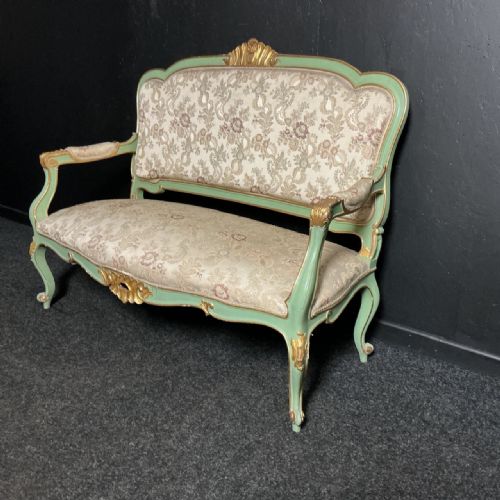
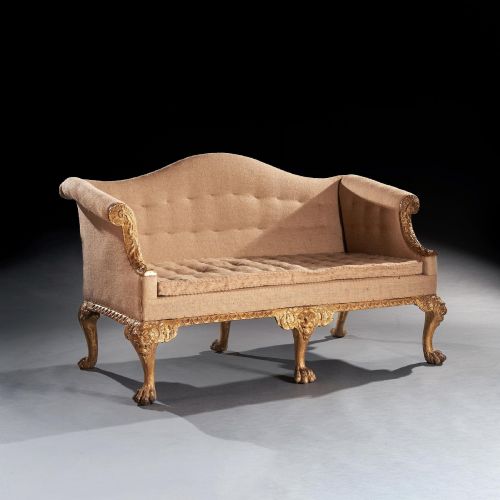
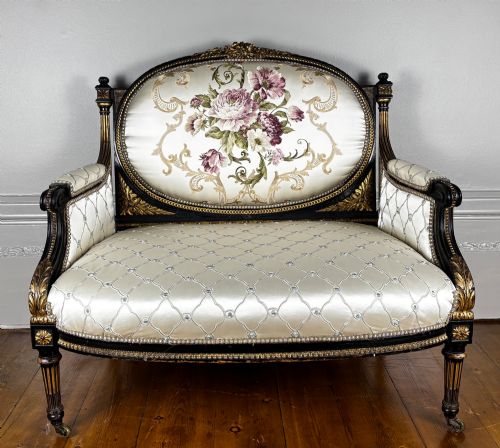


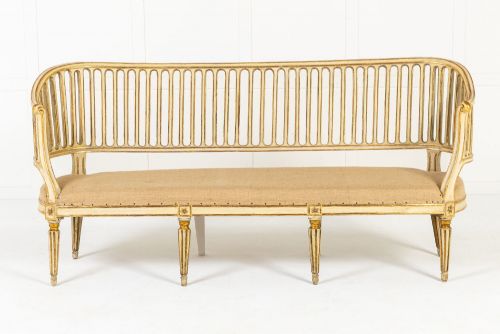


Carved Gilt Bench Sofa
These carved gilt bench sofa examples bring gilded elegance and classical form into a room.
Carved Gilt Bench Sofa
When you search for a carved gilt bench sofa, you look at elaborate seating designed for formal rooms, drawing rooms and grand salons. The pieces available here span from the eighteenth century through to the twentieth century, with nineteenth century items appearing most frequently.
The forms range from French canapés and boudoir settees to English country house settees and Italian neoclassical seating. You will encounter styles such as Louis XV, Louis XVI, Regency and George II, often featuring painted or gilded woodwork.
Makers drew on classical vocabulary to shape these seats, utilising cane, fabric and wood beneath layers of gold leaf, paint and parcel gilt. They function as striking focal points in a hallway, bedroom or principal reception room.
What varies in quality
The depth and crispness of the wood carving distinguish finer examples from simpler production, particularly where leaf or claw feet and ornate scrollwork appear. Superior pieces display hand-chiselled detailing in the giltwood rather than flat or cast ornament.
Proportion and scale dictate the visual success of the piece, with well-balanced arm heights and elegant leg forms commanding greater presence. The original integrity of the gilding and the quality of the underlying timber frame also determine the standing of each sofa.
Giles Grendey
The Carved Gilt Bench Sofa Glossary
- Canapé
- A decorative French upholstered sofa or settee with an exposed wooden frame. These typically feature open arms and carved rails characteristic of Parisian seating design.
- Giltwood
- Timber that has been coated with a thin layer of gold leaf or gold paint. This technique creates a luminous, reflective surface popular in formal European furniture.
- Parcel Gilt
- A decorative treatment where only specific carved details, highlights or motifs are gilded while the rest of the surface is painted or polished. It creates contrast against a dark ebonised or painted ground.
- Neoclassical
- A style of design inspired by classical antiquity that emerged in the eighteenth century. It prioritises symmetry, straight lines and restrained architectural ornamentation.
- Bergère
- An enclosed upholstered armchair or sofa featuring padded sides and a wooden frame. The back and sides are frequently caned or fully upholstered.
Carved Gilt Bench Sofa: Frequently Asked Questions
Where did people put a carved gilt bench sofa?
These seats belonged in formal drawing rooms, grand salons and private boudoirs where hosts received guests.
Today they serve equally well in large hallways, elegant bedrooms or principal reception spaces as statement seating.
How do I tell Louis XV and Louis XVI styles apart?
Louis XV pieces rely on asymmetrical curves, cabriole legs and organic rococo motifs such as scrolling leaves.
Louis XVI furniture shifts towards geometric symmetry, straight fluted legs and neoclassical details like ribbons and urns.
Can I use a antique settee for everyday sitting?
Most antique settees tolerate gentle daily use provided the internal frame and upholstery webbing remain sound.
Delicate carved frames and antique silk fabrics require more careful treatment than modern furniture.
What is the difference between a settee and a sofa?
The terms often overlap, though historically a settee denoted a narrower upholstered wooden bench seat.
Sofas traditionally offered larger, fully upholstered proportions designed to seat three or more people comfortably.