


Vintage Gilded Settee
These vintage gilded settees bring French and English neoclassical flair into a room, offering grand seating shaped by centuries of revival design.
Vintage Gilded Settee
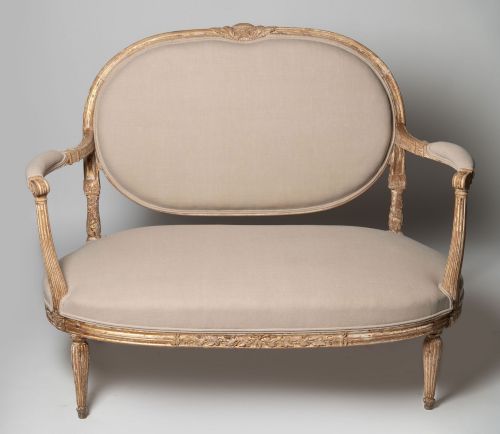
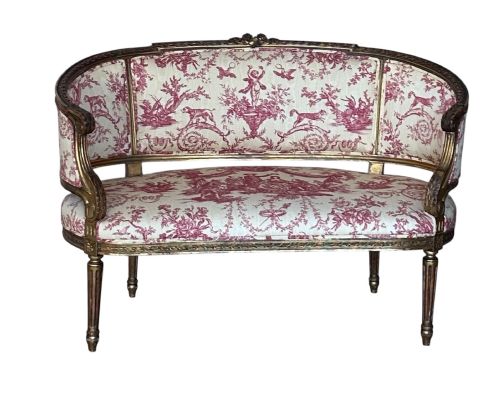
When you search for a vintage gilded settee, you are looking at ornate two-seat sofas and couches originating mostly from the nineteenth century. The pieces on this page span the 19th Century, 1880, and 1910, reflecting various revival movements.
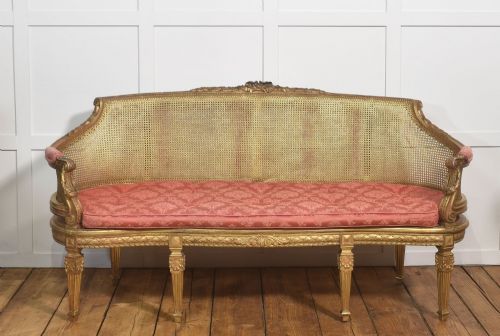
You are most likely to meet French Louis XV style, Louis XVI style, and Rococo Revival forms here. These seating options include both carved wooden frames and caned varieties finished in gold paint, giltwood, or dual paint and gilt decoration.
The assortment ranges from small painted canework couches to large French sofas and canapés. English examples also appear, usually manifesting as early nineteenth-century giltwood settees built for formal drawing rooms.
Materials and construction
Makers built these frames using solid woods like beech, shaping them into elaborate curves and straight neoclassical lines. Giltwood, gold paint, and simple paint finishes coat the structural timber, often combined with natural cane panels for seat bases and backs.
Upholstery materials recorded in the listings include linen, cotton, and assorted decorative fabrics. Carvers utilised traditional hand techniques to render floral motifs, ribbons, and fluted columns directly into the wooden frames before applying the surface gilding.
Listings feature beech frames combined with natural cane, linen, and cotton upholstery.
Judging quality in a gilded settee
The distinction between ordinary and superior pieces rests entirely upon the crispness of the wood carving and the depth of the gilding. Hand-carved giltwood frames display sharp, deep relief work, whereas lower-tier examples rely on simpler cast composition ornaments or plain painted surfaces.
Structural integrity of the beech frame and the tightness of the canework dictate the grade of the piece. Superior settees maintain rigid joinery and evenly tensioned cane, while lesser items show slack weaving and heavy restoration to the structural legs and arms.
The Vintage Gilded Settee Glossary
- Canapé
- An antique French sofa or settee, usually featuring an exposed wooden frame and an upholstered seat. They often match a suite of salon chairs.
- Giltwood
- Timber coated with a thin layer of gold leaf or gold paint. It forms the shimmering structure of high-status seating.
- Louis XVI Style
- A neoclassical design vocabulary characterised by straight lines, symmetry, fluted legs, and classical motifs. This style emerged strongly during revival periods.
- Rococo Revival
- A flamboyant design movement favouring asymmetrical scrolls, C-curves, and naturalistic plant forms. It draws inspiration from earlier eighteenth-century French royal aesthetics.
Vintage Gilded Settee: Frequently Asked Questions
How do I clean a gilded frame?
Dust the gilded wood gently with a dry, soft feather duster to remove loose particles. Avoid using liquid cleaners, polishes, or abrasive cloths that can strip the gold leaf or paint finish from the timber.
For stubborn grime, consult a professional conservator rather than attempting chemical removal at home. Protecting the fragile gilt surface preserves the historical integrity of the piece.
Were these settees meant for daily sitting?
These antique settees were originally designed for formal reception rooms, drawing rooms, and salons. They served both as decorative statements and functional seating for polite society.
While sturdy enough for gentle daily use, their delicate carved frames and historical fabrics require mindful handling. They suit low-traffic areas better than heavy family living spaces.
How do I tell Louis XV and Louis XVI styles apart?
Louis XV style pieces, linked to Rococo Revival, feature sweeping curves, asymmetrical cartouches, and cabriole legs. The overall aesthetic is fluid and organic.
Louis XVI style pieces embrace neoclassical symmetry, straight fluted legs, and geometric shapes like rectangles and ovals. The design leans towards architectural restraint rather than swirling foliage.
Can I reupholster a vintage settee?
Upholstery on these antique pieces can be replaced to match modern interior schemes. Traditional webbing and stuffing methods should be employed to maintain the correct historical profile.
Choose fabrics that respect the period of the frame, such as traditional linens or patterned cottons. Professional upholstery ensures the springs and internal frame remain secure and properly tensioned.