


Louis XVI Giltwood Sofa
A louis xvi giltwood sofa brings neoclassical grandeur into a room, offering carved frames and gilded surfaces crafted in France.
Louis XVI Giltwood Sofa
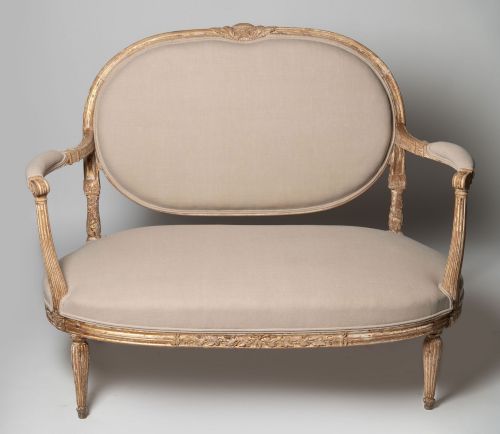
A louis xvi giltwood sofa is an upholstered seating piece defined by neoclassical restraint, straight fluted legs, and architectural symmetry. These pieces date from the nineteenth century through to nineteen ten, capturing revivals of earlier French aesthetics.
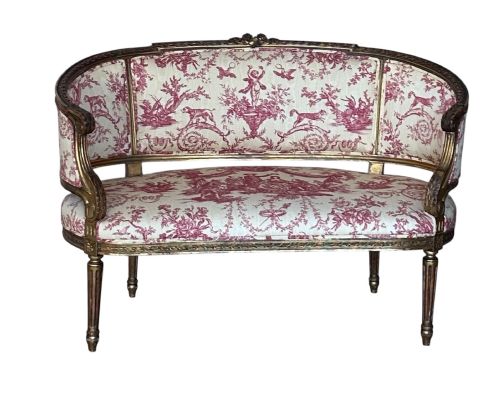
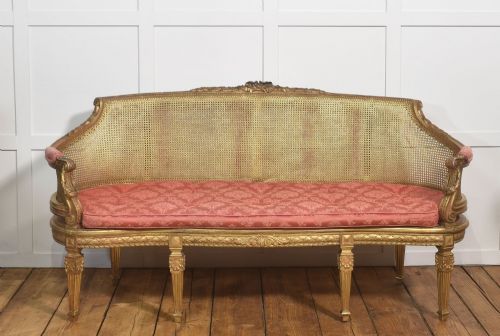
Buyers encounter larger salon suites, smaller two-seat settees, and cane-backed daybeds alongside standalone sofas. The core design follows the straight lines and carved ornamentation characteristic of French seating from this tradition.
Makers often drew upon Louis XVI revival styles, incorporating painted finishes, exposed wooden frames, and gilded surfaces. The resulting forms range from intimate hall seats to expansive reception room settees.
Materials and construction methods
Artisans built the structural frameworks using beech and general timber, carving the wood with classical motifs before applying a gilt finish. Giltwood surfaces reflect a process of laying thin gold leaf over a prepared base, creating a luminous metallic sheen.
Upholstery relies on traditional textiles, including linen and cotton fabrics, while certain airy variants incorporate woven cane panels into the backrest. Painted timber details frequently accompany the gilding, offering contrasting tones beneath the upholstery.
The joinery involves precise hand-carving for elements such as ribbon-tied crestings, fluted column legs, and acanthus leaf details. Frame integrity depends upon sturdy wooden construction beneath the exterior gold leaf and textile layers.
Some nineteenth-century makers snuck cane panels into daybeds so nobility could nap without ruining their heavy velvet coats.
Distinctions in craftsmanship
The refinement of the hand-carved woodwork dictates the primary tier of quality, distinguishing deeply sculpted acanthus leaves and crisp fluting from shallower, simpler mouldings. Superior frames exhibit harmonious proportions and sharp architectural lines.
The application of the gilt finish creates another major division, where expert burnishing provides depth and metallic brilliance compared to flat, uniform modern paints. Preservation of the original gilding and structural timber adds considerable merit to an example.
Upholstery execution and the retention of original supporting elements, such as cane panels or high-grade textiles, influence the overall integrity. Pieces retaining cohesive design schemes across matching salon suites represent the upper scale of survival.
The Louis XVI Giltwood Sofa Glossary
- Giltwood
- Timber coated with gold leaf or powder over a prepared gesso ground. This technique gives furniture a brilliant metallic surface finish.
- Canapé
- A traditional French term for an upholstered sofa or settee designed for multiple occupants. These forms often feature exposed wooden frames.
- Neoclassical
- A style drawing inspiration from classical antiquity, favouring straight lines, symmetry, and architectural motifs over curved rococo excess.
- Salon suite
- A matched set of seating furniture, including a central sofa and accompanying armchairs, created for formal reception rooms.
- Cane
- Woven rattan material used for lightweight, breathable backrests and seat panels on seating furniture.
Louis XVI Giltwood Sofa: Frequently Asked Questions
How do I care for a giltwood frame?
Dust the carved surfaces gently with a soft, dry cloth to prevent accumulation without disturbing the delicate gold leaf.
Avoid moisture, polishing compounds, and direct sunlight, which can degrade the underlying gesso and historical gilding over time.
Were these sofas used in bedrooms?
Most of these seating pieces belonged in formal reception rooms, salons, or grand hallways rather than private sleeping quarters.
Smaller settees and daybeds occasionally appeared in boudoirs for resting during daytime hours.
How do I distinguish revival periods?
Nineteenth-century revival pieces emulate eighteenth-century aesthetics through machine-assisted carpentry combined with traditional hand-carving techniques.
Examination of the underlying timber joints and tool marks helps determine whether a piece originates from the original neoclassical era or later revival periods.
Can these sofas fit modern interiors?
Their restrained architectural lines and gilded frames allow them to function as striking focal points in contemporary living spaces.
Neutral upholstery options help integrate historical seating forms into minimalist or eclectic modern room schemes.