
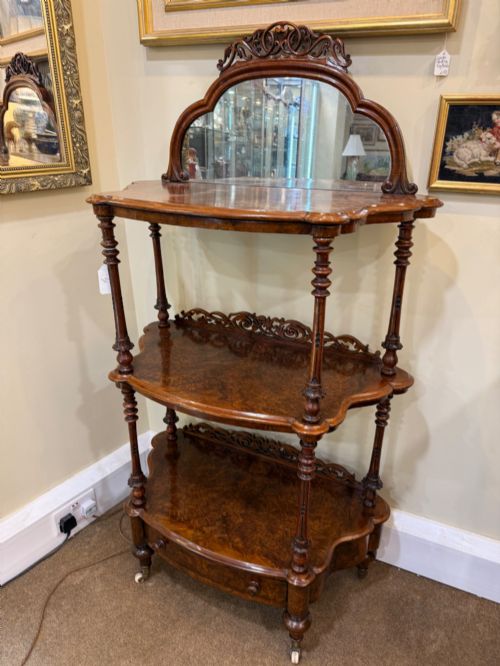
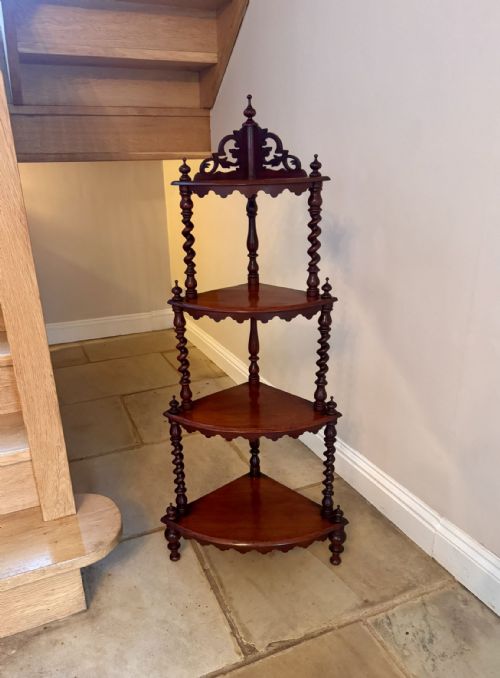
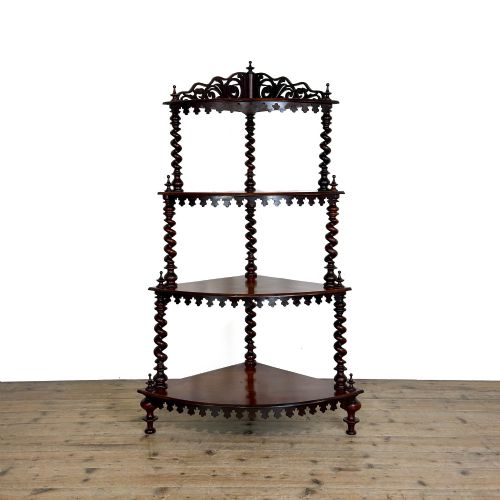

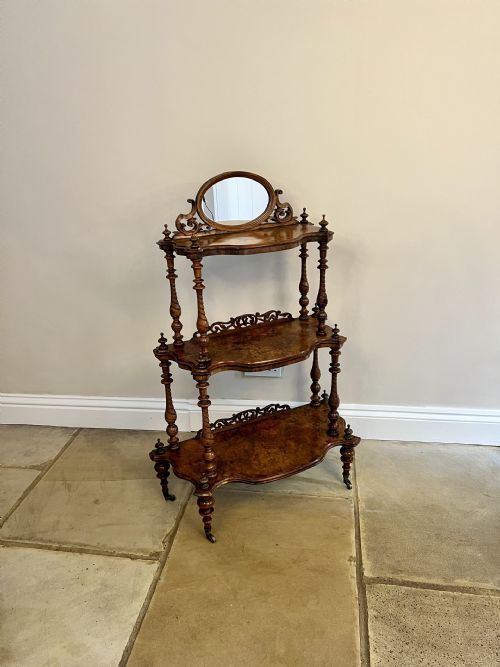
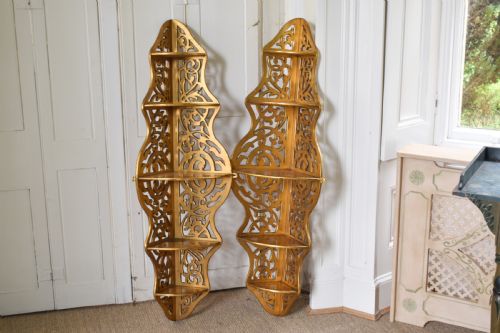
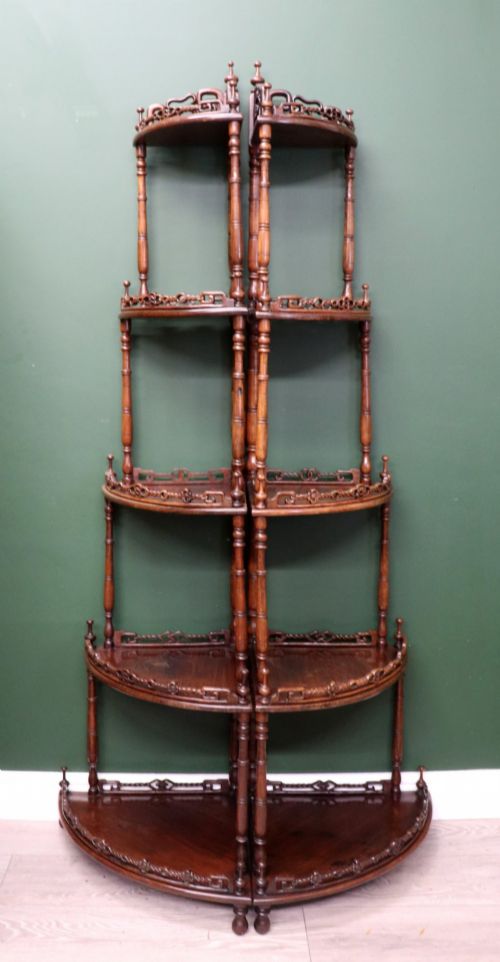
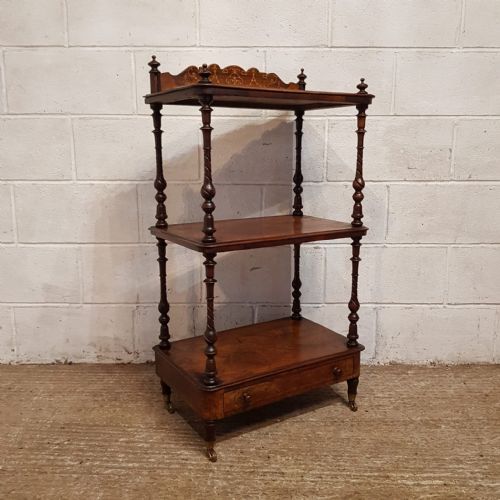
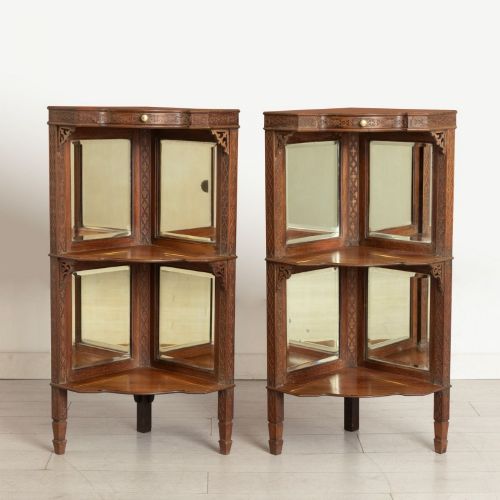
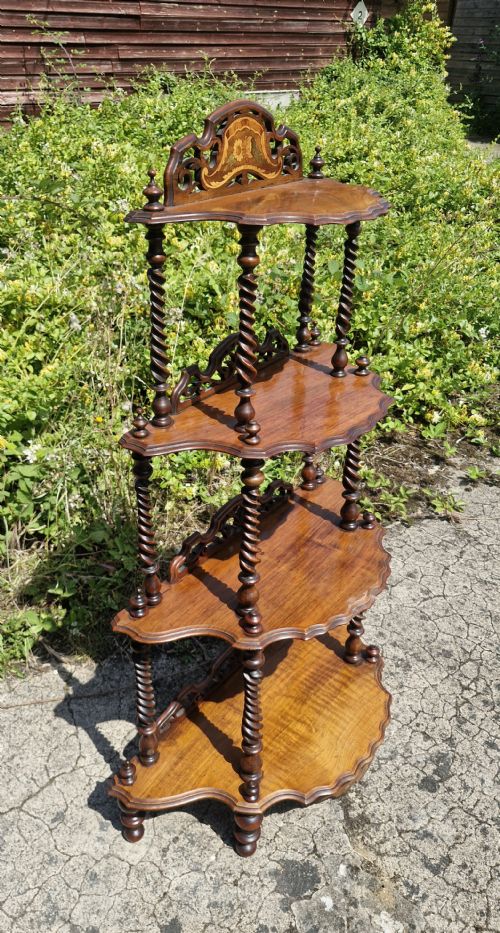


Carved Corner Etagere
A carved corner etagere fits tight to the room to display small treasures without crowding the floor.
Carved Corner Etagere
A carved corner etagere takes the form of tiered shelving designed to fit snugly into room junctions, frequently called whatnots or corner cabinets in nineteenth-century workshops. These pieces appear primarily from the Victorian era, spanning various decades of the nineteenth century with specific dates noted around 1850, 1860, 1880, and 1890.
The objects function as display stands and shelving units intended for parlours and drawing rooms to hold ornaments and decorative items. Most examples on this page utilise walnut, burr walnut, mahogany, and rosewood, often configured in multi-tiered arrangements such as four-tier and five-tier structures.
How they were made
Cabinet makers of the period constructed these units using dense hardwoods like walnut, burr walnut, and mahogany, frequently incorporating intricate marquetry inlay for surface decoration. Supporting elements often include turned wooden columns or brass components that separate the individual tiers.
Some pieces integrate glass doors or mirrored backs within the corner cabinet format, combining display space with enclosed storage. Surface finishes rely on traditional polishing techniques that highlight the natural grain patterns of the rosewood and burr walnut timbers.
The listings here draw entirely from the Victorian period, utilising woods such as walnut, mahogany, rosewood, and padouk.
What varies in quality
The distinction between standard production and exhibition quality lies in the selection of timber veneers, such as highly figured burr walnut against plain mahogany. Finer examples display meticulous marquetry inlay and careful carving along the structural framing rather than simple turned supports.
Makers such as Edwards & Roberts produced pieces where the joinery, brass mounts, and overall structural cohesion reflect superior workshop standards. The precision of the tier alignment and the depth of the carved ornamentation separate ordinary utility items from high-status Victorian pieces.
Edwards and Roberts
The Carved Corner Etagere Glossary
- Etagere
- A piece of furniture consisting of a set of open shelves for displaying small objects or ornaments. These tiers are typically supported by slender columns or pillars.
- Whatnot
- A multi-tiered piece of furniture designed for the storage and display of ornaments. The term emerged in the nineteenth century as an alternative descriptor for etageres and corner shelving units.
- Burr Walnut
- A timber derived from the wart-like growths on walnut trees, yielding highly decorative grain patterns. Cabinet makers prized this material for veneering the most visible surfaces of fine Victorian furniture.
- Marquetry Inlay
- The art of applying pieces of veneer to a structure to form decorative patterns and pictures. Workshops utilised various coloured woods to create intricate floral or geometric designs on tabletops and shelves.
- Aesthetic Movement
- A late nineteenth-century design style that emphasised visual beauty over narrative or moral function. Pieces from this period often reflect lighter forms and distinct material choices compared to earlier heavy Victorian designs.
Carved Corner Etagere: Frequently Asked Questions
What is an etagere?
An etagere is an open piece of furniture featuring multiple tiers designed specifically for display. These units hold decorative objects and ornaments across various levels.
In corner configurations, they utilise unassigned room angles to maximise display space without obstructing movement through the interior.
How do I date these pieces?
Dating relies on stylistic clues, timber selection, and construction methods associated with nineteenth-century cabinet making. Victorian pieces frequently feature burr walnut veneers, marquetry inlay, or turned wooden supports.
Earlier examples tend to show heavier proportions, while late nineteenth-century pieces occasionally incorporate Aesthetic Movement influences or lighter bamboo structures.
Where should I place a corner etagere?
These units belong in corners where standard rectangular furniture leaves awkward gaps. They serve well in drawing rooms, parlours, or hallways as focal points for collections of small objects.
The vertical tiered design draws the eye upward, making them effective in rooms with limited floor space.
What is the difference between a whatnot and an etagere?
The terms largely overlap in nineteenth-century English furniture terminology, both describing multi-tiered shelving units for display. Regional preferences and workshop catalogues dictated whether a maker labeled a piece a whatnot or an etagere.
Both forms prioritise open shelves supported by columns to present decorative ornaments to visitors.