
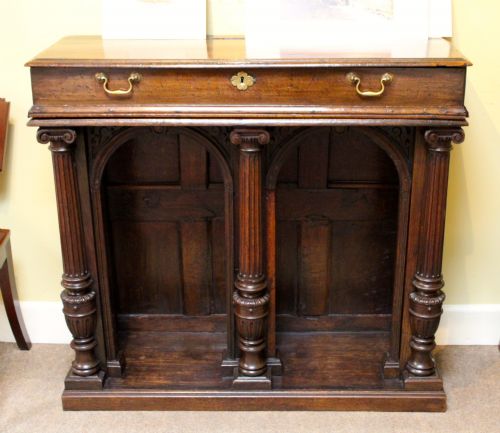


Carved Column Console Table
A carved column console table brings architectural presence and surface utility to a hall, crafted from timbers like mahogany and oak.
Carved Column Console Table
A carved column console table anchors an entrance hall or living space, offering a narrow surface designed to stand flat against a wall. The pieces appearing here span centuries from the seventeenth through the twentieth, taking forms such as serving tables, side tables, and card tables.
The most common examples you will encounter date from the nineteenth century, including Victorian interpretations and George IV or Regency designs. These tables frequently incorporate architectural supports, ranging from classical Corinthian columns to barley twist legs.
Makers and cabinetmakers built these forms using rich hardwoods, pairing timber frames with marble tops or flame mahogany veneers. Alongside traditional console tables, the selection includes related serving tables and library tables sharing similar structural columns.
Materials and construction methods
Cabinetmakers constructed these tables using solid timbers and select veneers, primarily working with mahogany, oak, walnut, rosewood, and ebonised wood. Pine and brass also appear in specific structural or decorative capacities.
Surfaces frequently feature marble tops inset into wooden frames, while timber elements showcase hand-carved columns and decorative veneers such as flame mahogany. Construction techniques rely on traditional joinery suited to heavy hardwoods and stone inserts.
The selection spans from seventeenth-century French Renaissance serving tables to twentieth-century Victorian style reproductions.
Distinctions in craftsmanship
Quality rests in the crispness of the hand-carving on the columns and the selection of timber grain, particularly where flame mahogany veneer or figured walnut is employed. Superior examples demonstrate precise joinery and well-integrated marble slabs.
Exhibition quality pieces from the nineteenth century display refined proportions and meticulous attention to detail across secondary woods and structural framing. Lesser examples rely on simpler execution without the depth of carving seen in more ambitious workshops.
The Carved Column Console Table Glossary
- Console table
- A wall-mounted or flat-backed table supported by brackets, legs, or columns, historically designed for display.
- Flame mahogany veneer
- A decorative wood slicing displaying a distinct flame-like grain pattern, prized for high-end furniture fronts and tops.
- Corinthian column
- A classical architectural column style featuring ornate carved capitals decorated with acanthus leaves.
- Barley twist
- A carved wooden furniture leg or support formed in a spiral twist resembling a stalk of barley.
Carved Column Console Table: Frequently Asked Questions
Where should I place a console table?
These tables suit hallways, entrance passages, and reception rooms where a shallow surface is required against a wall. Their narrow depth allows them to sit comfortably without obstructing walkways.
They function well beneath mirrors or paintings, providing a display space for decorative objects while maintaining a strong architectural silhouette.
How do I care for a marble top?
Marble surfaces require gentle cleaning with damp cloths and mild, pH-neutral soap to avoid dulling the stone. Acidic liquids can etch the polished surface.
Using coasters and mats protects the stone from stains and scratches, preserving the natural finish of the marble inset.
What timber types are most common?
Mahogany and oak dominate the selection, appearing in both solid construction and figured veneer forms. Walnut and rosewood also feature in period pieces.
Lighter woods like bleached oak and pine provide alternative appearances depending on the specific nineteenth-century style.
How do I identify the period?
Dating relies on timber selection, carving styles, and structural forms associated with Georgian, Regency, and Victorian eras. Architectural cues like Corinthian capitals help place pieces.
Construction methods and secondary woods offer further clues to the manufacturing decade, distinguishing earlier Georgian work from later revivals.