
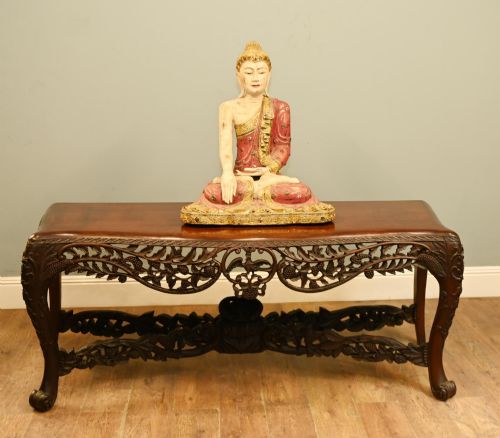
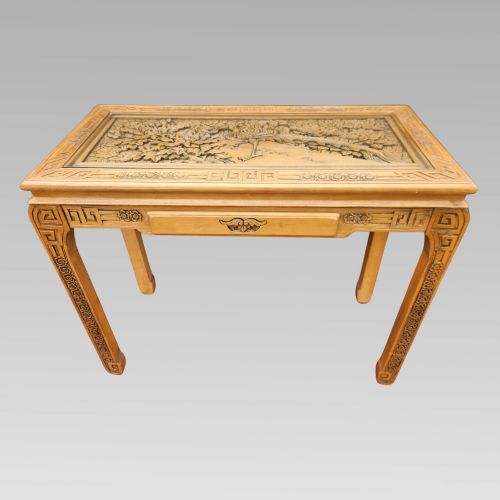


Carved Chinese Entry Table
These carved Chinese entry tables bring substantial presence to a hallway, offering rich wood and traditional forms suited to everyday placement.
Carved Chinese Entry Table
A carved chinese entry table typically manifests as an altar table, console table, or side table, fulfilling the role of a surface in a hall or reception space. The selection spans the nineteenth century through the early twentieth century, taking shape under styles such as Qing Dynasty and Chinese Export.
The console and altar forms dominate the offerings, often constructed from dense hardwoods or elm. Examples include rectangular formats, demi-lune shapes, and occasional side cabinets that share the same decorative vocabulary.
Regional variations and traditional motifs set these pieces apart from standard domestic furniture. Buyers encounter forms ranging from simple architectural altar tables to heavily decorated examples with deep relief carving.
Materials and construction methods
Cabinetmakers utilised dense timbers such as rosewood, hardwood, elm, and camphorwood to build these tables, relying on their structural stability for long tabletops and supporting legs. Brass hardware occasionally appears on associated side cabinets, while lacquer finishes provide a smooth, protective surface on specific regional pieces.
Joinery techniques allowed for sturdy frames without excessive metal fasteners, accommodating the natural movement of solid timber over decades of use. Carving was executed directly into the wood substrate or built up through layers of lacquer on export and decorative variants.
Listings feature woods spanning dense rosewood and hardwood to regional elm and camphorwood.
Distinctions in craftsmanship and form
The depth and clarity of the carving dictate much of the visual hierarchy among these tables, separating simple utilitarian pieces from elaborately decorated examples. Crisp lines in the wood relief and balanced proportions indicate greater care during production.
Choice of material also defines the tier of a piece, with dense hardwoods commanding attention over domestic elm or secondary softwoods. The integrity of the original surface finish, whether polished timber or red lacquer, preserves the character of the period.
The Carved Chinese Entry Table Glossary
- Altar table
- A traditional table form featuring upturned ends or flanged edges, originally designed for ceremonial use but adopted for domestic entryways. These pieces typically stand higher and narrower than standard western console tables.
- Qing Dynasty
- The final imperial dynasty of China, spanning from sixteen forty-four to nineteen twelve, which influences the dating of many traditional carved hardwood tables. Pieces from the late nineteenth century often carry design traits from this era.
- Elm
- A resilient domestic timber utilised by regional makers for furniture construction, known for its visible grain pattern and structural toughness. It provides a lighter alternative to dense tropical hardwoods.
- Lacquer
- A durable finish derived from tree sap, applied in multiple coats and polished to a hard sheen on certain export and regional tables. Red lacquer variants provide strong visual contrast in an interior.
- Demi-lune
- A half-moon shape used for console tables designed to sit flush against a wall in narrow hallways. This format saves floor space while maintaining a formal surface.
Carved Chinese Entry Table: Frequently Asked Questions
Where do I put a carved chinese entry table?
These tables find a natural home in hallways, entryways, and reception rooms where surface space is useful against a wall. Their narrow profile allows them to sit comfortably in circulation areas without obstructing movement.
Larger altar tables also serve well behind sofas or in living spaces to display decorative objects or lamps.
How do I clean a lacquer table?
Maintenance requires only a soft, dry cloth to remove dust from the surface of lacquered or wooden tables. Moisture should be kept to a minimum to protect the integrity of the finish.
Avoid chemical polishes and abrasive cleaners that can dull the traditional surface over time.
Are these tables heavy to move?
Hardwood and rosewood examples carry considerable weight due to the density of the timber used in their construction. Elm versions can be somewhat lighter but remain solid pieces of furniture.
Lifting requires two people to prevent strain on the joinery at the legs and apron.
How do I date a Chinese console table?
Dating relies on examining the construction methods, tool marks, wood shrinkage, and wear patterns accumulated across the nineteenth and early twentieth centuries. Stylistic markers tied to late Qing production also offer guidance.
Consulting the specific period details listed helps place each piece within its historical context.