
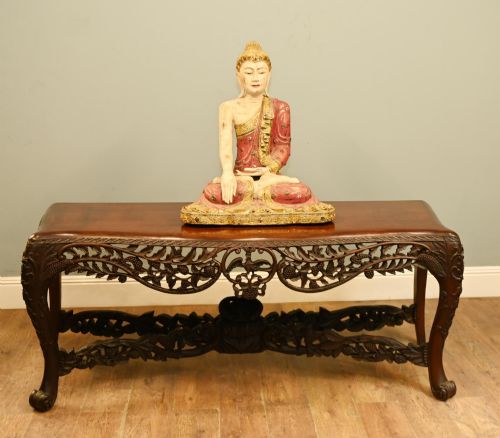
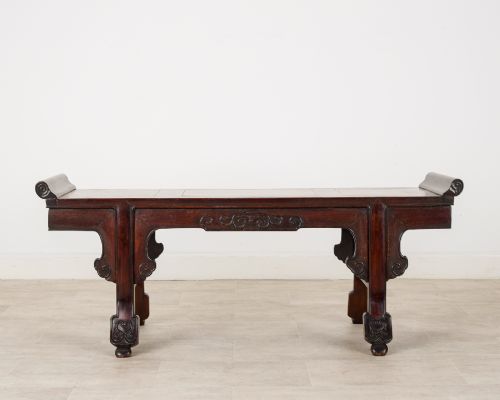


Brown Hardwood Altar Table
These brown hardwood altar tables bring structural clarity and rich grain to modern rooms through traditional Chinese forms.
Brown Hardwood Altar Table
A brown hardwood altar table is a long, narrow surface derived from traditional Chinese forms, designed originally for display or ceremonial use rather than dining. When you search for this phrase, you find pieces shaped by centuries of woodworking tradition, ranging from low benches to tall console tables.
The versions most likely to appear on this page span the eighteenth and nineteenth centuries, including Qing Dynasty examples and Chinoiserie interpretations. Forms vary from simple corner-leg tables to plank-top trestles, window seats, and demi-lune consoles.
How these pieces were made
Makers utilised dense Asian hardwoods alongside elm, employing traditional joinery that allowed the timber to expand and contract with humidity. Surfaces were finished to highlight natural grain or layered with lacquer.
Carving was applied selectively to aprons and legs, particularly on Qing Dynasty pieces, contrasting with the austere plainness of plank-top trestles and side tables.
Every listed table uses hardwood or elm, spanning the eighteenth century through to the early twentieth century.
What varies in quality
Quality rests in the selection of the timber and the crispness of the joinery, where tighter tolerances distinguish finer workshop production from simpler domestic furniture. The weight and density of the hardwood directly affect the stability and presence of the piece.
Carved ornament reveals the hand of the maker through depth and undercut detail, whereas lesser examples rely on shallow surface incisions that lack dimension.
The Brown Hardwood Altar Table Glossary
- Altar table
- A narrow rectangular table with upturned flanges or straight ends, traditionally placed against a wall for display.
- Qing Dynasty
- The final imperial dynasty of China, spanning the seventeenth to early twentieth centuries, known for restrained scholarly furniture and ornate carving.
- Demi-lune
- A half-moon shape used for console tables designed to sit flush against a wall.
- Trestle table
- A table construction where the top rests on supportive side assemblies rather than four individual corner legs.
- Chinoiserie
- European interpretation and imitation of Chinese artistic traditions, applied here to decorative console forms.
Brown Hardwood Altar Table: Frequently Asked Questions
What is a brown hardwood altar table?
A brown hardwood altar table is a long, narrow table originating from traditional Chinese furniture design, built for display or domestic use.
These pieces feature dense timbers, straightforward corner legs or trestle supports, and sometimes carved aprons dating from the eighteenth and nineteenth centuries.
Where were altar tables placed?
Altar tables were traditionally positioned against interior walls in reception halls, acting as focal points for decorative objects or ceremonial items.
Today, their narrow proportions make them practical console tables in hallways, living rooms, and narrow spaces.
How do I identify a Qing Dynasty table?
Qing Dynasty tables often feature specific carved motifs on the aprons, corner spandrels, and dense hardwood construction typical of the period.
They carry structural characteristics of nineteenth-century Chinese joinery, distinguishing them from later reproductions or European adaptations.
Can I use an altar table as a desk?
Altar tables can serve as desks or writing surfaces, provided the height matches your seating and clearance requirements.
Their shallow depth fits smaller rooms well, though their traditional design lacks modern drawers or cable management.
What materials are used?
These tables are constructed primarily from dense Asian hardwoods, sometimes paired with elm secondary woods or finished with lacquer.
The natural grain provides the primary visual interest, complemented occasionally by glass tops or carved decorative elements.