


Buttoned Leather Bench
A buttoned leather bench brings deep upholstery and tailored hides to a room, offering a sturdy seat or low table grounded in traditional English design.
Buttoned Leather Bench
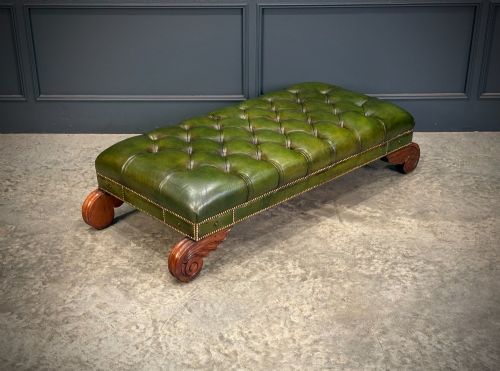
A buttoned leather bench encompasses low footstools, long window seats, ottomans, and hearthside club fenders constructed across the Victorian, Edwardian, and Regency eras. These pieces emerge in domestic interiors, country houses, and clubs, serving multiple roles as seating, footrests, and coffee tables.
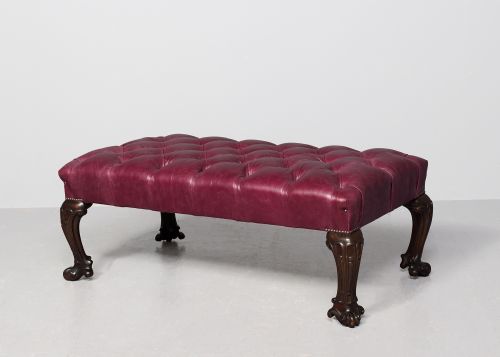
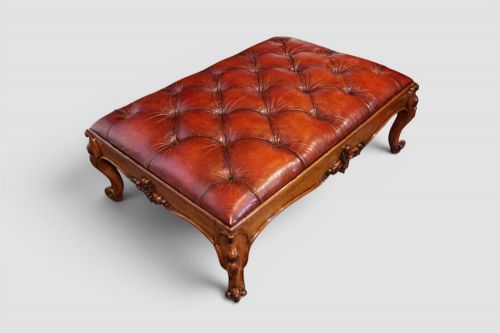
The version most commonly encountered on this page is the footstool or ottoman, often framed in mahogany, walnut, or oak, alongside brass and steel club fenders. Victorian and Edwardian examples dominate the selection, bringing substantial proportions and deeply tufted upholstery into view.
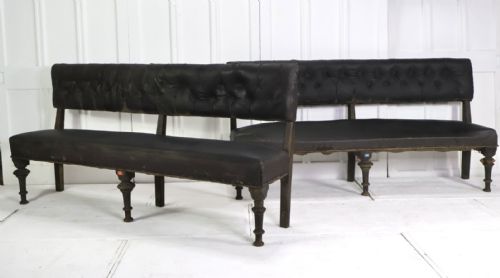
Makers such as James Shoolbred appear among the listings, alongside Irish country house pieces and substantial cast steel or polished brass club fenders. Forms range from compact footstools to expansive window seats and snooker hall benches designed for heavy daily use.
Materials and Construction Methods
Frames rely on dense timber foundations such as mahogany, walnut, oak, and painted wood, joined to support heavy upholstery and frequent sitting. Brass-studded details often secure the edges of the hide, while metal frameworks define the robust structure of club fenders.
Upholstery involves hand-dyed red, green, burgundy, and castle green leather pulled into deep buttoned tufts across the seating surface. This traditional technique creates distinct folds in the hide, distributing tension evenly across the cushion while establishing a tactile, textured finish.
Buttoned Leather Bench Retail Price Guide 2026
Typical asking prices for buttoned leather bench among the pieces listed under this phrase on Sellingantiques today, from the lower quarter to the upper quarter. They describe what is for sale here now, not the wider market.
A steel club fender hails directly from the In & Out Club, built for gentlemen who presumably valued a sturdy seat.
Distinctions in Quality and Craft
Quality rests upon the integrity of the timber frame and the depth of the joinery beneath the upholstery. Finer examples display substantial mahogany or walnut structures with crisp turnings and fluted legs, whereas simpler pieces utilise basic wood frames or functional steel and brass bases.
The treatment of the leather further separates categories of work, with hand-dyed hides and precise buttoning demonstrating superior craftsmanship. The weight and finish of the brass or cast steel on club fenders similarly signal the original investment in materials.
James Shoolbred
The Buttoned Leather Bench Glossary
- Club Fender
- A low hearth seat featuring metal uprights and a padded leather top, originally designed for warming feet near an open fireplace. These frames incorporate brass or cast steel.
- Ottoman
- A low, upholstered seat without a back or arms, frequently used as a footstool or centre table. Examples in the listings appear in large proportions suitable for country houses.
- Buttoning
- An upholstery technique where twine pulls the leather deep into the stuffing to secure shapes and create diamond patterns. This method provides the characteristic tufted surface.
- Window Seat
- A long bench built or placed to fit the recess of a window, often supported on wooden frames with fluted legs. These long stools accommodate multiple sitters.
Buttoned Leather Bench: Frequently Asked Questions
What is a club fender?
A club fender is a specialised low seat built around a fireplace, combining a metal frame with padded leather top rails. They allowed people to sit directly by the hearth.
Over time, these pieces migrated into broader room settings while retaining their distinctive open metalwork bases and sturdy proportions.
How do I use an ottoman?
An ottoman functions as a flexible surface for resting feet, sitting, or serving as a low coffee table when paired with a tray. Their deep upholstery makes them comfortable focal points in a drawing room or study.
Placing one before a sofa or beneath a window utilises traditional country house placement methods.
How do I identify Victorian pieces?
Victorian pieces often display heavier proportions, rich walnut or mahogany frames, and deeply buttoned red or green leather upholstery. They reflect the period's preference for comfort and substantial domestic furniture.
Makers from this era frequently incorporated brass-studded trim and robust turnings that mark them out from lighter Regency designs.
What distinguishes Regency styles?
Regency designs favour cleaner classical lines, sometimes incorporating fluted legs and mahogany frames without the heavier Victorian bulk. These pieces look toward earlier classical forms while maintaining practical seating utility.
They appear in the listings as distinct footstools and long benches that bring refined proportions to a room.