
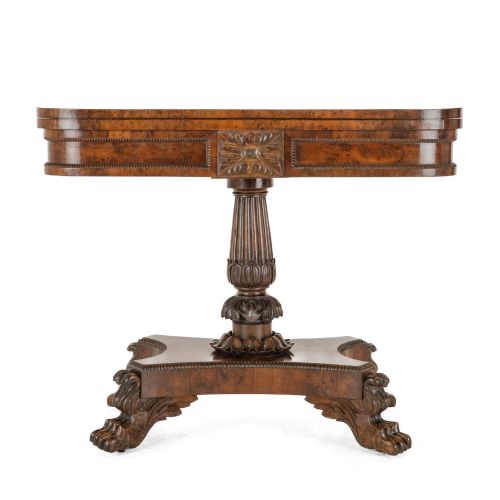


Burr Yew Table
A burr yew table brings extraordinary mottled grain and rich honey tones to a room, offering a focal point with centuries of English cabinet-making heritage behind it.
Burr Yew Table
A burr yew table is a piece of antique or period furniture defined by the distinctive, swirling growth patterns of yew wood burr, typically encountered in forms such as occasional tables, card and games tables, writing desks, and centre tables.
The materials recorded in these pieces span from Georgian and Regency eras through the Victorian period and into the twentieth century, often incorporating contrasting timbers like rosewood, satinwood, and mahogany.
Buyers searching for a burr yew table most commonly meet nineteenth-century examples, particularly from the Regency period, alongside Georgian designs and occasional twentieth-century interpretations.
How they were made
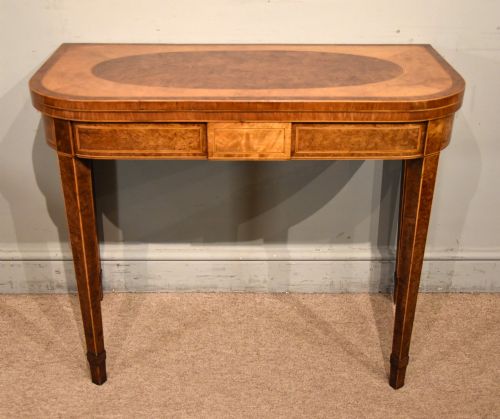
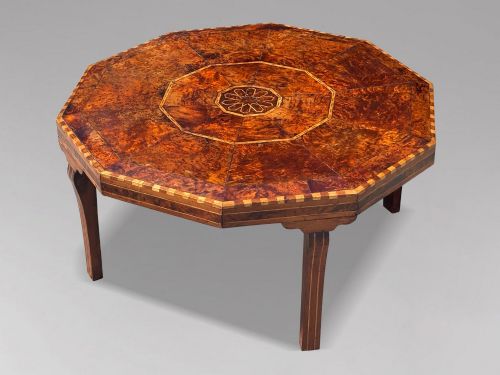
Cabinet makers utilised thin veneers of burr yew applied to stable secondary woods, allowing the chaotic and decorative grain to cover expansive surfaces like table tops without warping.
Crossbanding in contrasting timbers such as satinwood, rosewood, or mahogany frames the central burr panels, while brass fittings and intricate inlay work complete the construction of finer examples.
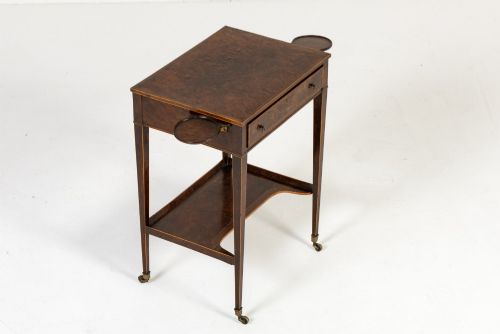
Historic cabinet makers occasionally utilised burr yew on stereoscopes and teapoys to ensure even tea-drinking or viewing was accompanied by maximum botanical confusion.
What varies in quality
Quality rests primarily in the density and visual rhythm of the burr figuring across the timber, alongside the precision of the crossbanding and the integrity of the underlying cabinet work.
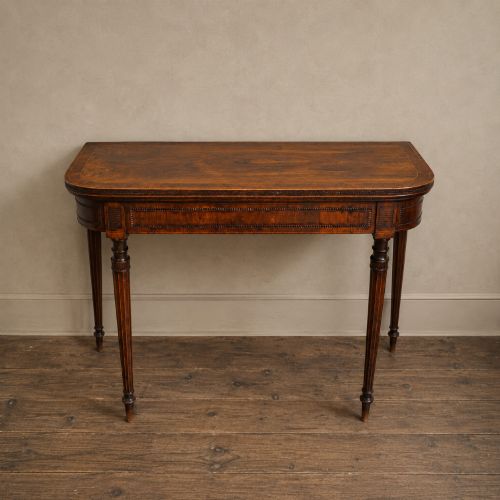
Peculiarities in proportion, the crispness of turned pedestal bases, and the restrained use of secondary contrasting woods separate standard production from exceptional cabinet making.
Robert James·George Bullock
The Burr Yew Table Glossary
- Burr
- A growth on a tree where grain has grown in a deformed, swirling manner, producing highly decorative patterns when sliced into veneer.
- Crossbanding
- A strip of veneer applied to the border of a table top with the grain running perpendicular to the centre, framing the main timber.
- Teapoy
- A small stand or box on a pillar and claw feet, originally designed to hold containers of loose tea.
- Pembroke table
- A small table with hinged drop leaves on either side, often fitted with a single drawer.
- Sutherland table
- A narrow drop-leaf table where the leaves fold down almost vertically, supported by pivoting gate legs.
Burr Yew Table: Frequently Asked Questions
How do I date a burr yew table?
Dating relies on observing the structural proportions, secondary timbers, and characteristic joinery methods associated with periods like the Georgian, Regency, or Victorian eras. Cabinet-making styles evolved from the clean pedestal forms of the late eighteenth century into heavier, more decorative Victorian interpretations.
Examining the underside and drawer linings reveals construction details that anchor the piece within a specific century. Comparing the specific veneer application against documented pieces helps narrow down the decade of manufacture.
Where should I place a burr yew table?
These tables suit principal reception rooms, studies, or hallways where their distinctive grain and warm amber tones can be appreciated up close. Occasional and lamp tables fit comfortably beside seating areas, while larger centre tables anchor the middle of a room.
Direct sunlight should be avoided to protect the sensitive veneers from fading or drying out over time. Placing the piece away from direct heat sources preserves the stability of the timber and the underlying glue.
What is the difference between yew and burr yew?
Standard yew wood displays a relatively straight grain with growth rings and a warm, pale reddish-brown tone. Burr yew comes from a woody outgrowth on the tree, yielding a chaotic, knotted pattern of dark eyes and swirling figure.
Because burr timber is scarce and difficult to work in large solid pieces, it is almost exclusively used as a decorative veneer over stable base woods. This creates a striking visual contrast that standard yew timber simply does not possess.
How do I care for antique veneer?
Maintaining burr yew veneer requires gentle dusting with a dry, soft cloth and avoiding chemical polishes or excessive moisture. Applying a microcrystalline wax periodically feeds the wood and maintains a protective barrier against humidity changes in the room.
Keeping the table away from radiators and open fires prevents the historic glue beneath the veneer from becoming brittle. Promptly attending to minor lifting with appropriate conservation adhesives prevents further separation from the substrate.