



Burr Walnut What Not
A burr walnut what not is a tiered display stand that brings rich figuring and practical elegance to a Victorian interior.
Burr Walnut What Not
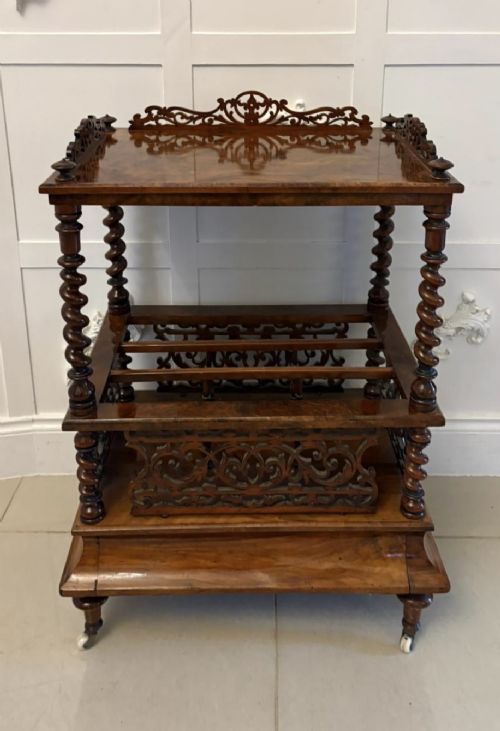
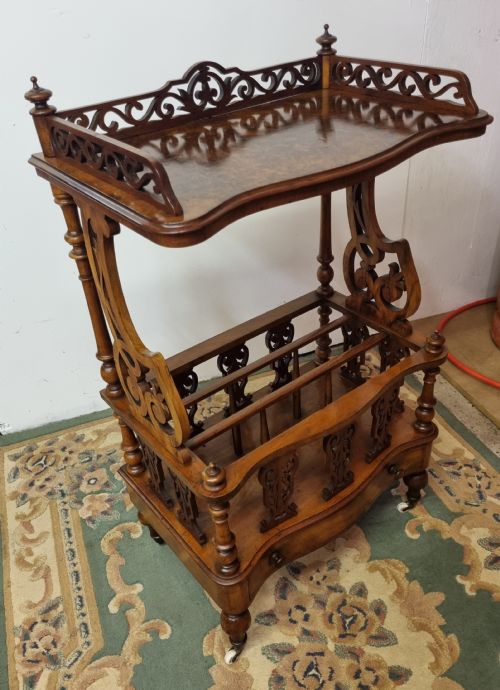
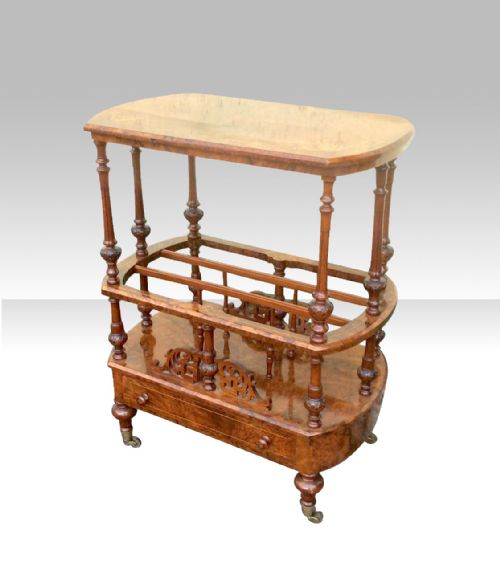
When you search for a burr walnut what not, you encounter multi-tiered display pieces and hybrid forms from the nineteenth century, particularly the Victorian era. The version you are most likely to meet on this page is a Canterbury whatnot combining open shelving with partitioned sections for magazines or sheet music.
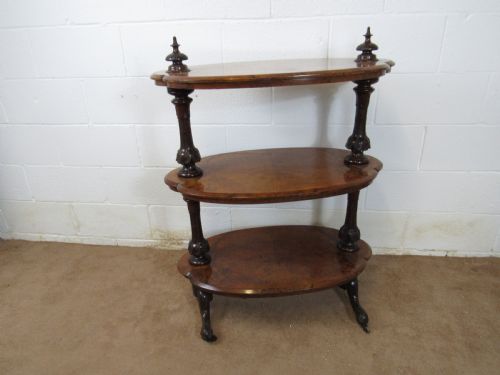
The evidence shows these pieces appearing in various configurations, including corner shapes, serpentine designs, and three-tier étagères. Many examples integrate occasional tables, music cabinets, and work tops into their multi-level structures.
Originating predominantly from mid-Victorian workshops around eighteen-sixty to eighteen-seventy, these items served as versatile furniture for the parlour and drawing room. They display distinct styling ranging from straightforward Victorian utility to ornate Louis XV influence.

How they were made
Cabinet makers utilised burr walnut veneers applied over solid carcases to create the characteristic swirling grain patterns across the shelves and panels. Inlaid details in contrasting woods, alongside marquetry work, frequently decorate the main surfaces.
Structural elements often incorporate ebonised wood for contrast, while metal fittings such as brass castors and ormolu mounts appear on selected pieces. Ceramic, porcelain, and glass components occasionally form part of the decorative scheme on specific stands.
Listings demonstrate that burr walnut whatnots frequently incorporate brass hardware, ceramic elements, and ebonised wood details alongside walnut veneers.
What varies in quality
The richness and symmetry of the burr walnut veneer dictate the visual impact of the piece, with tightly swirled figuring commanding greater appreciation. Finer examples display meticulous marquetry inlay and careful matching of the grain across multiple tiers.
Construction choices also separate standard production from superior items, visible in complex serpentine shapes, corner designs, and carved details such as shamrock motifs. Robust proportions and integrated functions like music racks or drop leaves elevate the standing of individual pieces.
Holland & Sons·T Wilson of London
The Burr Walnut What Not Glossary
- Burr walnut
- A wood veneer taken from the growth excrescences of a walnut tree, prized for its intricate and swirling grain patterns. It forms the primary visual surface on Victorian whatnots.
- Whatnot
- A tiered open-shelved piece of furniture designed for displaying ornaments, books, or bric-a-brac. It developed in popularity throughout the nineteenth century.
- Canterbury
- A low stand featuring vertical partitions, originally designed for holding sheet music or books. When combined with a whatnot, it creates a dual-purpose item of furniture.
- Étagère
- A French term for a piece of furniture consisting of a set of open shelves for displaying small objects. These tiers are typically supported by slender columns or uprights.
- Marquetry
- The art of applying decorative pieces of veneer to a structure to form intricate designs or pictures. It is frequently seen on the top surfaces of Victorian tables.
Burr Walnut What Not: Frequently Asked Questions
What is a burr walnut what not used for?
These pieces were originally designed for displaying ornaments, ceramics, and small decorative items in Victorian reception rooms. Many examples include lower sections specifically configured for holding books, magazines, or sheet music.
Today, they function well in modern interiors as versatile side tables or corner display units. Their tiered structure allows for vertical storage and display without occupying excessive floor space.
Are all these stands made of solid walnut?
Most pieces utilise a secondary wood carcase overlaid with fine burr walnut veneers. This technique allowed cabinet makers to showcase the decorative swirling grain across wide surfaces while maintaining structural stability.
Solid walnut was reserved for turned supports, frames, and mouldings, while ebonised wood and brass frequently appeared as contrasting trim.
What is the difference between a whatnot and an étagère?
A whatnot is a general English term for a multi-tiered shelving unit used for storage and display. They often incorporate enclosed cabinets, drawers, or Canterbury racks.
An étagère specifically refers to an open-tiered stand of French origin, focusing primarily on display surfaces supported by slender uprights or columns.