
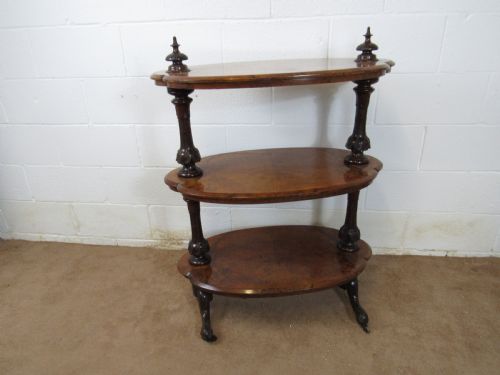
3 Tier Walnut What Not
A 3 tier walnut what not brings tiered shelving and rich timber grain into a room, offering both display space and architectural presence.
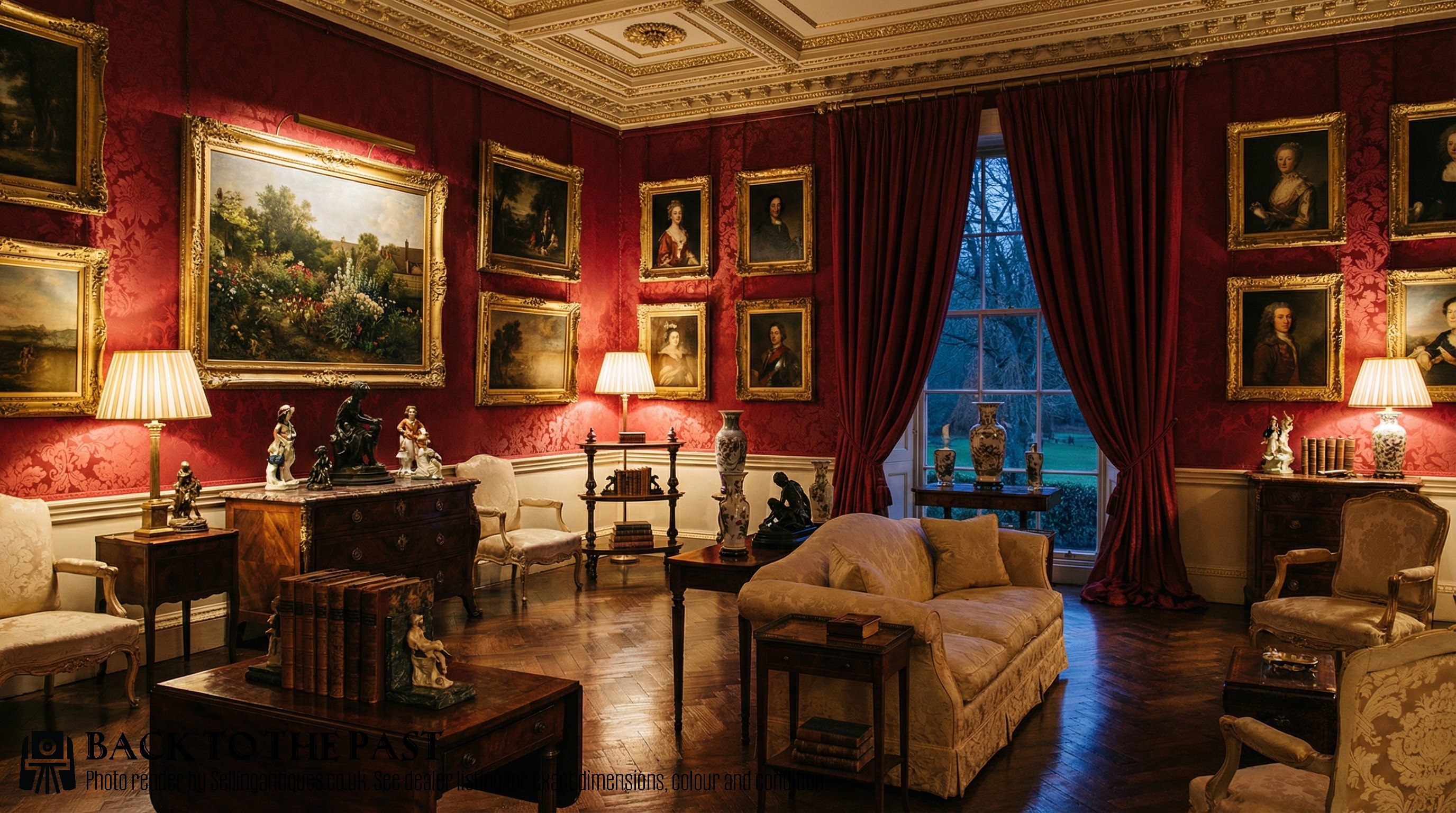
3 Tier Walnut What Not
A 3 tier walnut what not is a multi-level display piece designed for the parlour or drawing room, frequently appearing in Victorian incarnations and French Napoleon III or Louis XV styles. The form relies on three horizontal shelves supported by columns or turned uprights, sometimes incorporating a lower cupboard, drawer, or magazine rack.
The version most likely to meet you on this page is a Victorian burr walnut piece featuring figured timber grain, turned spiral support columns, and turned finials. Examples span from mid nineteenth-century manifestations around 1860 up to 1900, occasionally crossing into related forms like etageres, music cabinets, and canterburys.
Makers recorded in the archive and current listings include notable firms such as Gillows and Holland & Sons, alongside French marquetry pieces and simpler corner cabinets. Whether designated as a whatnot, etagere, or tea trolley, the core function remains the exhibition of ceramics, glass, and decorative objects.
Quality differences
Quality in a 3 tier walnut what not rests upon the selection of the timber veneer, particularly the richness and symmetry of the burr walnut figure across the shelves. Finer workshops invested in precise marquetry inlay, substantial brass or ormolu mounts, and cleanly turned spiral support columns rather than plain turned spindles.
Listings feature walnut, burr walnut, ebonised wood, and ormolu across Victorian and French Napoleon III styles.
Gillows·Holland & Sons
The 3 Tier Walnut What Not Glossary
- Whatnot
- A piece of furniture consisting of three or more open shelves for displaying small objects or ornaments. It gained popularity during the Victorian period.
- Etagere
- A piece of furniture with a set of open shelves for displaying ornaments, closely related in form to the whatnot. French examples often incorporate marquetry and Louis XV styling.
- Burr Walnut
- Timber taken from a walnut tree growth where the grain has grown in a deformed, swirling manner. It produces highly decorative veneer patterns prized in nineteenth-century cabinet making.
- Canterbury
- A low stand with partitions for sheet music, books, or newspapers, frequently combined with walnut shelf tiers or magazine racks in Victorian examples.
- Ormolu
- Gilded bronze or brass applied as mounts, feet, or decorative highlights on furniture. It provides metallic contrast to dark walnut timbers.
3 Tier Walnut What Not: Frequently Asked Questions
What was a whatnot used for originally?
These tiered stands served as display furniture in nineteenth-century drawing rooms for ornaments, porcelain, and small decorative objects. They kept prized collections visible and organised within formal living spaces.
In subsequent decades, variations such as tea trolleys and music cabinets adapted the basic shelf structure for serving refreshments or holding sheet music near a piano.
How do I tell a Victorian piece from 1900 examples?
Mid nineteenth-century pieces from around 1860 typically employ heavy burr walnut veneers, turned spiral support columns, and elaborate marquetry. The timber selection tends to show deep figuring and substantial construction.
Later pieces approaching 1900 often exhibit lighter proportions, simpler turned uprights, or French influenced styling. The detailing becomes more restrained compared to high Victorian ornamentation.
Where does the name whatnot come from?
The term originated in the nineteenth century as a colloquial label for a piece of furniture designed to hold 'what nots' or miscellaneous small possessions. The name stuck and became the standard descriptor in trade and maker records.
Alternative designations such as etagere or dumb waiter appear in historical listings depending on whether the piece leaned towards French styling or serving functions.
How do I live with a 3 tier walnut what not?
Place the unit against a sturdy wall in a reception room or hallway where foot traffic will not destabilise the open shelving. The multiple tiers accommodate books, ceramics, and plants while occupying minimal floor space.
Keep the walnut timber away from direct sunlight and strong heat sources to prevent the burr veneer from drying out or splitting over time.