
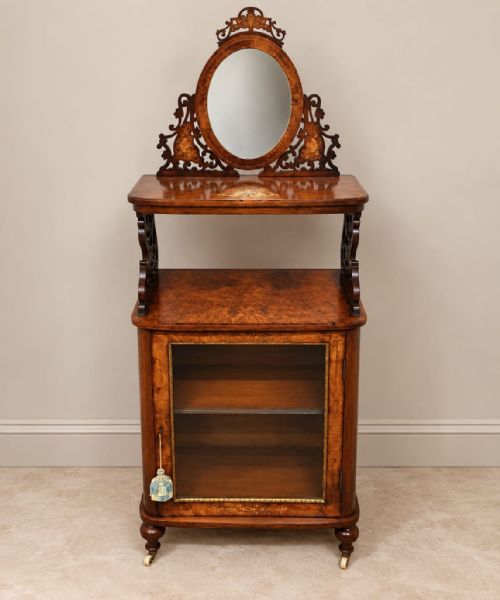


Burr Walnut Pier Mirror
A burr walnut pier mirror brings warmth and striking grain patterns to a room, hung between windows or above a console.

Burr Walnut Pier Mirror
When you search for a burr walnut pier mirror, you find tall, narrow looking-glasses designed to fit the narrow wall space between windows, known as the pier. The selection includes examples styled after the George II and Queen Anne periods, alongside Victorian pieces and later 20th-century interpretations.
Most items you meet on this page span the 18th century to the Victorian era and the early 20th century, frequently incorporating burr walnut veneer with rich figuring. Some pieces arrive paired with console tables or take the form of wall mirrors featuring fretwork frames.
You also encounter related furniture forms in the evidence, such as side cabinets, console tables, and music cabinets, which share the same walnut materials and architectural placement.
How they were made
The makers of these mirrors selected burr walnut for its complex, swirling grain patterns, applying thin veneers over secondary timbers to create rich decorative surfaces. Gilding and parcel-gilt accents often highlight the carved details on frames from the George II style and 18th-century traditions.
Ebonised details and brass fittings appear alongside marble tops on related console tables, showing a mix of contrasting materials. Glass plates are set into wooden frames, sometimes accompanied by fretwork silhouettes derived from earlier Georgian designs.
Periods represented across the items span the 18th century through the Victorian era up to 1920.
What varies in quality
The fineness of the burr walnut figuring dictates much of the visual appeal, with tightly knotted and symmetrical grain patterns marking out superior examples. Craftsmanship in the fretwork cutting and the depth of parcel-gilt highlights further distinguish ambitious workshops from simpler production.
The preservation of the original mirror glass and the crispness of the framing joints separate well-kept pieces from those that have suffered heavy restoration or replacement components over the centuries.
The Burr Walnut Pier Mirror Glossary
- Pier mirror
- A tall, narrow looking-glass made specifically to hang on the wall space between two windows. These mirrors often match console tables positioned directly beneath them.
- Burr walnut
- A prized timber harvested from walnut tree growths, showing intricate, swirling grain patterns. It is sliced into thin veneers for decorative furniture surfaces.
- Fretwork
- Openwork ornamentation cut in thin wood panels, frequently seen on the scrolled outlines of Georgian and 18th-century mirror frames.
- Parcel-gilt
- A decorative technique where only specific carved details of a wooden frame are highlighted with gold leaf. This creates a contrast against the dark walnut ground.
- Console table
- A table designed to be fixed against a wall, frequently topped with marble and paired beneath a pier mirror.
Burr Walnut Pier Mirror: Frequently Asked Questions
Where should I hang a pier mirror?
These mirrors were traditionally designed for the narrow wall space between two windows, where they reflected available daylight into the room.
Today, they work well in hallways, narrow entryways, or above matching console tables where their vertical proportions suit limited wall widths.
How do I date an 18th-century style mirror?
Dating relies on examining the construction methods, timber choice, and frame silhouette, comparing them against known periods like George II or Queen Anne.
Later revival pieces from the 19th and early 20th centuries often copy these earlier styles closely, requiring careful inspection of the wood age and backing boards.
What is burr walnut?
Burr walnut comes from a growth or burl on the walnut tree, which produces dense, knotted, and highly decorative grain patterns.
Cabinet makers slice this wood into thin veneers to cover larger surfaces, creating rich visual movement that plain timber lacks.
Are pier mirrors sold with tables?
Some pier mirrors are recorded alongside marble-topped console tables or side cabinets as combined furnishings intended for the same wall.
Others exist purely as wall-hanging frames without associated furniture bases.