



Burr Walnut Nest Tables
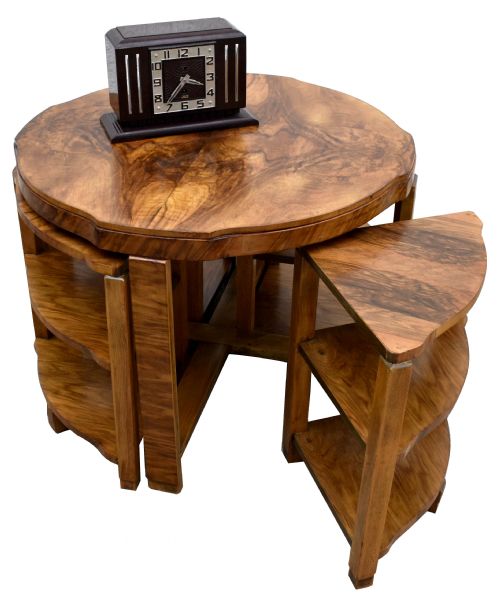
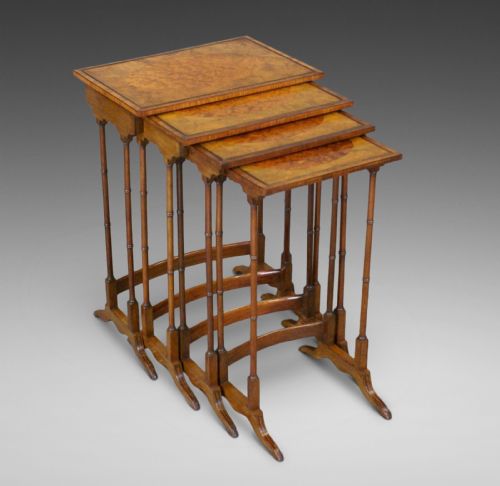
These burr walnut nest tables offer nested surfaces of rich timber, combining practical utility with striking figured grain.
Burr Walnut Nest Tables
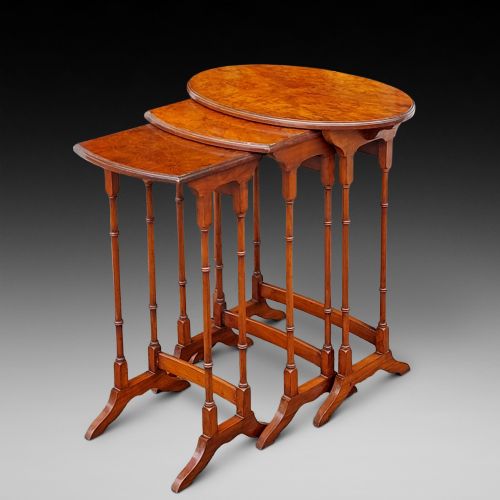
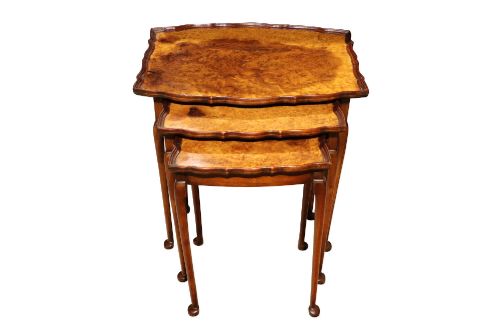
When you search for burr walnut nest tables, you encounter sets of graduating tables designed to slide neatly beneath one another when not in use. These pieces appear primarily in Edwardian and Art Deco designs, alongside occasional Victorian examples.
The configurations vary from sets of three and four tables up to larger quintetto sets of five surfaces. They serve as adaptable occasional tables for living spaces, offering temporary table space that packs away compactly.
How they were made
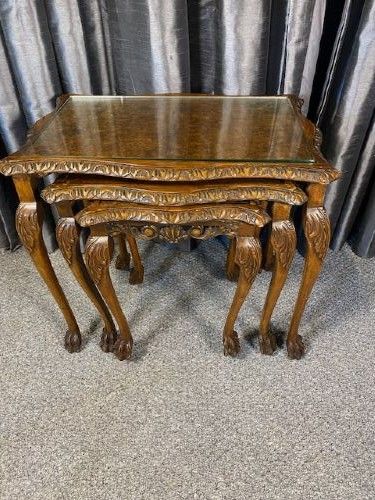
Cabinet makers utilised decorative veneer sliced from walnut burrs, applied over solid secondary woods such as mahogany or hardwood to create the distinctive swirling grain patterns on the top surfaces. Frames and legs often incorporated solid walnut or mahogany, sometimes shaped in Queen Anne revival cabriole styles.
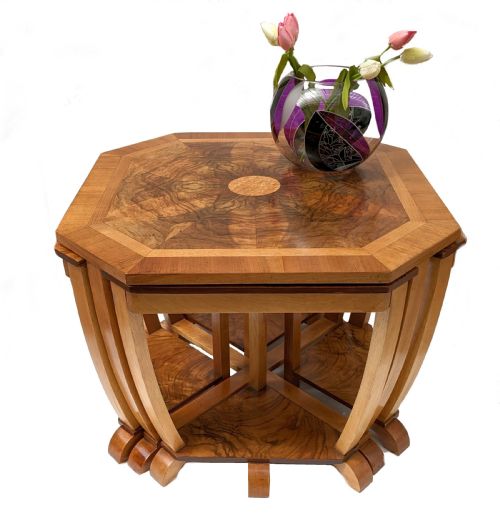
Art Deco examples from the twentieth century relied on clean geometric lines and matched veneer panels, while Edwardian and earlier sets frequently employed carved edges, pie crust rims, or glass protection over the timber.
While walnut and burr walnut dominate, related hardwoods like mahogany and teak appear in the underlying framework of these tables.
What varies in quality
The distinction between ordinary and exceptional sets rests on the density and symmetry of the burr walnut figuring across all graduating surfaces, rather than just the primary table top. Master makers aligned the grain so the pattern flows logically when the tables are nested or displayed together.
Construction methods also set pieces apart, seen in the solidity of the joints where the legs meet the subframes and the precision required to allow each smaller table to slide smoothly into position without binding.
Harry and Lou Epstein·Hille
The Burr Walnut Nest Tables Glossary
- Burr walnut
- A veneer taken from the growth deformity of a walnut tree, yielding complex, swirling patterns highly prized in fine cabinet making.
- Quartetto
- A matched set of four graduating tables designed to nest together. These pieces typically scale down efficiently from the largest primary table to the smallest.
- Quintetto
- A matching set of five nesting tables. This larger arrangement provides substantial surface options while maintaining a compact footprint.
- Pie crust
- A carved, raised decorative border shaping the edge of a table top. This moulding appears on select Edwardian and early twentieth century examples.
- Cabriole leg
- A furniture leg featuring a double curve, typically arching outward and then tapering inward to a foot. This style is frequently observed on Queen Anne revival pieces.
Burr Walnut Nest Tables: Frequently Asked Questions
How were nest tables used originally?
These sets provided flexible surface space for afternoon tea, reading materials, or needlework in formal sitting rooms. Servants or hosts could easily pull out the smaller tables as guests arrived and pack them away afterward.
Their modular design made them particularly suited to smaller urban drawing rooms where floor space was at a premium during the Edwardian and Art Deco periods.
How do I tell Edwardian sets from Art Deco ones?
Edwardian versions often feature traditional details like cabriole legs, carved edges, or Queen Anne revival styling. The timber work tends to lean toward classic proportions with applied decorative mouldings.
Art Deco sets instead emphasise clean, streamlined silhouettes, waterfall edges, and symmetrical book-matched veneers without traditional carving. The focus shifts entirely to the boldness of the geometric grain patterns.
Can I use these tables for daily coffee cups?
Polished walnut surfaces respond well to careful daily use when protected from moisture and heat. Many period examples historically featured custom glass tops to shield the delicate veneer from everyday wear.
Using coasters and avoiding direct placement of hot cups preserves the French polish or varnish. The underlying hardwood structures remain sturdy for holding light items.
What is a quintetto set?
A quintetto set comprises five graduating tables rather than the standard three or four. Each table scales down incrementally so the entire assembly slides into a single compact footprint.
These larger sets require high precision in the workshop so the movement remains smooth across all five individual pieces.