


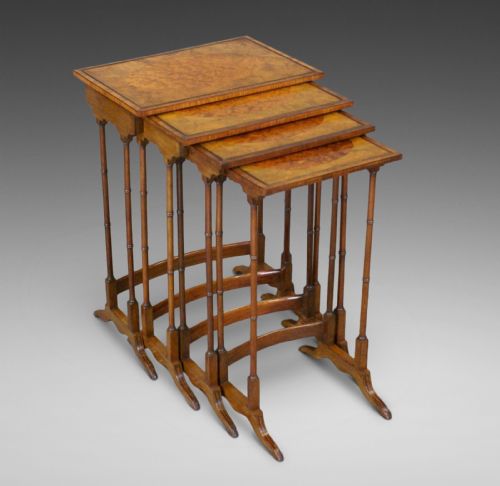

Brown Walnut Nesting Tables
Brown walnut nesting tables are practical sets of graduating occasional tables that tuck neatly away when floor space matters.
Brown Walnut Nesting Tables
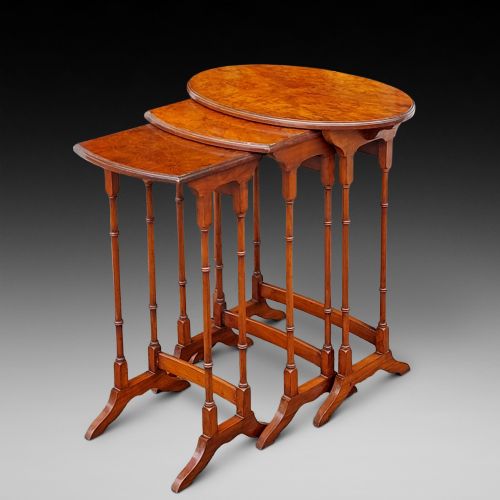
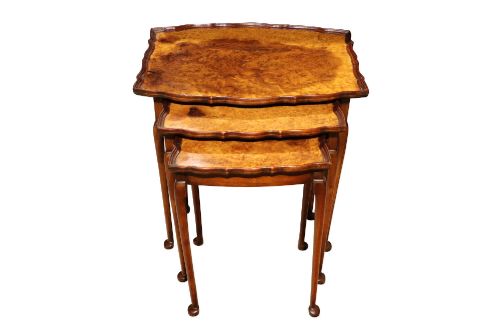
Brown walnut nesting tables combine functional utility with compact design, offering multiple surfaces that slide one beneath another into a single footprint. When exploring brown walnut nesting tables, buyers encounter configurations ranging from sets of three to sets of five tables.
The pieces appearing on this page span several eras from the late nineteenth century through to the mid twentieth century, including Edwardian and Art Deco examples. Traditional forms sit alongside revival styles such as Queen Anne and Jacobean, alongside French parquetry and inlay work.
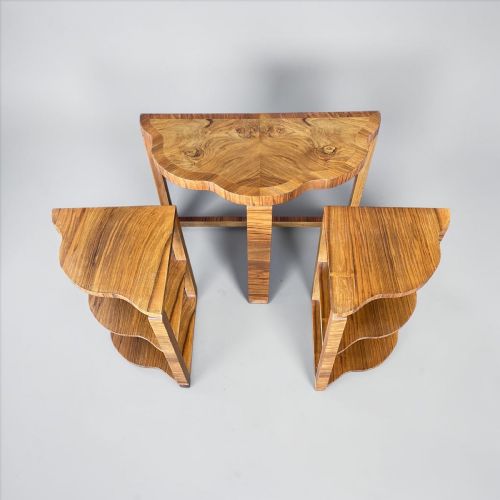
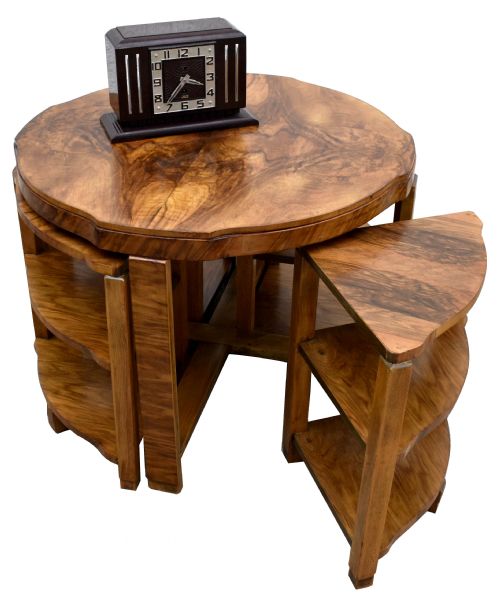
Sets most commonly comprise three or four graduated tables, though quartetto and quintetto arrangements appear in Edwardian and Art Deco designs. These tables serve flexibly across living spaces as tea tables, coffee tables, or display surfaces.
Materials and Construction
Walnut and burr walnut form the primary visual and structural surfaces, frequently utilised as fine veneers laid over solid hardwood or oak secondary framing. Burr walnut veneer provides distinctive swirling grain patterns across the tabletops, particularly prominent in Edwardian and Art Deco pieces.
Parquetry and floral inlay decorate selected tops, contrasting lighter and darker wood elements within geometric or botanical compositions. Skilled cabinet makers joined frames using traditional techniques to ensure each smaller table slides smoothly into its predecessor.
Some Edwardian makers squeezed five tables into a single stack, ensuring nobody is ever short of a surface for their teacup.
Evaluating Quality and Craftsmanship
Quality reveals itself in the selection and bookmatching of walnut veneer across the graduated surfaces, ensuring the grain flows logically from one table to the next. Finer sets display precise parquetry work and careful timber selection rather than plain timber surfaces.
Structural integrity depends on the precision of the joints and the clearance between frames, allowing each table to nest without binding or scratching adjacent surfaces. Maker attribution, such as pieces produced by Heal's or Harry and Lou Epstein, distinguishes workshop production from standard commercial output.
Harry and Lou Epstein·Heal's
The Brown Walnut Nesting Tables Glossary
- Burr Walnut
- Timber taken from a tree growth or burl, yielding complex, swirling grain patterns highly prized for cabinet tabletops. It is sliced into thin veneers to showcase the decorative figure.
- Quartetto
- A set comprising four graduating tables designed to nest together. The term originates from musical ensembles of four.
- Parquetry
- Geometric patterns formed by small pieces of wood veneer laid down in flooring or furniture tops. It often creates contrasting tiled effects using various timber tones.
- Nesting Tables
- A set of multiple tables of diminishing size that slide one underneath another to save space. They remain stationary individually and combine into a single stack when not in use.
Brown Walnut Nesting Tables: Frequently Asked Questions
How do I care for walnut veneer surfaces?
Dust surfaces regularly with a soft, dry cloth and avoid placing them in direct sunlight or near heat sources to prevent the veneer from drying out.
Use coasters under glasses and protect the wood from moisture to preserve the polished finish over time.
What is the difference between a trio and a quartetto set?
A trio set contains three graduating tables, whereas a quartetto set consists of four tables designed to slide together.
Both configurations offer space-saving benefits, but quartetto sets require slightly more depth when fully stacked due to the additional frame.
How can I tell an Edwardian set from an Art Deco set?
Edwardian sets frequently display traditional revival styling, such as Queen Anne legs or subtle stringing, reflecting earlier aesthetic influences.
Art Deco sets favour cleaner geometric lines, striking burr walnut grain configurations, and bolder proportions typical of the interwar period.
Were these tables originally used for tea?
Many smaller nesting tables from the Edwardian period were designed to hold afternoon tea cups and plates in drawing rooms.
As living habits shifted through the twentieth century, they adapted easily to serve as general coffee tables or side surfaces.