


Regency Style Nesting Tables
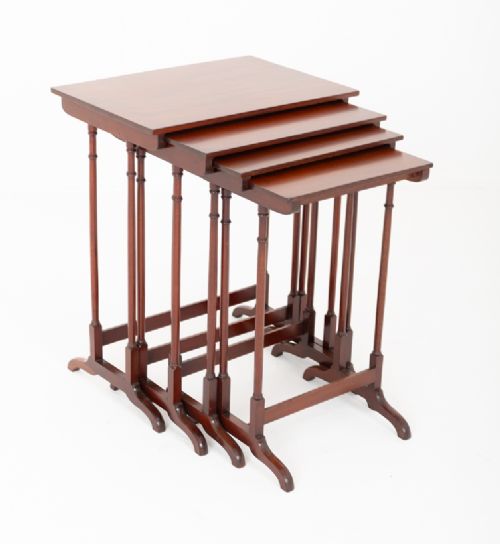
Regency style nesting tables offer clever multi-tiered surface space in polished wood, designed to slide together neatly when floor space matters.
Regency Style Nesting Tables
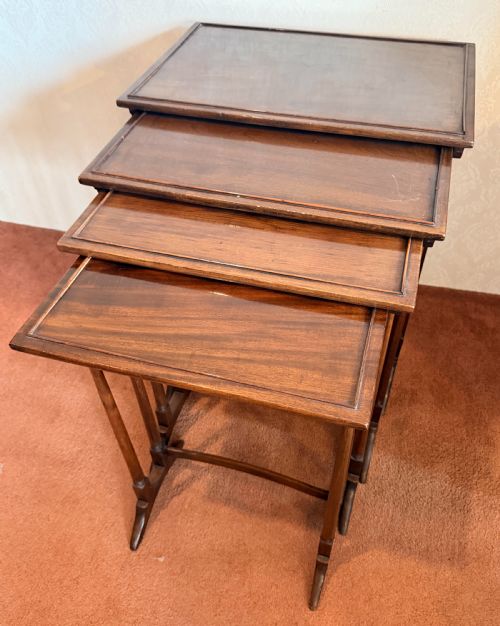
Regency style nesting tables provide a graduating set of smaller surfaces that tuck completely under one another when not in use. These pieces appear in forms housing three or four individual tables, often described historically as quartetto sets.
The selections here span the nineteenth century, Edwardian era, and later revival periods up to nineteen twenty. Mahogany remains the dominant timber, accompanied by occasional examples in yew veneer, burr walnut, satinwood, and lacquer.
How they were made
Cabinetmakers constructed these frames primarily from solid mahogany and wood veneers, utilising timber grain for decorative effect on the table surfaces. Workshops applied lacquer and gilt paint finishes to specific decorative iterations influenced by Chinoiserie tastes.
Tables feature scaled dimensions allowing each smaller frame to clear the underside of the preceding one with minimal clearance. Joinery techniques prioritise stability across multiple lightweight legs while maintaining slender profiles.
Regency Style Nesting Tables Retail Price Guide 2026
Typical asking prices for regency style nesting tables among the pieces listed under this phrase on Sellingantiques today, from the lower quarter to the upper quarter. They describe what is for sale here now, not the wider market.
Current listings feature pieces spanning the nineteenth century, nineteen hundred, Edwardian era, and nineteen twenty, constructed in mahogany, yew, walnut, and lacquer.
What varies in quality
Quality rests in the selection of timber veneers and the precision of the graduating dimensions. Higher standard sets employ figured woods like yew or burr walnut on the primary surfaces rather than plain timber.
Construction integrity defines the upper tier of pieces, where joints remain tight despite the constant friction of sliding tables in and out. Finer examples display balanced proportions across all four graduating tiers without excessive bulk in the legs.
The Regency Style Nesting Tables Glossary
- Quartetto
- A matched set of four graduating tables designed to nest together. This historical term frequently appears in nineteenth-century descriptions.
- Veneer
- A thin layer of figured wood applied over a secondary timber base to create decorative surfaces. Yew and burr walnut frequently appear in this format.
- Chinoiserie
- European artistic style reflecting Chinese motifs, often expressed through lacquer and gilt paint on occasional tables.
- Regency Revival
- Later nineteenth and early twentieth-century manufacturing periods replicating the distinctive furniture designs of the early nineteenth century.
Regency Style Nesting Tables: Frequently Asked Questions
What is a quartetto table set?
A quartetto set consists of four graduating tables designed to slide sequentially beneath one another to save floor space.
Cabinetmakers built these arrangements so that each smaller frame fits precisely into the next largest structure.
How were these tables used historically?
Owners deployed the individual surfaces around a room for tea, writing, or holding decorative objects during social gatherings.
Purchasers stored the entire assembly compactly against a wall when extra surface area was unnecessary.
Are all these tables from the Regency period?
The selection includes genuine nineteenth-century items alongside Edwardian pieces and nineteen-twenty revival examples.
Various periods adopt the Regency aesthetic through slender legs, formal proportions, and classic mahogany construction.
What woods appear in these listings?
Mahogany forms the primary timber across the majority of these nesting and occasional table assemblies.
Other examples incorporate decorative surfaces utilising yew veneer, burr walnut, satinwood, and dark lacquer.