
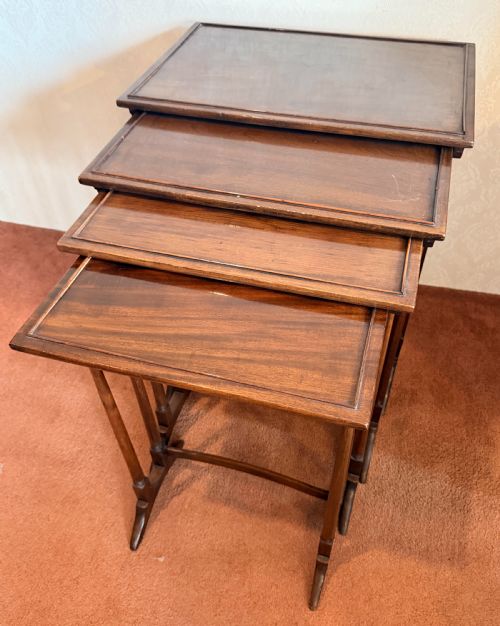
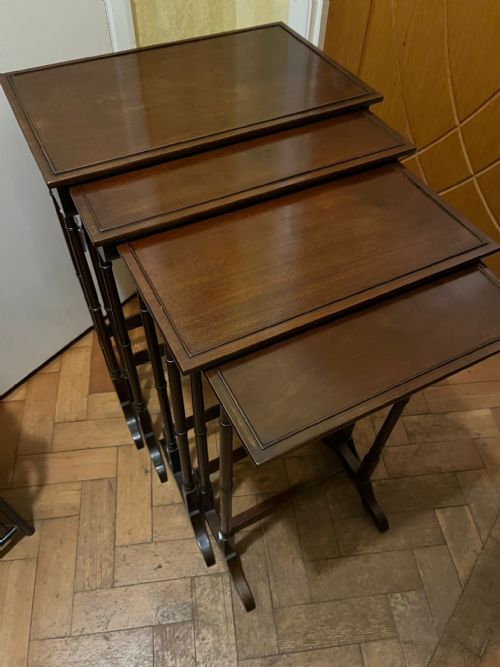


Mahogany Nest of Four
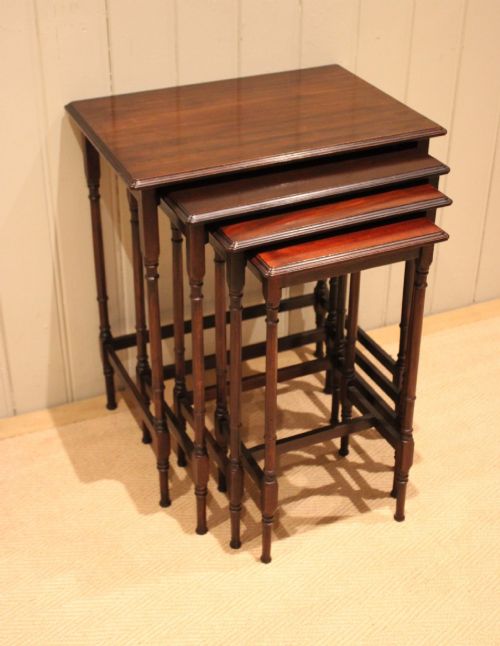
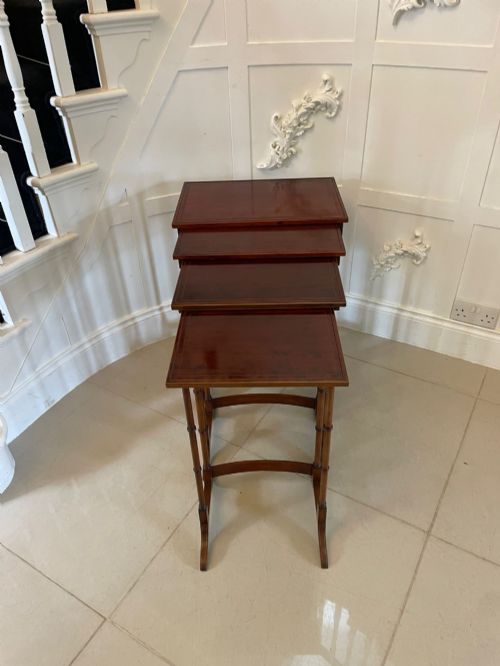
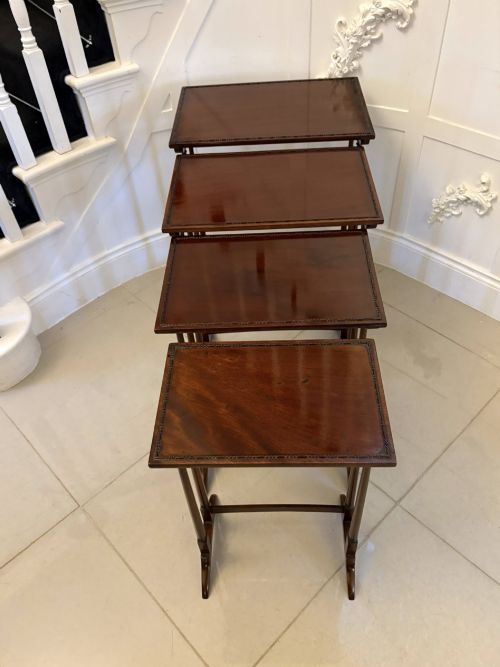
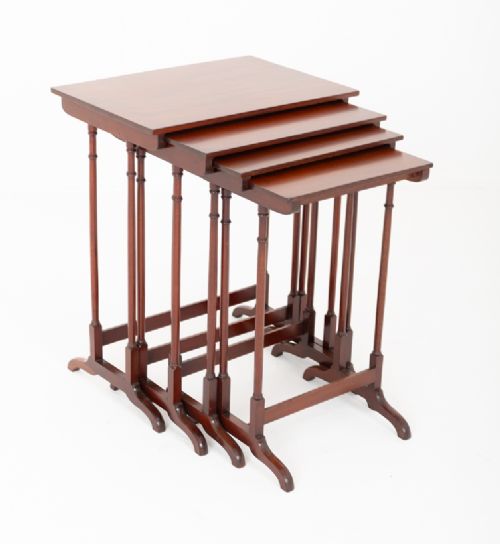
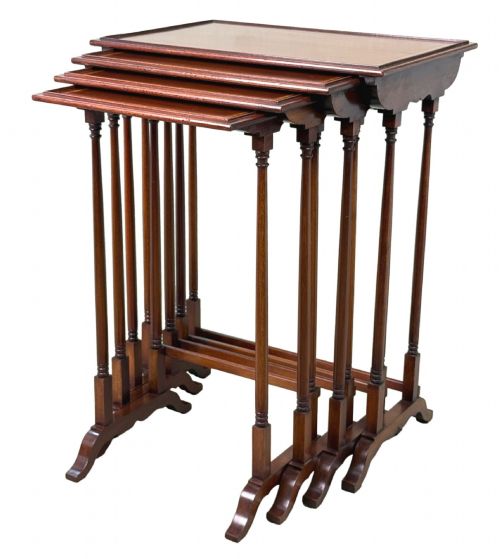
A mahogany nest of four provides four graduated tables that slide neatly together when floor space matters.
Mahogany Nest of Four
A mahogany nest of four comprises a graduated set of four tables designed to stack beneath one another into the footprint of the largest single table. This clever space-saving arrangement gained widespread popularity during the Victorian and Edwardian periods, evolving from earlier Sheraton and Regency designs.
The pieces appearing most frequently on this page date from the Edwardian era and the late nineteenth century, alongside occasional Georgian style revivals and later twentieth-century interpretations. These sets function practically as occasional, lamp, side, or coffee tables while remaining visually unified when stowed.
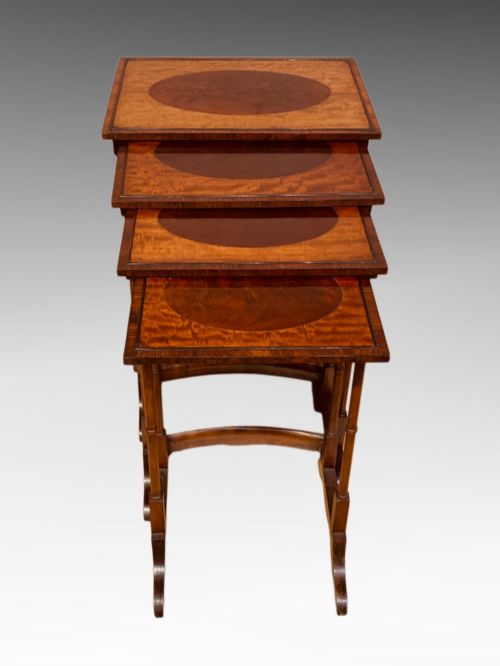
Originating as quartetto sets, they rely on precise scaling so that each smaller table slides smoothly into the frame of the one above it. Buyers encounter plain mahogany surfaces as well as examples decorated with contrasting inlay.
Materials and construction
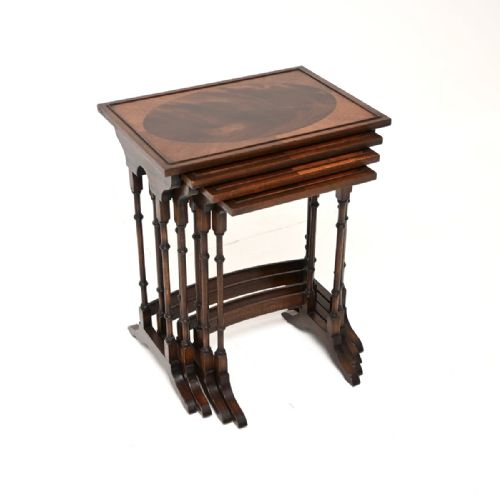
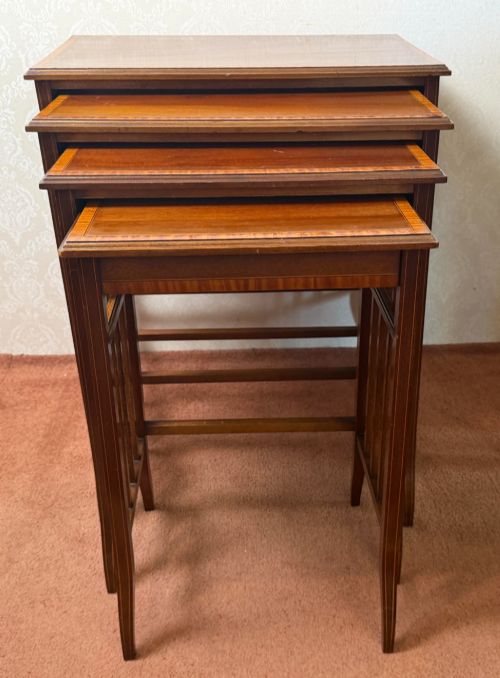
Carpenters built these tables using solid mahogany and mahogany veneers, occasionally selecting figured timber for the main top surfaces to display rich grain patterns. Workshops applied secondary timbers such as satinwood and maple for banding, alongside boxwood and ebony stringing to create geometric or floral borders.
Leg construction varies between square tapered supports and slender turned columns, often linked by small stretcher rails on the smaller tables for structural stability. Joinery requires exacting tolerances so that all four tables maintain structural integrity despite their reduced scale and slim profiles.
Some Edwardian sets were marketed as wine, sofa, or lamp tables, anticipating the modern multi-tasking living room.
Distinctions in craftsmanship
Quality separates plain utility pieces from master-carved or finely inlaid sets through the selection of timber and the precision of the joinery. Figured mahogany grain and crisp satinwood crossbanding indicate higher workshop standards.
The smoothness of the stacking action and the rigidity of the assembled tables demonstrate the maker's skill. Finer examples maintain structural tightness across all four frames without excessive play or loose joints.
The Mahogany Nest of Four Glossary
- Quartetto
- A traditional term for a set of four graduated stacking tables designed to nest together. Nineteenth-century and Edwardian makers used this designation frequently on trade labels.
- Satinwood
- A yellow-brown tropical timber utilised for contrasting crossbanding and inlay work on mahogany furniture. It provides bright visual definition against darker primary woods.
- Veneer
- A thin layer of figured wood applied over a stable secondary timber base. This technique allows workshops to display decorative grain patterns across table tops without risking warping.
- Crossbanding
- A decorative border of veneer laid with the grain running perpendicular to the main panel. It frames the perimeter of table tops on finer Edwardian and Victorian sets.
Mahogany Nest of Four: Frequently Asked Questions
What is a quartetto table?
A quartetto table refers to one of a set of four graduated nesting tables. The term originates from nineteenth-century trade descriptions.
These sets were designed to sit compactly in a corner or beside a sofa until individual tables were needed for tea or lamps.
How were nesting tables used?
Victorians and Edwardians utilised these stacking sets in drawing rooms and sitting rooms as flexible occasional furniture. When guests arrived, the smaller tables pulled out to hold drinks or books.
Between uses, the smaller tables slid sequentially beneath the largest top to save floor space.
How do I date a mahogany nest?
Dating relies on timber selection, inlay styles, and leg construction visible across the pieces. Edwardian examples often feature delicate boxwood stringing and satinwood crossbanding on square tapered legs.
Earlier nineteenth-century pieces tend toward heavier proportions and simpler mahogany surfaces without elaborate border details.
Are all four tables the same size?
Each table in the set diminishes in height and width so that the smaller ones fit entirely under the next size up. The largest table stands at standard occasional table height.
The smallest table sits at the bottom of the stack with the slimmest frame and shortest legs.