
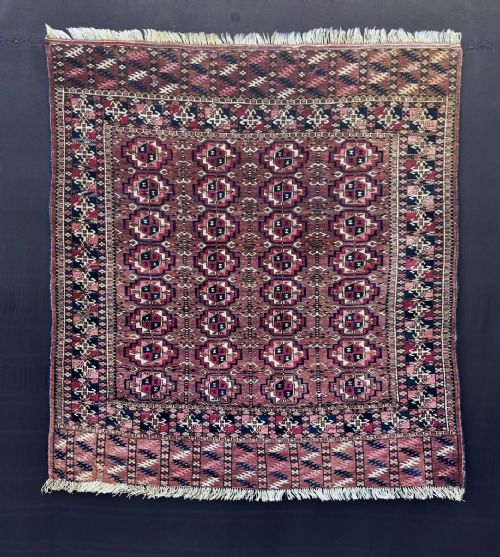


Bukhara Wool Rug
A bukhara wool rug brings the geometric discipline and rich madder tones of Central Asian weaving straight to the floor.
Bukhara Wool Rug
A bukhara wool rug is a tribal weaving originating from Central Asia, most frequently associated with the traditions of the Turkmen tribes such as the Tekke, Ersari, Saryk, and Yomut. These pieces span the nineteenth and early twentieth centuries, appearing as area rugs, main carpets, wedding rugs, and occasionally long runners.
The visual vocabulary relies heavily on repeated octagonal motifs known as guls, arranged in precise rows across deep madder red or occasionally brown grounds. Buyers searching this phrase will predominantly encounter antique Tekke and Ersari works dating from the late nineteenth century, alongside later village interpretations from Afghan makers.
Tribal weavers produced these works for domestic use, dowries, and ceremonial purposes rather than Western export markets, ensuring a direct link to nomadic traditions. Each surviving carpet reflects the specific regional iconography of its maker, from turreted guls to intricate border guards.
How they were made
The construction of a bukhara wool rug relies on hand-spun wool for the pile, chosen for its natural lanolin content and durability under heavy foot traffic. Foundations often incorporate supplementary animal fibres, utilising goat hair or horsehair alongside cotton to lend the structure additional strength.
Weavers dyed the fleece using natural dyes derived from local plants and insects, producing the deep reds, browns, and ivories that define the aesthetic. Knotting techniques were tightly executed by hand, creating a dense pile that preserved intricate geometric patterns over decades of use.
Some weavers incorporated animal hair foundations simply because the family goat had stronger opinions on spinning than the sheep did.
What varies in quality
Quality in a bukhara wool rug is determined by the density of the knotting and the fineness of the wool preparation. Finer pieces demonstrate exceptional precision in the execution of repeating guls and a softer, more pliable handle due to superior hand-spinning.
The integrity of the natural dyes dictates visual longevity, with superior examples retaining deep saturation and subtle tonal variations across the field. Foundation materials also play a role, as robust goat hair or horsehair foundations provide superior dimensional stability compared to standard cotton.
The Bukhara Wool Rug Glossary
- Gul
- A primary octagonal medallion repeated across the field of Turkmen weavings. Each tribe utilised distinct variations to signify lineage and identity.
- Madder
- A natural red dye derived from the root of the Rubia plant, forming the dominant background colour in most Central Asian tribal rugs.
- Pile
- The vertical or slanted soft yarn surface of a rug, formed by knotting wool or hair yarn around the warp threads.
- Warp
- The longitudinal threads stretched tightly on the loom that form the structural skeleton of the rug.
- Dowry rug
- A specialised weaving created as part of a bride's trousseau, often featuring symbolic motifs intended to bring prosperity and protection.
Bukhara Wool Rug: Frequently Asked Questions
How do I care for my rug?
Vacuum your rug gently without using a rotating brush roll to protect the wool pile from unnecessary friction.
Professionally clean the textile only when soiled, avoiding harsh chemical treatments that strip natural lanolin from the fleece.
Where were these rugs made?
These textiles originate across Central Asia, including regions historically governed by the Emirate of Bukhara and modern Turkmenistan.
Nomadic and village groups such as the Tekke, Ersari, and Yomut tribes produced these pieces within their traditional encampments and settlements.
How do I identify tribal designs?
Examine the primary octagonal motifs, known as guls, which vary in shape and arrangement according to the specific tribe of origin.
Look for distinctive border patterns and secondary motifs that distinguish a Tekke weaving from an Ersari or Saryk counterpart.
Can I place these on stairs?
Certain long formats, such as antique stair carpet runners, are specifically structured to handle the directional wear of steps.
Ensure you use an appropriate underlay to prevent slipping and to cushion the foundation fibres against the hard stair edges.