
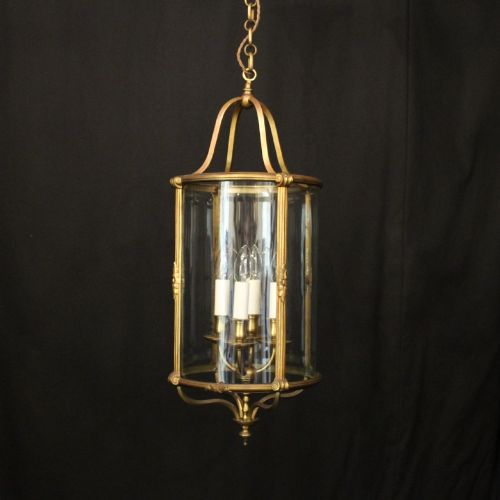
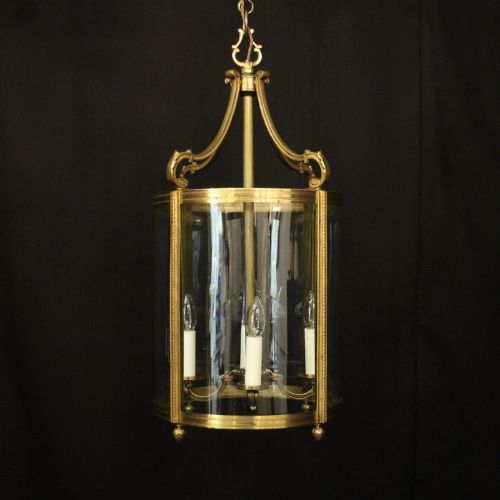


Bronze Glazed Hall Lantern
These bronze glazed hall lanterns are classical French and English entryway pendants that cast an inviting warmth through bevelled glass.
Bronze Glazed Hall Lantern
A bronze glazed hall lantern provides overhead illumination for entrance halls, corridors, and vestibules while establishing a distinguished period atmosphere. These fixtures typically hang from short chains or rods, positioning the light source centrally within the vertical space of a high ceiling.
Most examples encountered here originate from France and date from the late nineteenth century through the early decades of the twentieth century. Common forms include multi-light pendant configurations styled after French Rococo, Louis XV, and Louis XVI designs alongside substantial English country house coaching lanterns.
The primary function remains architectural framing, defining the threshold of a residence with substantial metalwork and clear panes. Buyers select these pieces to anchor traditional interiors, utilising their historical silhouettes to create a sense of established permanence.
Materials and construction
Makers constructed the structural frames of these lanterns using cast bronze, brass, and gilt bronze, often applying surface treatments such as silver gilding or painted finishes. Metal components were cast in sections and joined mechanically or soldered, creating rigid cages designed to support heavy glass panes.
Glazing typically consists of thick, bevelled glass panels secured within the metal framework by glazing bars or internal clips. These bevels refract the internal light, producing varied patterns across surrounding entrance walls.
The listings span the nineteenth century through the 1930s, featuring brass, silvered bronze, and gilded bronze combined with bevelled glass.
Judging quality in a bronze glazed hall lantern
Quality reveals itself in the crispness of the metal casting and the depth of the chased ornamentation, where fine French neoclassical and rococo motifs display sharp relief. Heavier gauge bronze frames maintain structural integrity better over decades of suspension, resisting the distortion seen in lighter commercial counterparts.
The integration of the glass panels dictates much of the visual success, particularly when bevelled edges align precisely with the geometry of the frame. Superior examples utilise heavy, clear plate glass rather than thin substitutes, ensuring proper light refraction and historical accuracy.
The Bronze Glazed Hall Lantern Glossary
- Bevelled glass
- Glass panes featuring an angled edge ground and polished to a specific width. This treatment refracts light and adds decorative dimension to the lantern panels.
- Gilt bronze
- Bronze metal that has been coated with a thin layer of gold leaf or applied gold paint. It provides a luminous finish that catches ambient hall light.
- Rococo revival
- A nineteenth-century design movement characterised by asymmetrical scrolls, naturalistic plant motifs, and ornate curves. It heavily influences French lighting from this era.
- Pendant light
- A hanging light fixture suspended from a ceiling by a cord, chain, or metal rod. Hall lanterns utilise this form to clear doorways and illuminate entry spaces.
Bronze Glazed Hall Lantern: Frequently Asked Questions
How high should I hang a hall lantern?
Hang the lantern so the bottom clears the floor by at least seven feet, ensuring adequate clearance for people walking underneath.
In spaces with very high ceilings, adjust the chain length so the fixture centres visually between the floor and the ceiling plane.
Can these antique lanterns take modern bulbs?
Most antique lanterns accept standard modern candelabra or Edison screw bulbs, provided the internal wiring has been updated by a professional electrician.
Check the interior socket capacity during installation to ensure it matches current safety standards and desired illumination levels.
How do I clean the glass panels safely?
Remove dust with a soft, dry cloth before applying a mild glass cleaner directly to a cloth rather than the lantern itself.
This prevents moisture from seeping into the aged metal joints or behind the gilded surfaces during routine maintenance.
What distinguishes Louis XVI style from Rococo?
Louis XVI design favours symmetry, straight lines, urns, and classical architectural motifs inspired by ancient Rome and Greece.
By contrast, Rococo style embraces asymmetrical curves, C-scrolls, and exuberant natural forms without rigid geometric order.