
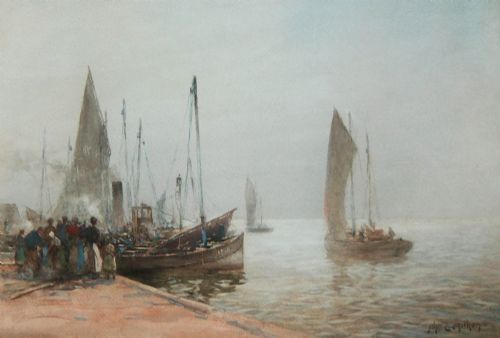
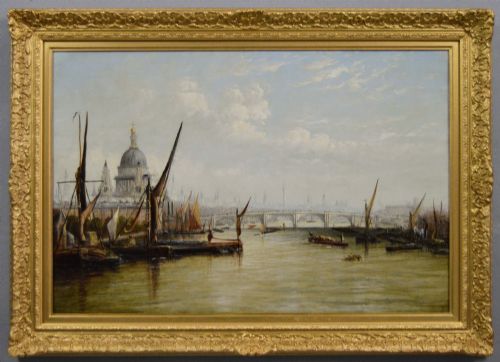
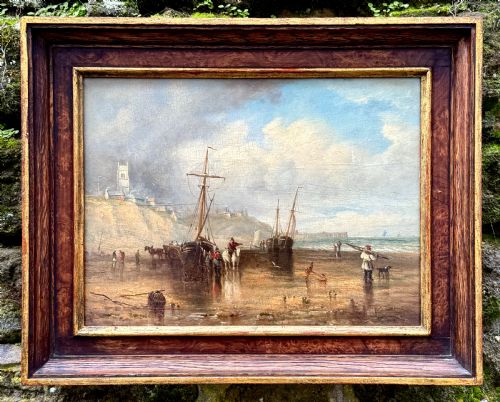
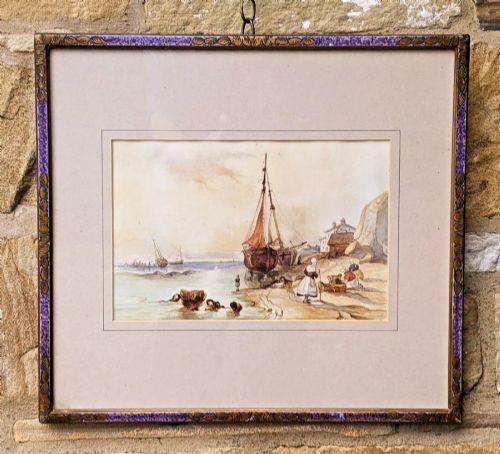


British School Marine Art
British school marine art captures coastal life, harbours and shipping through oil and watercolour from the nineteenth and twentieth centuries.
British School Marine Art
British school marine art encompasses paintings of coastal scenes, harbour views, rivers and open seas created by British artists. Collectors searching this phrase encounter works ranging from Victorian watercolours to mid-twentieth-century Impressionist canvases.
The objects take the form of framed oil paintings, watercolours on paper and works on card. Subjects span bustling fishing ports like Staithes and Whitby, Thames townscapes and dramatic stormy seas.
Nineteenth-century pieces dominate the selection, frequently depicting sailing ships, clippers and frigate movements around the English coast. Later works reflect the atmospheric approaches of the Newlyn School and regional British Impressionism.
Materials and technique
Artists painted primarily in oil on canvas, oil on card, or utilised watercolour on paper. Oil paints provided deep tones for stormy seas and moonlit coastal scenes, while watercolour allowed delicate washes for harbour light and river skies.
Many works incorporate supportive elements such as gold leaf on frames, whilst supports range from stretched canvas to heavy paper and card. Brushwork varies from the tight maritime detail of the Victorian era to the looser, expressive marks of later Impressionist painters.
Listings feature works spanning the nineteenth and twentieth centuries, executed in oil on canvas, oil on card, and watercolour on paper.
Assessing quality
Quality rests upon the artist's handling of light, atmosphere and maritime perspective. Superior works demonstrate confident draughtsmanship in rigging, hull structure and coastal architecture.
The distinction between standard decorative works and fine art lies in the sensitivity of the palette and the vitality of the brushwork. Works by named painters with documented regional subjects typically command stronger interest than unsigned school pieces.
James E Aitken·Francis Moltino·Thomas Creswick·William Frederick Settle·Frank H Mason·William Wyld·Percy Brooke·William Lambert Bell·Thomas Bush Hardy·William Lee Hankey·S J Lamorna Birch·Alec Caruthers Gould·Rowland Henry Hill·Walter Williams·Gordon Meadows·Edmund John Niemann
The British School Marine Art Glossary
- Newlyn School
- An art colony based in Cornwall that focused on plein-air painting of fisherfolk and coastal life. Members captured natural light and authentic local conditions.
- Watercolour on paper
- A painting medium where pigments are suspended in a water-soluble vehicle applied to paper supports. It creates luminous translucent effects favoured for marine skies.
- Oil on canvas
- Pigments bound in drying oil applied to a stretched woven fabric support. This combination offers rich depth and longevity for maritime scenes.
- Impressionism
- A style emphasising unblended colour and visible brushstrokes to capture transient effects of light. In British marine art, it translates to atmospheric treatments of moonlit water.
British School Marine Art: Frequently Asked Questions
What is British school marine art?
It refers to paintings and watercolours executed by British artists depicting ships, coastal harbours, rivers and seascapes.
These works span from the Victorian period through the early twentieth century, reflecting changing artistic styles and maritime history.
How were these marine paintings displayed?
Historically, these artworks were framed in timber, often accented with gold leaf, and hung in domestic interiors.
Today, they suit traditional and contemporary spaces alike, provided they are kept away from direct sunlight and excessive moisture.
How do I identify a watercolour from an oil painting?
Watercolours are painted on paper under glass, showing translucent washes where the paper grain remains visible beneath the pigment.
Oil paintings utilise heavier paint layers applied to canvas or card, possessing a textured surface that requires no protective glass.
What subjects appear most frequently?
Common subjects include fishing vessels, harbour towns like Staithes and Whitby, river traffic on the Thames, and dramatic coastal storms.
Artists frequently documented specific regional ports alongside imaginative maritime scenes.