
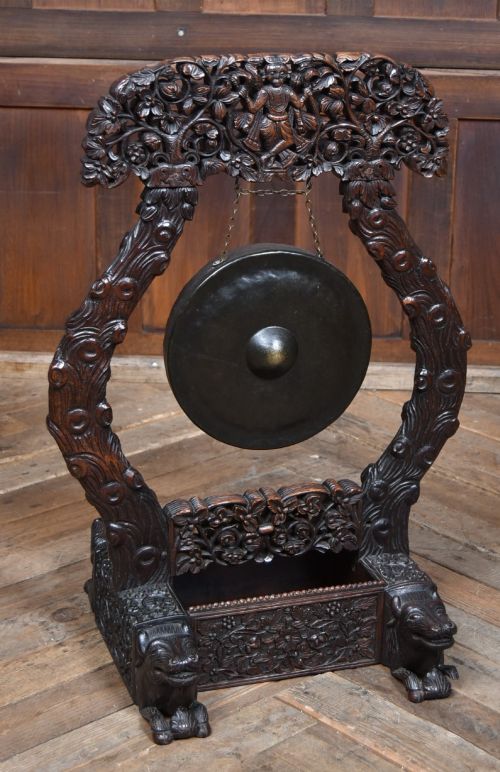
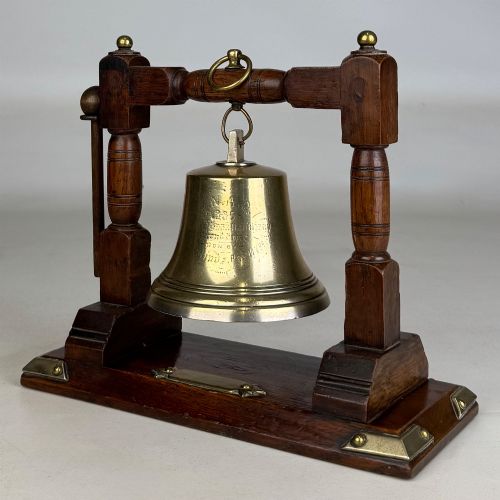
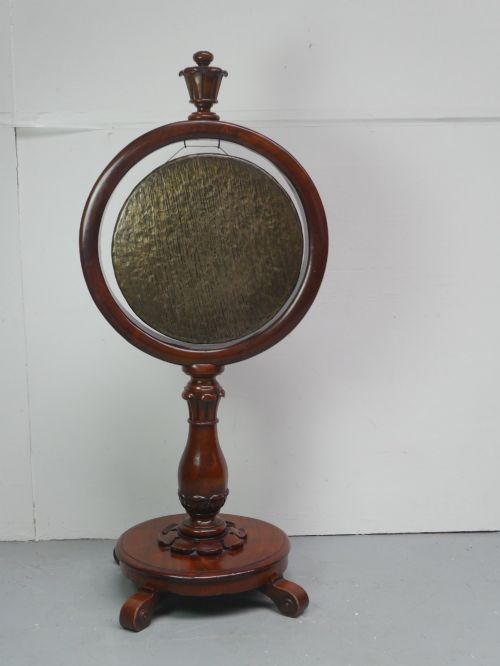
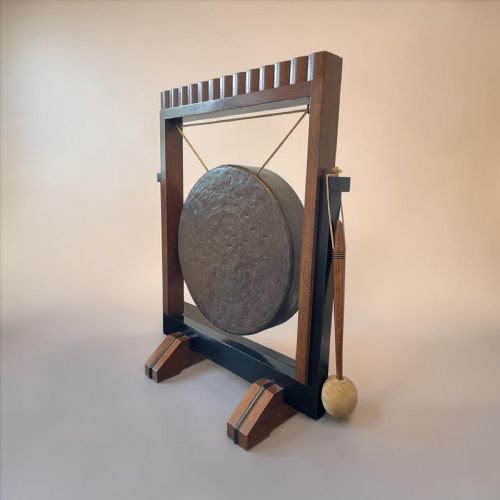

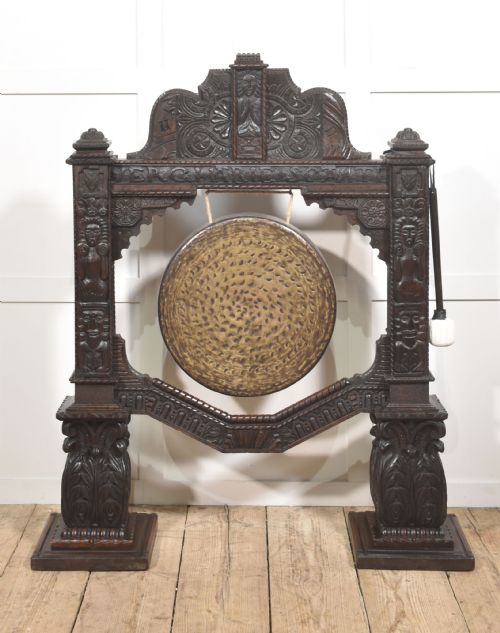


Brass Standing Gong
These brass standing gong examples bring deep, resonant tone and striking architectural presence to an interior.
Brass Standing Gong
When you search for brass standing gong, you are looking at substantial percussion pieces designed to summon households or signal services, suspended within frames of timber or metal. The examples available here span the nineteenth century, the Edwardian era, and the nineteen-thirties, showing both domestic dining room accessories and larger floor-standing models.
Most pieces function as practical dinner gongs or hall bells, though variants range from compact table models to monumental floor-standing designs. The frames frequently display distinct period aesthetics, including Gothic Revival, Art Nouveau, and Arts and Crafts movements.
Materials and construction
The manufacture of these pieces relies on the union of cast metalwork and joinery, combining brass or bronze bells with dense hardwoods such as oak, walnut, and mahogany. Supporting frames often incorporate wrought iron, cord suspension, and carved details that reflect the period style of the maker.
Bells are cast to achieve specific acoustic properties, while frames are constructed using traditional mortise and tenon joinery to support the weight and vibration of the metal. Stands frequently feature carved ornamentation, ranging from Gothic tracery to Chinese dragon motifs.
The inventory combines British Gothic Revival and Arts and Crafts designs with Chinese export and Burmese pieces.
Evaluating quality and proportion
Quality in a brass standing gong rests upon the resonance of the metal and the integrity of the framing timber. Superior examples feature heavier gauge brass or bronze that produces a clear, sustained tone when struck, paired with robustly constructed stands of quarter-sawn oak or figured mahogany.
Proportion and carving depth further distinguish the range, with better pieces displaying crisp, hand-carved details on the wooden frame rather than machine-routed decoration. The balance between the scale of the bell and the structural support determines the overall presence of the piece.
The Brass Standing Gong Glossary
- Dinner Gong
- A percussion instrument mounted on a stand, historically used in large country houses to announce meals. They were placed in halls or corridors for maximum acoustic reach.
- Gothic Revival
- An architectural and decorative style popular during the nineteenth century, characterised by pointed arches, trefoils, and heavy carved woodwork. This style appears frequently on Victorian stands.
- Art Nouveau
- A design movement of the late nineteenth and early twentieth centuries known for flowing, organic lines and stylised natural forms. It influences the metalwork of several table and floor models.
- Arts and Crafts
- A movement emphasising traditional craftsmanship and visible construction methods using natural materials. Pieces from this tradition avoid excessive ornamentation in favour of honest joinery.
- Chinese Export
- Objects produced in China specifically for Western markets during the nineteenth and early twentieth centuries. These often combine traditional Eastern iconography with forms suited to European interiors.
Brass Standing Gong: Frequently Asked Questions
How loud is a brass standing gong?
These gongs are designed to project sound clearly across multiple rooms, producing a deep and resonant tone when struck with a proper mallet.
The volume depends largely on the diameter and thickness of the brass or bronze disc, as well as the open construction of the surrounding wooden frame.
Where should I place a standing gong?
Traditional placement is in a hallway, reception room, or large dining space where the acoustic properties and decorative timber frame can be fully appreciated.
Ensure the stand rests on a stable, level floor so the suspended bell hangs freely without touching the structural supports.
How do I date a brass gong?
Dating relies on the stylistic clues of the wooden frame, such as Gothic Revival tracery or Art Nouveau curves, alongside construction techniques like joinery and screw types.
Materials also offer guidance, as heavy oak and walnut typify the nineteenth and early Edwardian periods, while later pieces adopt simpler geometric lines.
What is the difference between a table gong and a floor gong?
Table gongs feature compact frames designed to sit securely on sideboards, hall tables, or desks, using smaller bells suited to intimate spaces.
Floor standing gongs are taller, heavier pieces built to stand directly on the floor, often featuring substantial mahogany, oak, or wrought iron frames.