
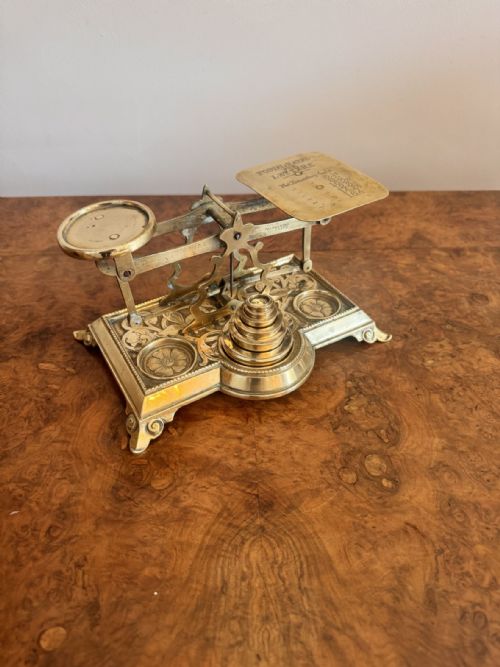

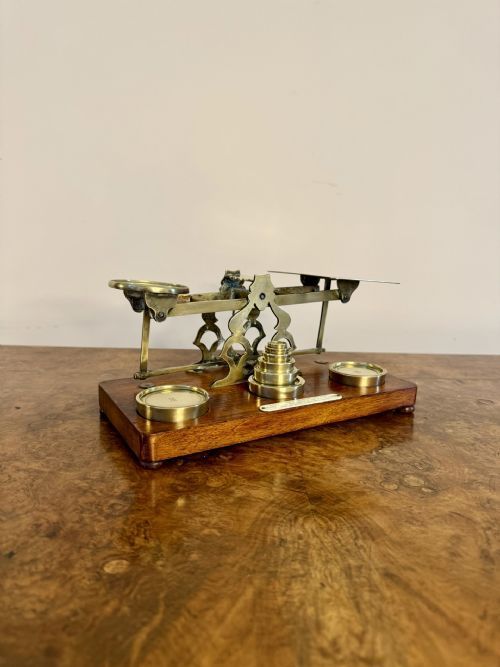


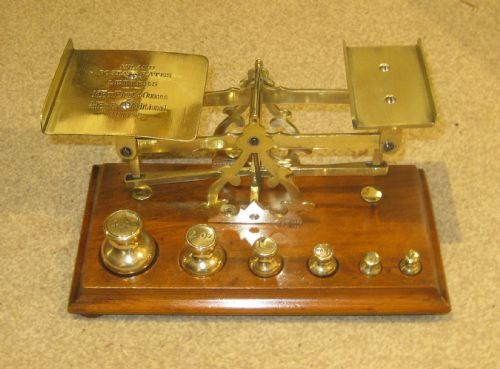

Brass Postal Balance Scales
These brass postal balance scales combine utilitarian precision with the rich warmth of period timbers, making them a handsome desktop addition for any collector of domestic metalwork.
Brass Postal Balance Scales
When you search for brass postal balance scales, you are looking at functional Victorian and Edwardian desk accessories designed to weigh correspondence before postage rates were calculated by weight alone.
The versions you are most likely to meet on this page sit upon wooden bases fashioned from mahogany, oak, walnut, or hardwood, often accompanied by their original matched sets of brass square weights.
These objects span several decades of the nineteenth and early twentieth centuries, ranging from standard platform designs to unusual configurations like candlestick or Irish variations.
Materials and construction
The primary material is cast and polished brass, forming the balance arms, pans, and weights that give the instruments their bright metallic contrast.
Timber bases are constructed from durable hardwoods such as mahogany and oak, shaped and polished to support the delicate mechanical movements of the balance.
Some decorative examples incorporate polished marble or rich green malachite panels set into the wooden base for added visual distinction.
Listings feature mahogany, oak, walnut, malachite, and marble alongside polished brass components.
Judging quality in postal scales
Quality reveals itself in the crispness of the maker's stamp and the clean finishing of the brass casting, where sharper lines separate workshop standards.
The selection of timber plays a major role, with figured mahogany, dense walnut, or inset panels of malachite and marble marking out the finer examples.
Complete sets featuring their original matching brass weights retain a higher degree of historical integrity than those assembled later.
S Mordan·S Mordan and Co London·Ratcliff Birmingham·S P and Sons
The Brass Postal Balance Scales Glossary
- Postal scale
- A weighing device specifically calibrated for determining letter and parcel postage rates. These instruments typically feature a brass balance mechanism mounted on a wooden plinth.
- Square weight
- A flat, square-shaped piece of brass designed to sit securely in a dedicated recess on the scale base. Sets usually diminish in size to measure various postage tiers.
- Candlestick scale
- An ingenious combination object that merges a desk candleholder with a functional letter balance. It serves a dual purpose for writing correspondence by candlelight.
- Steelyard
- A weighing instrument utilising a sliding counterweight along a graduated arm. This format appears occasionally in postal balances of the period.
- Malachite
- A vibrant green copper carbonate mineral used occasionally as an ornamental decorative panel on nineteenth-century desk accessories.
Brass Postal Balance Scales: Frequently Asked Questions
What are brass postal balance scales?
These are nineteenth and early twentieth-century weighing instruments utilised in homes and offices to determine correct letter postage. They combine functional brass balance arms with wooden bases.
Most examples date from the Victorian and Edwardian eras, reflecting the expansion of postal services during those periods.
How do I know if the weights are original?
Original sets typically include matching brass square weights that fit neatly into dedicated slots or recesses upon the wooden base. The wear and patina should match the brass of the scale arm.
Replacements often show inconsistencies in colour, finish, or fit within the designated wooden storage compartments.
What woods were used for the bases?
Maker workshops utilised sturdy hardwoods capable of supporting the brass mechanisms through daily use. Mahogany, oak, and walnut appear frequently across surviving examples.
More decorative models occasionally feature exotic stones such as marble or malachite set directly into the wooden platform.
How should I clean the brass?
Period brass generally benefits from retaining its warm, aged patina rather than undergoing aggressive polishing down to bright metal. Gentle dusting with a soft cloth is usually sufficient for regular maintenance.
Avoid harsh chemical dips that strip away the historical character accumulated over a century or more of existence.