




Brass Letter Scales
Brass letter scales are heavy desk implements designed to weigh mail, combining utilitarian function with polished metal and timber construction.
Brass Letter Scales
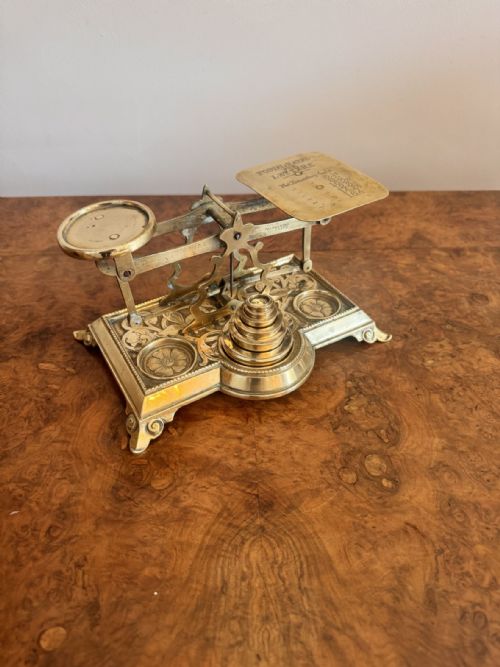
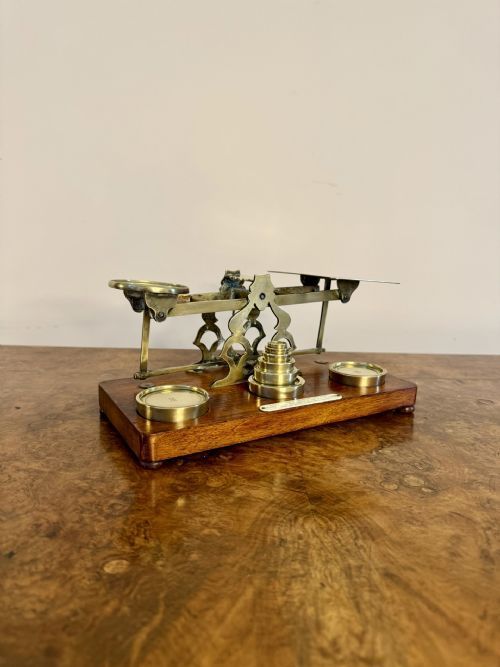
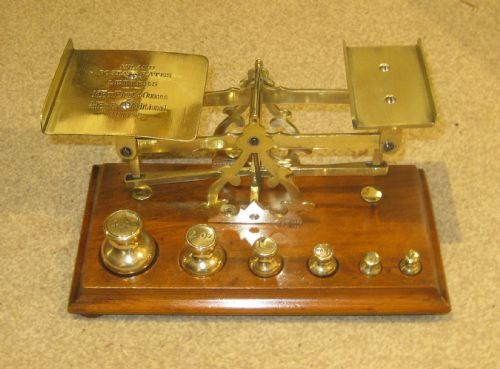
Brass letter scales are desktop devices designed for weighing correspondence before postage rates were fixed by weight steps. You will frequently encounter examples mounted on rectangular wooden bases or fitted with ornamental mineral slabs.
The objects span the Victorian and Edwardian eras, with examples appearing across the nineteenth and early twentieth centuries. Most pieces sit upon bases fashioned from mahogany, walnut, or oak, occasionally accompanied by inserts of malachite, marble, or slate.
Makers produced these balances in various dimensions, from compact domestic sets to very large platforms. The mechanism typically involves a central pivoting beam supporting pans or platforms for letters and corresponding fractional weights.
How they were made
Manufacturers cast the primary structural components from brass, which was then polished to a bright finish. The metal beams, indicators, and weight platforms are paired with dense hardwoods selected for stability.
Carpenters shaped mahogany, walnut, and oak to form the rectangular or serpentine plinths that anchor the mechanism. In more decorative instances, stonework such as malachite, slate, or marble forms the base plate beneath the brasswork.
Listings feature brass postal scales mounted on mahogany, walnut, oak, malachite, and marble bases from the Victorian and Edwardian periods.
What varies in quality
Quality rests upon the weight of the cast brass and the complexity of the mechanism. Substantial gauge metal and crisp engraving on the scale plates separate ordinary production from superior workshop output.
The choice of base material and cabinet-making detail dictates the tier of the piece. Selected timbers like burl walnut or fitted hardwood boxes alongside decorative stone inserts indicate higher grade manufacturing.
S Mordan·Sampson Mordan·S Mordan and Co·T J Smith Son and Downes·John Heath·J and E Ratcliff·S P and Sons
The Brass Letter Scales Glossary
- Postal scales
- A weighing device specifically calibrated for letters and small parcels. These instruments determined the correct postal tariff based on the weight of the paper.
- Letter balance
- An alternative mechanical layout where a vertical indicator moves across a graduated quadrant rather than using suspended pans. It performs the same weighing function on the desk.
- Malachite
- A green copper carbonate mineral used as a decorative inlay or base slab on select Victorian examples. Its distinctive banded pattern provides a rich contrast to polished brass.
- Steelyard
- A weighing instrument featuring a sliding weight on a unequal-armed lever. This layout appears among specialised postal balances.
- Square weights
- Flat, square or rectangular brass weights stamped with denomination marks. They sit neatly in dedicated slots within the wooden base of the scale.
Brass Letter Scales: Frequently Asked Questions
How do brass letter scales work?
These devices operate on a balance principle where the letter sits on one platform and calibrated weights are placed on the other. The pivoting metal beam levels out when the weight of the post matches the assigned brass pieces.
Finer examples use a graduated quadrant indicator instead of two pans. The pointer moves along a scale to show the exact postage weight required.
What periods do these scales come from?
The surviving pieces originate primarily from the Victorian and Edwardian eras. Dates span from the mid-nineteenth century through the early nineteen-hundreds.
Stylistic shifts reflect this timeline, moving from robust mid-Victorian mahogany designs to lighter Edwardian oak and walnut configurations.
Did these scales come with weights?
Many sets were supplied with matching brass weights fitted into recessed slots on the wooden base. These weights correspond to historical postal increments.
Some surviving scales lack their original weights due to loss over time. Finding a complete set with matching stamped weights is typical of well-preserved examples.
What woods were used for the bases?
Cabinet makers utilised dense hardwoods such as mahogany, walnut, and oak for the foundational plinths. Burl walnut and figured mahogany appear on finer decorative models.
These woods were shaped, polished, and sometimes fitted with stone slabs like malachite or marble to anchor the brass mechanism securely.