


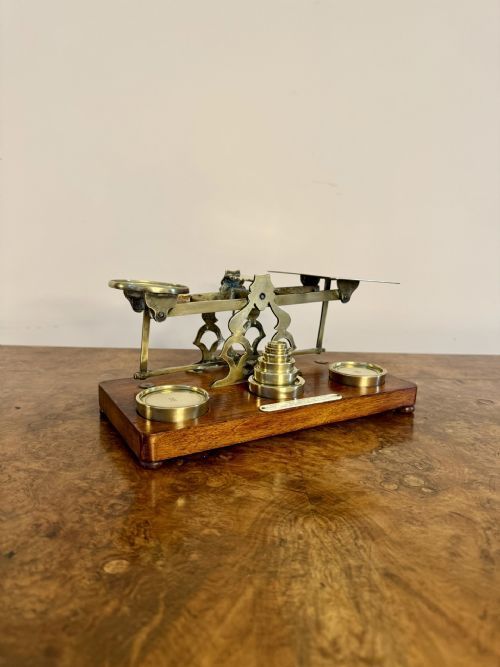


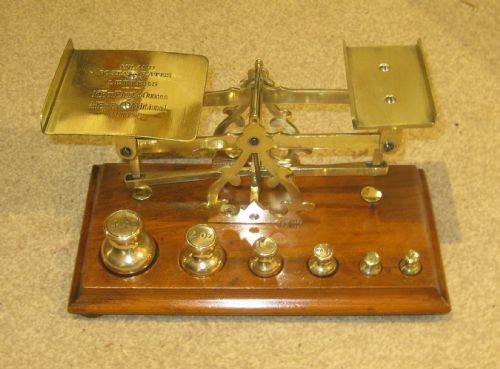


Victorian Postal Scales
Victorian postal scales are functional desk instruments that combine brass mechanisms with timber bases or decorative stone.
Victorian Postal Scales
Victorian postal scales are practical desk accessories designed to weigh letters and small parcels for the post. Buyers searching for Victorian postal scales encounter a range of forms, from simple brass balances mounted on wooden bases to ornate designs incorporating marble or malachite.
Specialised variations also appear, including candlestick shapes and silver or gilded finishes. Many examples retain their original matched sets of brass weights, which fit neatly into dedicated slots on the wooden plinth.
Materials and construction
Makers utilised cast and sheet brass for the balance arms, pans, and upright supports, ensuring precise calibration and durability. These metal components were often polished to a bright finish or occasionally gilded.
Wooden bases were typically fashioned from dense timbers such as mahogany and walnut, shaped with moulded edges to house the balance. Finer desk accessories incorporated decorative mineral inlays like malachite and marble into the plinth design.
Victorian Postal Scales Retail Price Guide 2026
Typical asking prices for victorian postal scales among the pieces listed under this phrase on Sellingantiques today, from the lower quarter to the upper quarter. They describe what is for sale here now, not the wider market.
Assessing quality and detail
The distinction between standard examples and finer pieces lies in the crispness of the brass casting and the selection of cabinet timber. Maker-signed mechanisms from established London or Birmingham firms elevate a piece above unmarked workshop output.
The presence of original, matching brass weights housed in the base adds significantly to the completeness of an instrument. Superior execution also shows in decorative embellishments such as surface engraving or inset semi-precious stones.
S Mordan Co London·Ratcliff Birmingham·Henry Williamson Birmingham
The Victorian Postal Scales Glossary
- Postal scale
- A desk instrument designed to weigh correspondence to determine the correct postage rate. These balances typically feature a central pivot supporting two pans or a single platform.
- Plinth
- The wooden or stone base upon which the weighing mechanism is mounted. This platform frequently incorporates compartments or slots to store the matching brass weights.
- Candlestick scale
- A specific form where the central support of the balance is styled to resemble a candlestick. This dual-purpose design was popular on nineteenth-century writing desks.
- Balance arm
- The horizontal metal bar that pivots on a central fulcrum to weigh items placed on the pans. The accuracy of the instrument depends on the precise balance of this arm.
Victorian Postal Scales: Frequently Asked Questions
How do Victorian postal scales work?
These instruments operate on a traditional balance principle where an item placed on the letter pan raises the counterweight or shifts the indicator arm. Graduated brass weights are added to the opposing side until the mechanism levels.
Most domestic desk scales were calibrated to measure in ounces and drams, corresponding to nineteenth-century postal tariffs for letters and small packets.
Are original weights usually included?
Many surviving sets retain their original brass weights, which are often stamped with matching numbers or fit into specific slots on the timber base. Finding a complete set with all original weights is less common.
When weights are missing, collectors frequently seek out period replacements that match the style and denomination required for the specific scale.
How should I clean brass scales?
Polishing brass should be approached with caution to preserve the historic surface and any subtle patination accumulated over time. A soft, dry cloth is usually sufficient for routine dust removal.
Avoid abrasive metal cleaners that can strip away the fine details of the casting or damage adjacent wooden and stone elements on the base.
What woods were used for the bases?
Mahogany and walnut are the primary hardwoods encountered on these desk accessories, chosen for their stability and rich grain. These timbers were often polished to a deep gloss finish.
Some examples integrate decorative stones such as marble or malachite directly into the wooden plinth to appeal to higher-end Victorian tastes.