






Brass Letter Balance
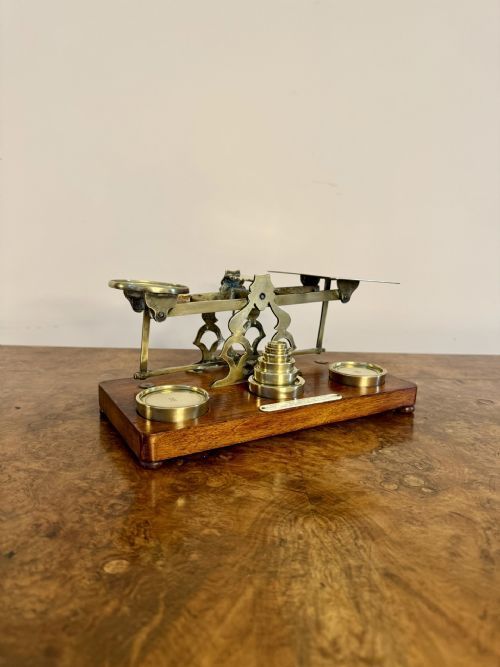
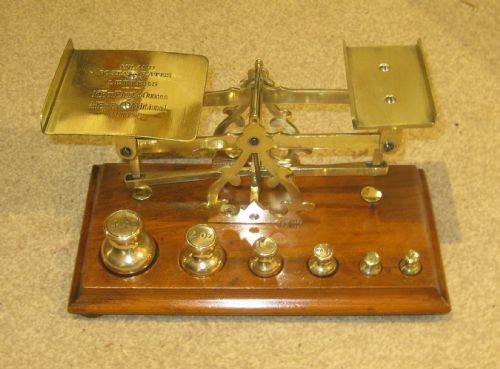
These brass letter balance pieces are precision instruments for weighing mail, prized for their mechanical ingenuity and handsome desk presence.
Brass Letter Balance
A brass letter balance is a specialised desktop instrument designed to weigh correspondence accurately before postage rates became standardised by weight alone. When you search for a brass letter balance, you encounter pieces originating primarily from the Victorian and Edwardian eras, spanning the mid-nineteenth century up to nineteen ten.
The dominant forms on this page include traditional freestanding postal scales mounted on wooden bases alongside clever combination pieces and novelties. You will regularly find mahogany, oak, and walnut wooden bases paired with polished brass mechanisms, whilst occasional examples incorporate decorative materials such as malachite or marble.
Materials and construction
These instruments rely on cast and sheet brass for the operating beams, pans, and calibrated weight plates, ensuring durability and precise balance. The metal components are frequently mounted onto shaped wooden plinths fashioned from dense hardwoods like mahogany, oak, and walnut to provide stability during use.
Maker signatures and capacity markings are typically engraved or stamped directly into the brass work or applied via metal plaques. Selected specimens incorporate stone elements such as malachite or marble into the base or platform construction to elevate the decorative appeal of the desk accessory.
Brass Letter Balance Retail Price Guide 2026
Typical asking prices for brass letter balance among the pieces listed under this phrase on Sellingantiques today, from the lower quarter to the upper quarter. They describe what is for sale here now, not the wider market.
Listings feature brass letter balances spanning the Victorian and Edwardian periods, utilising materials such as mahogany, oak, walnut, malachite, and marble.
Judging quality and execution
Quality in a brass letter balance rests upon the crispness of the casting, the precision of the fulcrum, and the crisp legibility of any engraved maker inscriptions. Superior examples maintain smooth articulation in the moving balance arm and retain their original matching graduated weights.
The selection of timber for the base heavily influences the overall character, with dense, well-figured mahogany or quarter-sawn oak denoting careful original manufacture. Elaborate detailing, such as integrated candlestick holders or scarce stone panels like malachite, distinguishes exceptional production from standard commercial office output.
S.Mordan London·S Mordan & Co London·RATCLIFF BIRMINGHAM
The Brass Letter Balance Glossary
- Letter balance
- A precision weighing device specifically calibrated for checking postal rates on correspondence and small parcels. These mechanisms use leverage and gravity rather than standard hanging pans.
- Postal scales
- An alternative term for devices used to determine the correct postage required for letters based on weight thresholds. They frequently incorporate fitted trays designed to hold brass weights.
- Fulcrum
- The pivot point upon which the brass balance beam rests and pivots during the weighing process. Smooth operation depends entirely on the minimal friction at this precise junction.
- Hardwood
- Dense timber derived from broad-leaved trees, commonly utilised for the mounting bases of these scales. Mahogany, oak, and walnut feature prominently among the surviving examples.
- Malachite
- A green copper carbonate mineral occasionally used as an ornamental decorative panel on nineteenth-century desk accessories. Its distinctive banded patterns provide a striking contrast to polished brass.
Brass Letter Balance: Frequently Asked Questions
How do these scales work?
A brass letter balance operates through a pivoting metal arm that lifts a platform or depresses a pointer when an envelope is placed upon it. The mechanism translates the downward pressure into a clear visual reading against a calibrated scale.
Many designs utilise a set of small brass weights placed on a matching platform to counterbalance the item being measured. This mechanical interaction ensures the correct postage amount is determined before dispatch.
What periods do these pieces span?
The available selection spans the Victorian and Edwardian eras, with dates ranging from around eighteen fifty through to nineteen ten. Mid-nineteenth-century examples often display robust utilitarian construction alongside specialised configurations.
Later Edwardian models frequently refine the aesthetic while maintaining the traditional brass and hardwood construction. Each era brings subtle shifts in decorative taste and mechanical refinement to the desk.
Are original weights usually included?
Many surviving examples retain their matching set of brass weights, which rest neatly in fitted recesses on the wooden base. These weights were essential for calculating heavier post or verifying the balance calibration.
When a piece retains its original weights, it offers a complete snapshot of functional Victorian or Edwardian office equipment. Sets missing their weights remain desirable as decorative desktop objects.
How should I clean the brass?
Maintaining the finish requires gentle dusting and occasional cleaning with an appropriate non-abrasive metal polish formulated for brass. Care must be taken around engraved maker inscriptions and delicate pivot points to preserve the surface.
Many collectors prefer to leave a mellow patination in the recessed areas while maintaining a soft gleam on the raised surfaces. Avoid harsh chemical dips that strip away the authentic character accumulated over decades.