





Victorian Letter Balance
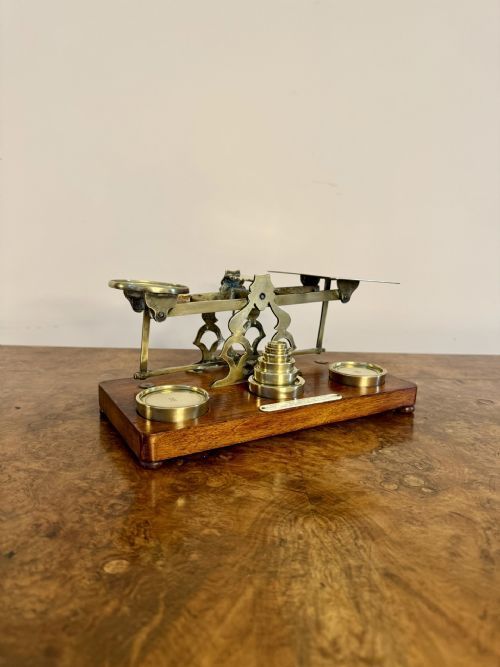
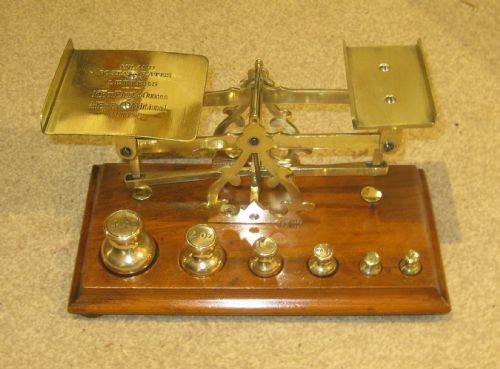
These Victorian letter balance scales are precision instruments for weighing mail, prized for their handsome nineteenth-century brass and timber construction.
Victorian Letter Balance
A victorian letter balance is a desktop device designed to weigh correspondence before postage rates changed by weight, taking the form of a lever or platform scale. The examples gathered here span the nineteenth and early twentieth centuries, running from the mid Victorian period through to Edwardian iterations.
Origin details in the evidence point towards British production, with specific makers operating out of London and Birmingham. These domestic workhorses served offices and writing desks before digital scales replaced them.
How they were made
The makers of these balances relied on heavy brass for the beams, pans, and square weights, ensuring the metal could withstand daily handling while maintaining calibration. This brass work is frequently mounted to seasoned timber bases fashioned from mahogany and walnut.
Alternative models incorporate mineral elements into the design, utilising materials such as green malachite and marble to elevate the desk accessory into a luxury item. Mechanics involved finely balanced levers that required exact counterweights to register the correct postage.
Victorian Letter Balance Retail Price Guide 2026
Typical asking prices for victorian letter balance among the pieces listed under this phrase on Sellingantiques today, from the lower quarter to the upper quarter. They describe what is for sale here now, not the wider market.
Some nineteenth-century desk clerks had to weigh mail by candlelight, which explains why a few clever scales doubled as candlesticks.
What varies in quality
Quality in a victorian letter balance rests on the presence of a recognised maker's stamp and the inclusion of matching original brass weights. Pieces bearing workshop details from established London or Birmingham names command greater attention than unsigned utilitarian examples.
The choice of base materials also distinguishes the tier of a balance, with figured mahogany and walnut or decorative inserts like malachite marking out higher grades of nineteenth-century manufacture. The crispness of the brass casting and the integrity of the original polish further separate standard workshop output from finer showroom pieces.
The Victorian Letter Balance Glossary
- Letter balance
- A precision weighing device calibrated to determine postal rates for letters. These instruments use a pivoting beam or spring mechanism.
- Postal scales
- A broader term encompassing various desk scales utilised for weighing parcels and mail. They often include a fitted wooden base designed to hold matching weights.
- Malachite
- A green copper carbonate mineral used for decorative inlays on nineteenth-century desk accessories. Its distinctive banded patterns add colour to the brass and wood framework.
- Candlestick postal scale
- A combined form where the weighing mechanism doubles as a candle holder. This dual-purpose design saves desk space.
Victorian Letter Balance: Frequently Asked Questions
What are victorian letter balances used for?
These instruments were utilised in nineteenth-century offices and homes to weigh letters and small parcels precisely. Getting the weight right ensured that correspondence complied with strict postal regulations of the era.
Today, they serve primarily as decorative desktop antiques. Collectors appreciate their combination of brass mechanics and hardwood bases.
How do you date a postal scale?
Dating relies on stylistic clues, materials, and maker marks stamped into the brass beam or wooden base. Pieces span from the mid nineteenth century through the Edwardian era.
Earlier models often feature substantial mahogany bases and square brass weights. Later pieces from around nineteen hundred show shifts in timber preference and manufacturing style.
Did these scales come with weights?
Many examples were manufactured with a matching set of brass weights that nested or slotted into the wooden base. Finding a complete set matching the scale enhances the historical integrity of the piece.
Some designs utilise a swing arm or pointer mechanism instead of loose weights. Both styles were common during the Victorian period.
What timbers were used for the bases?
Cabinet makers utilised dense hardwoods such as mahogany and walnut for the weighted bases. These timbers provided a stable, heavy foundation for the delicate brass weighing mechanism.
More decorative items occasionally incorporated marble or malachite alongside the standard woods. The grain and finish of the timber help distinguish the period of manufacture.